

Antoinette Wilson has never taken the predictable route. Her life spans publishing, dance, filmmaking and years spent exploring more sustainable ways of living. From Brazil to Buenos Aires to rural New Zealand, each shift has been driven by curiosity rather than convention. Now, after a decade of documentary work on community and the environment, she’s considering what the next chapter might hold, as Adrienne Matthews finds out.
There are people whose lives move in a straight line from school to career to family, and then there are those whose paths unfurl like a map they draw as they go, each turn guided by instinct, curiosity or a sudden sense of wonder. Filmmaker, publisher and dancer Antoinette Wilson belongs firmly to the second group. When you sit with her, you get the impression of someone who has lived a range of different lives, each decade fuelled by an internal fire set on providing her with adventure and a quest for exploration and the deep desire to tell the stories of those who have a passion for nature.
“I still don’t know where it comes from,” she says. “My childhood didn’t point me toward any of this. Nature scared me. We never camped or hiked. My parents were very work focused. There was none of this eco-living or environmental awareness in our home.”
Born in Tasmania, raised in suburban Christchurch, she remembers neighbourhood adventures, friendships and books, but not nature. Nature existed at a distance, a place of unknowns and potential danger. Yet this same woman would go on to become one of Australasia’s most compelling storytellers on sustainability, community sufficiency, simple living and the urgent need to realign our lives with the planet.
The first spark came not from forests or wild places, but from whales and dolphins. In her early teens she fell into a sudden, burning obsession with marine life. By 15, she was volunteering at Christchurch’s Environment and Peace Information Centre every weekend, padding barefoot into the shop in paisley dresses, a little peace sign around her neck. “Such a little hippie,” she says, rolling her eyes affectionately at her younger self.
She helped in the shop, compiled research and participated in conversations about activism and Greenpeace campaigns. It lit a flame that would never go out, even as her maths and science grades shut the door on her marine-biologist dreams. “I failed both. Quite spectacularly,” she laughs, “so that wasn’t going to happen.”
Life had other adventures in mind. At 17 she was offered an AFS exchange scholarship and was selected to go to Brazil, where she was placed in the city of Piracicaba with a middle-class family. Most AFS students were placed with wealthy families, but she had specifically requested a family she thought would be similar to her own. They lived in a neighbourhood where many schoolmates lined up for milk in the mornings and came from the slums. “It was a very different experience from most AFS students,” she says.
Within two weeks she found the thing that would change everything again: Capoeira. The Afro-Brazilian dance-martial art mesmerised her instantly with its animal-like movements, fluidity and fire. She joined an academy. The family she lived with was horrified. In early-90s Brazil, Capoeira was “for black people,” something a middle-class white girl was emphatically not expected to engage in. Worse still, she fell in love with a young black man from the academy. The family’s discomfort quickly escalated. AFS contacted her parents, concerned about her “behaviour,” only to be reassured by her mum and dad that their daughter was simply doing exactly what an intercultural exchange ought to inspire. Eventually the cultural pressure became too much and she was asked to leave the household.
She was transferred to another family who were wealthy but less rigid. While she had to meet her boyfriend outside the house, they at least stopped trying to shape her into someone she wasn’t. For the rest of the year she trained in capoeira 17 hours a week, dancing with her academy friends by the river on Sundays, absorbing the rhythms and grit of Brazilian street life while building a sense of self that would anchor her for decades. “It was magical,” she says simply. “I just fitted into that world.”
Returning home, she studied English and Classics at the University of Canterbury, though life intervened again when her mother announced she was selling her home and offered Antoinette and her sister a choice: a financial inheritance or backpacking overseas altogether. “We were 20 and 21. Of course we chose the adventure,” she laughs. Six months through South America followed, staying in cheap hostels, navigating precarious rides on buses and trains. “We were even on a train that derailed with Michael Palin and his film crew aboard.”
Returning to New Zealand, Antoinette tried going back to university, but it felt pointless. “I’d taken a temporary job working for my father who was a book publisher and I was learning so much more by being on the job, which became my career. It was an instant love affair with the craft of book making, ideas, manuscripts and organisation. “I think I’m a natural organiser,” she says, “and being in a small publishing house meant I could be part of the whole process.”
She learned to edit by manually keying in an editor’s handwritten corrections. “We were lucky to have that training ground. You can’t replicate that now in the days of online editing.”
Soon she was chasing the bigger publishing dream: head of editorial at Random House, New York or London. She landed a job at Random House Australia but instead of launching her into big-time publishing, it derailed her ambitions completely. “I didn’t like the vibe,” she admits. “Big publishing houses seemed to be all about marketability and profit. I lost the passion.”
She left for a tiny publisher, Pluto Press, where she flourished amid the creative chaos and freedom.
Living in Sydney, her dancing soul reawakened. She rediscovered capoeira but then encountered Tango, which took her whole heart. “It opened up my world,” she says, laughing at the intensity of it. “Ten years of absolute devotion. My ex calls it my ‘gap decade.’ I have no idea what happened politically or culturally. Life was all tango.”
Eventually she returned to Christchurch and began organising tango events. A chance workshop with a teacher from Buenos Aires changed everything yet again. “She spoke to me of the elderly milongueros, lifetime dancers whose musicality and groundedness made dancing with them a transcendent experience,” she explains. “She told me to go to Argentina and learn from them. When I protested that I was saving for a house, she quipped, ‘Forget the house. These men are dying.’”
Six months later, she was living in Buenos Aires. What followed were six extraordinary years of dancing every night until three or four in the morning, running a B&B for tango dancers, organising boutique festivals and editing manuscripts for her father in the afternoons after a quick siesta. “It was an entrancing time,” she says, “but ultimately not a healthy lifestyle.” Life in Buenos Aires was loud, polluted, hectic. People lived under constant economic stress and in the middle of that whirlwind she stumbled across a book that would reorient her entire life again: Nourishing Traditions. “It changed everything,” she says. “It woke me up. I started asking, how am I actually living? What am I putting into my body? What kind of life am I creating?”
This shift would eventually pull her home. At age 40 she had expected to be managing a major editorial department in New York or London. Instead, she was working four days a week on an organic community-supported agriculture farm in the Wairarapa in exchange for vegetables, and she was happy. “I loved it. I loved the soil, the rhythm, the community.”
From there she stepped deeper into permaculture, completing a design course, exploring communal living, and slowly unlearning her old fear-based relationship with nature.
Then came the opportunity that would change her life again: a call for participants in a year-long sustainability project in Gippsland, Australia, an experiment in living within a “one-world footprint,” filmed for a documentary. “I looked at the email and thought, that’s exactly what I want to do.”
She applied and was accepted. It was, she admits, the hardest year of her life. Nine strangers with no filming experience, no communal-living experience, wildly different backgrounds while embarking on a huge philosophical undertaking, but it was also where she met Jordan Osmond, who was developing very special skills as a filmmaker. As tensions developed between Jordan and his co-director about how to shape the film, Antoinette stepped in with her editor’s mind, helping craft the story. The final documentary went on to gather more than four million views. It was also the birth of Happen Films and the start of a beautiful relationship.
For the next decade, the pair created a body of work that would quietly influence people around the globe: intimate, beautifully shot documentaries about real people reimagining how to live through regenerative agriculture, community sufficiency, and conscious consumption. Their YouTube channel now has nearly half a million subscribers and they have inspired countless viewers to rethink their choices. Many of their films have become touchstones in the sustainability movement.
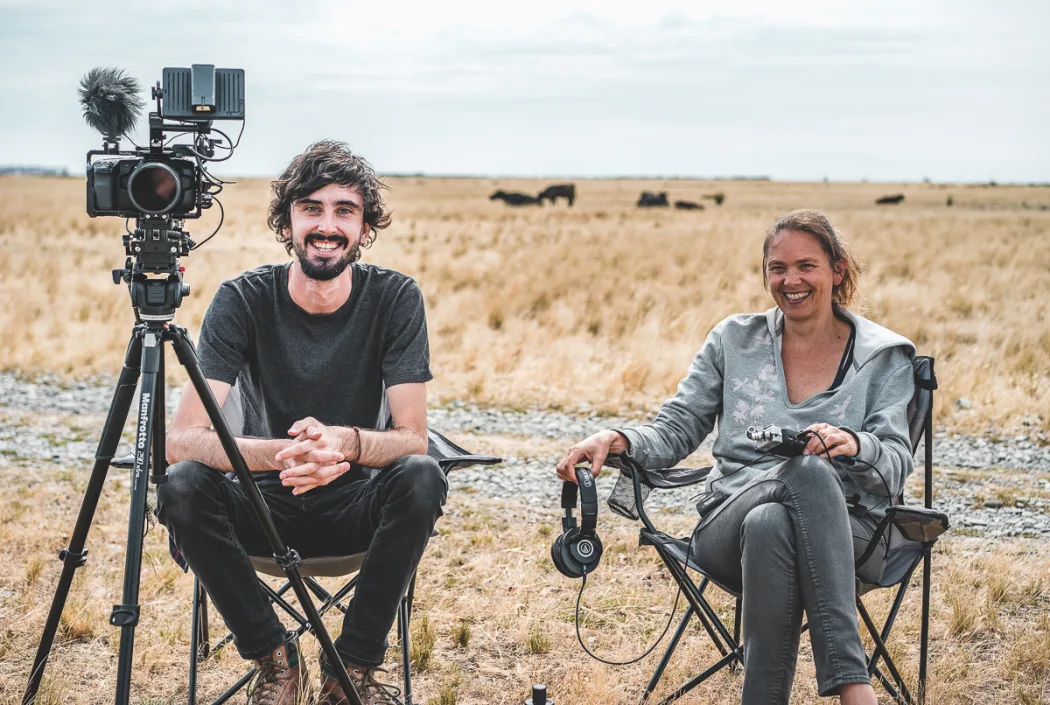
Their newest feature film, ‘The New Peasants’, which had its New Zealand premiere recently at The Suter, feels like a culmination. It follows a family in Victoria who haven’t shopped at a supermarket or driven a car for 20 years, who practise community sufficiency rather than self-sufficiency, and who raise their children with deep intentionality. The film explores both the beauty and the complexity of choosing a radically different life. It won Best Environmental Documentary at the Melbourne Documentary Film Festival and has been picked up for wider distribution worldwide. “It feels like our best work,” she says.
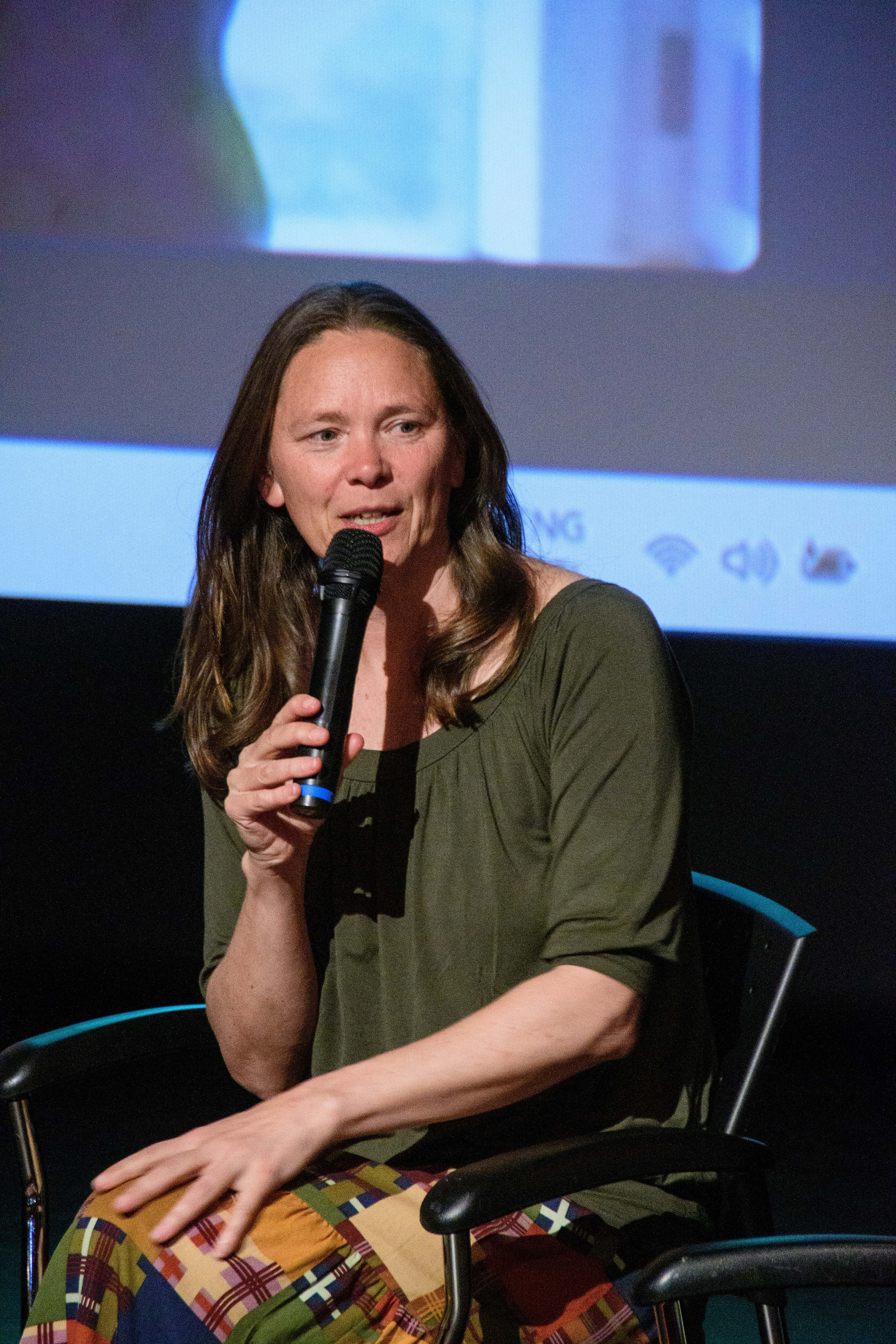
Although Antoinette and Jordan amicably ended their relationship, they continue working together and she honours their time together with gratitude. “I’ll forever be grateful for what we built together.”
Today, Antoinette stands at another one of her life’s crossroads. She recently sold the tiny house she and Jordan built together in the Moutere Hills, partly to free herself from debt and responsibility, partly to honour the truth that the house belonged to a chapter that has now closed. “I miss it,” she says, “but I also don’t. I feel like I’m preparing for the next stage of my life and am enjoying the change to living in the heart of Nelson city.”
What that stage will be, publishing, filmmaking, something else entirely, remains open. What she knows is what the last decade has taught her: that life becomes richer when lived consciously, when every choice is examined for how it impacts the world and one’s own wellbeing. She has learned to move slowly from a life shaped by fear toward one shaped by groundedness, presence, and trust. “I’m not there yet,” she says, “but that’s the journey.”
Nature, once frightening, is now something she approaches with growing ease. Years of interviewing people who regenerate forests, grow food ecologically, or live lightly on the land have gently rewired her relationship with the natural world. “People assume I’m very outdoorsy because of the films,” she admits, “but really, I’m learning from the people we film to be more comfortable in the world.”
She practices qigong and studies the science of the vagus nerve, teaching her anxious body how to soften. She has learned, slowly, that fear doesn’t have to run her life and she has discovered that the human stories around her – farmers, tiny-house builders, gardeners, activists, artists – are endless sources of wisdom and hope. “There are so many inspiring people in the world,” she says. “We don’t hear enough about the positive ways people are impacting on each other and the planet.”
For Antoinette, the future is about the small, daily acts of consciousness that help us live within our planetary boundaries, in harmony with our values.
Publishing defined her twenties. Tango consumed her thirties. Permaculture shaped her forties and now, she says, “I’m wondering who I want to be next.”
Life can revolve around destinations but for Antoinette, there is the willingness to keep beginning again, to learn, soften and evolve.
