
ROBYN PARKES
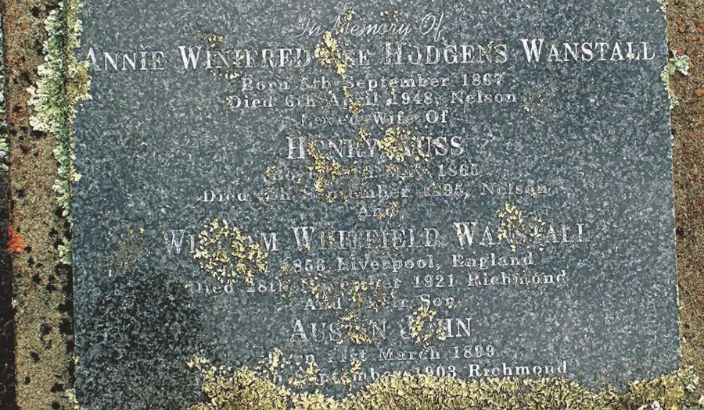
Liverpudlian, William Wanstall arrived in Nelson around 1877 and settled in Richmond.
About 18 months later, he went into business as a painter, builder, cabinet maker, plumber and gasfitter in Queen Street, later adding undertaker to his list of trades.
William was a hard worker, willing to take on anything. He successfully tendered for multiple jobs, having the ability to turn his hand to different tasks.
Painting the gas lamps in Nelson, building a bridge on the Appleby Road, painting the River Terrace schoolhouse, constructing a teacher’s house at Churchill and building a bridge on the Dovedale Hill road are but a few examples of his work.
In 1884 William married Emily Marjory Sutton, daughter of James and Mary Ann Sutton, but the marriage was short-lived.
Their first child, a son, was born in May 1885 at Wakefield, but only lived for one day.
Emily died a few days later from the effects of her confinement. One can only assume how this affected William, as by the end of June he had sold all his household effects and furniture from the Wakefield home.
Two years later he married Kate Keen. The couple settled in Hope and William became involved with many organisations and clubs.
He was a member of the Loyal Marine Lodge, the Hope School committee, Richmond Institute committee, secretary of Richmond Philharmonic Society, rifle club, Richmond Cycling and Athletic Association, secretary of Richmond Fire Brigade, the Phoenix Cricket club committee and donated his time as a scenic painter for drama events.
William became an agent for acetylene gas and at times contracted to the Richmond Borough Council for services.
In 1901 he was asked by the council to submit specifications for an acetylene gas lamp for Richmond street lighting.
His response was the exhibit a sample light outside the borough office, which cost around ½d an hour.
With council approval, he quoted the cost of erecting lamps in Queen Street and at the corners of Salisbury Road, Cambridge Street and Gladstone Road.
The quote was accepted, but for reasons not specified he was later required to comply with the conditions of his offer, as the work was deemed unsatisfactory.
In August 1892 Wiliam lost his second wife Kate, their youngest child Eulalie being only 13 months old.
Five years later, in 1897, he married for a third time, to Winifred Ann Hodgens.
William was appointed colour-sergeant of the Stoke Rifle Volunteers, a position he held for many years before being promoted to battalion sergeant major in 1903. In July 1905 he was awarded the New Zealand Volunteer Service Medal for long service.
He continued to be involved with community organisations and clubs and in April 1907 became a foundation member of the Richmond Hockey Club, to which he was appointed as delegate. Following a life well lived, William passed away in 1921 and was buried in St Joseph’s churchyard.
