
ROBYN PARKES
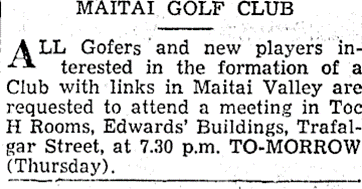
The Maitai Golf Club (Incorporated) was formed in 1937 at a meeting in the Toc H rooms attended by about 30 prospective members.
The proposed course was half a mile past the first Maitai ford, where a nine-hole layout of 3000 yards with a bogey of 36 was considered possible.
Subscriptions were expected to be no higher than £2 2sh if the club could attract around 150 members.
A 10-year lease was discussed, allowing the club to use the land for six months each year.
Two bridges were needed to access the links, with an estimated cost of £25.
The first officers elected were President F. Powell, club captain J. Hargrave, secretary A. Bolam, auditor W. Jaques and committee members E. Hudson, C. Hammond, B. McLaren, J. Addison, D. Johnson and K. Cameron.
A tentative start date for play was set for about a month later, prompting volunteers to clear the ground.
Several working bees were held and by May the fairways were playable, although improvements were still needed.
A temporary bridge was installed until a permanent one could be built.
Plans were made to open the course the following weekend for members and friends.
By the end of May, 76 people had signed up – 49 men and 27 women.
The next step was building a clubhouse and a permanent bridge. E. Piper and J. Deighton joined the committee, with Deighton taking on the role of treasurer. Green fees were set at 1sh 6d per round, and even before the first games were played, the committee was considering extending the course further up the Maitai to add four or five more holes.
The first club competition was held on 9 June, King’s Birthday, featuring medal rounds for men and women in the morning and a four-ball match in the afternoon.
K. Day won the medal round. Later that month, a fundraising dance was organised at the Nelson School of Dancing to help enlarge the grounds.
The first annual meeting in March 1938 reflected on a successful year.
The report acknowledged the foresight of Boyd Hargreaves, who was instrumental in forming the club, and noted the sadness of losing him due to a transfer from Nelson.
Membership was capped at 125 to avoid overcrowding, and games and competitions were held almost every week during the first season.
A clubhouse and bridge had been built, and the need for a professional coach was raised to help new players learn the rules and maintain etiquette.
The first year’s results were considered very pleasing, and the club looked set for a bright future, which it continues today.
