
ROBYN PARKES
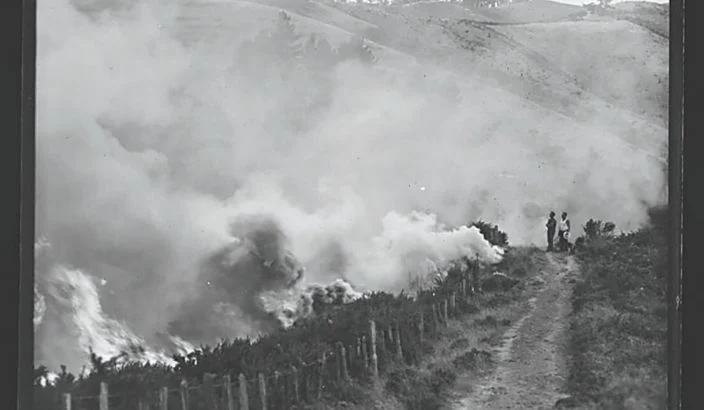
In early 1908, the country was suffering from a lack of rain and long hot days, resulting in drought conditions. The Nelson district was not immune, and fire became an ever-present threat.
Settlers watched the skies for a break in the weather, but there was no relief. Inevitably, grass, gorse and bush fires broke out across the district. Motueka Valley, Sherry Valley, Tadmor, Korere, Riwaka, Marahau and Golden Bay were all in the firing line.
Several bush fires in the hills around Motueka Valley swept across a large area, leaving the district enveloped in smoke. A farmer in Graham Valley, thinking rain would fall, set fire to scrub. Unable to contain it, the fire spread rapidly until it had a front of about six miles.
In Upper Tadmor, small fires that had been burning for around three weeks were freshened by strong winds. Each day the fire found more fuel, creating a trail of destruction. The already parched land was void of grass and farmers sold their sheep for whatever they could get – at times as little as five shillings per head.
Homes were lost, farms destroyed and farming machinery ruined. Trees grown for milling were gone, a blow for sawmilling businesses that set them back years. In Sherry Valley and Tadmor, Mr Currin lost 500 to 600 acres of milling timber, Joseph Rollet lost 400 acres of felled bush, Frederick Gibbs lost 300 acres and Stephen Smith lost 50 acres. Messrs Moffit, Goodall, Pahl and R and T Hodgkinson each lost about 100 acres.
Sam Wells and Mr Phillips lost their homes, and Mr Roeske lost his farm and some sheep. As the fire got close to Phillips’ house, settlers beat it back three times, but the fire turned for a fourth and they were unable to save the home.
Fires spread to Korere and homesteaders worked to protect their homes. Men battled for hours to save the home of E Newport and were finally successful, but many were injured in the process.
On the Motupiko side, the fire had a front of three or four miles, mostly green bush. Thirty men battled flames for two days to save the properties of Mr Coleman and Newport. A team worked to draw a dray containing tanks between the river and the scene. Buildings were covered in sacks and blankets kept saturated – luckily this worked.
In Riwaka, fire spread through the bush with Herbert Smith and Messrs Stewart, Ryder, Best and Pattie all losing property. Best lost his sawmill along with men’s cottages and a large amount of timber.
In Aorere, Henry Baigent’s sawmill was under threat and as the wind turned, flames caught the mill and quickly destroyed it. Baigent had only recently upgraded the mill by building a seven-stalled stable, extending the tramway and making other improvements in readiness for summer and autumn cutting. The destruction of the bush around the mill would have provided about three years’ work.
Finally, on 1 February, the skies opened and the rain was enough to dampen the fires, allowing settlers to take stock of their losses and begin the long task of recovery.
