
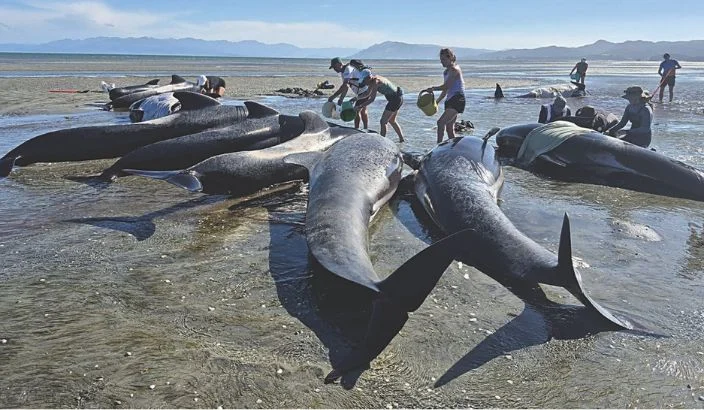
Recurring pilot whale strandings at the notorious Farewell Spit could be inexorable, according to the Department of Conservation.
In the latest summer hoodoo for the migrating marine mammals, more than 50 first came ashore at the natural whale trap on 8 January.
By the next day, 15 had re-stranded, and six were found deceased. Fifteen were refloated on Saturday, but 14 of them were back to square one on Sunday, restranding at Pūponga and Farewell Spit; one had died.
Thirteen were refloated on Sunday evening, but another two died overnight, and 11 were found stranded on Monday morning, 4km along Farewell Spit, showing signs of failing health.
Project Jonah says euthanising these remaining whales was the most humane action.
The group acknowledged the community response to the erratic incident by locals, holidaymakers, Department of Conservation (DOC) staff, Cetacean Ecology Research Group, and Manawhenua Ki Mohua to successfully return 42 whales to sea.
DOC says proposals have been suggested for many years to prevent strandings or create a pilot whale deterrence from Golden Bay, which has included beacons, sonar, reflectors, nets, and noise-generating devices.
However, it says these are a mixed blessing due to risks to other cetacean species, the difficulty of dissuasion from traditional feeding habitats, navigational errors, and the size of the stranding zone could still allow the whales to slip past beacons.
“The main Golden Bay stranding zone extends over 20km and even with 400 beacons they would still be 50 metres apart, leaving ample space for pilot whales to swim under or around them,” DOC says.
“Nor is there evidence to suggest pilot whales would follow a line of beacons rather than simply swim through them.”
DOC acknowledges logistical feasibility hurdles are at bay too. “Any system of beacons [or nets] would need to extend over many kilometres and involve a very large number of structures,” it says.
“Such a system would be expensive to manufacture, install and maintain. Large parts of Golden Bay are trawled and dredged by the commercial fishing industry, and it would be difficult to obtain approvals to install any devices which would interfere with these activities.”
