
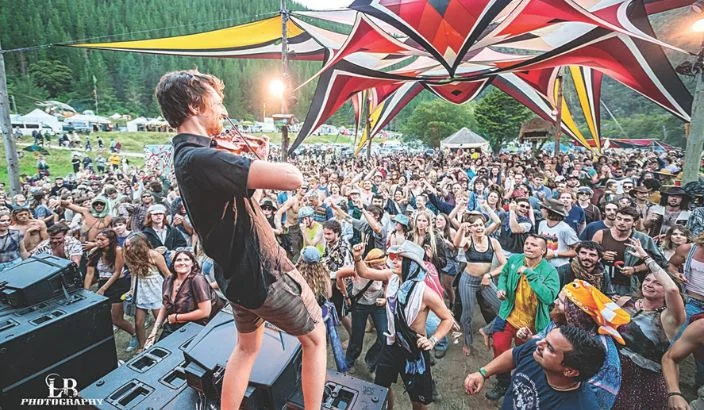
An underground music showpiece faces its swansong. Staged in the Cobb Valley for 11 years, Twisted Frequency has amped up the local economy, employed locals, been instrumental in uplifting musicians, and drawn thousands of national and international visitors over the Tākaka Hill for the five-day festival over the New Year.
But like other summer music festivals across the motu, the double whammy of the economic pressures and the cost of living crisis has created a bum note.
It has mostly been reflected by lower volumes of ticket sales, making Twisted Frequency increasingly difficult to sustain.
Its Wellington-based founder and director, David Tait, says unless there’s resounding public support to keep the event in tune, it could be another casualty in an increasingly perilous summer festival sector when 2027 ticks over.
“We don’t want to stop doing the festival, the momentum, the mana, and energy in our community is at an all-time high, but if enough people can’t afford to come to the festival, then we can’t afford to run it,” he accepts.
“It’s been really hard to come to terms with the idea of putting it to rest. There’s a lot of pain, but there’s also a lot of community spirit and strength that is coming through to help try to save it.
“But the amount of deficit that we’re facing and the uncertainty of people being able to afford tickets in a year’s time doesn’t give us enough confidence to say we’re just going to carry on.”
David says Twisted Frequency had its largest audience at its 2024-2025 event, its tenth anniversary, with around 3500 tickets snapped up, but less than 2500 tickets were sold for its 2025-2026 event.
“A resounding echo” from fans had been the travel costs, and saving for $500 tickets had become unviable. I’ve never spent so much time, energy and money promoting my festival as I did [for the 2025-2026 event],” he says. “I sent out thousands of discount codes for previous ticket holders, we had a really staunch social media campaign, and spent [tens of thousands on marketing].
“None of it has any really measurable effect on the final outcome; people are just too poor at the moment.”
The government announced in September 2025 a $10 million Event Boost Fund as part of a wider $70m events and tourism package, but it wasn’t designed to rescue struggling festivals.
David says Twisted Frequency being grassroots would make it “too small a voice in a very noisy room” if it sought government support.
“Funding underground art events would be one of the most drastically effective and beautiful things that a politician could do in this dire situation that we’re in,” he hopes.
“I’m not expecting any handouts or for the attitudes to change in terms of the type of music industry entities that the government is choosing to support at the moment.”
David says the drums will be beating throughout this year to save the music with upwards of 40 fundraiser events held in Aotearoa and abroad, and sales of merchandise and compilation albums from the festival’s headline acts.
A koha can also be donated with ticket purchases for its 2026-2027 event. “We’ve been working directly with some grant writers who are helping us pro bono try and find some funding, because we’ve never managed to get any, despite our attempts,” he says.
