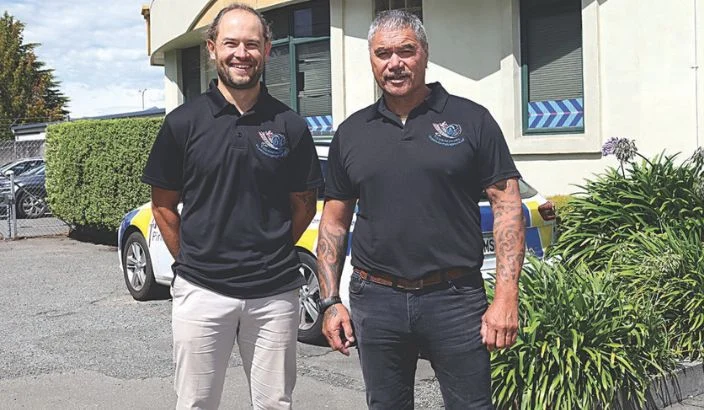
An intelligence specialist has answered the call to come home to Te Tauihu where he has stepped into a police role that has been vacant for years, aiming to strengthen relationships between police and iwi.
Taia Goad (Ngāti Porou, Ngāti Kahungunu) has taken on the role of Pouwhakataki - district iwi liaison coordinator, Māori responsiveness – a position designed to help improve connections between police and iwi, a relationship that has at times been fractious.
Taia joined the police eight years ago – saying at the time that he would only give them five years of his life. Prior to joining police, he was a digger driver and did a bit of teaching, which was already a change from his previous job as a brewer.
Living in Wellington, his role with police was in intelligence, which he loved, but was ready for a change. So mid-last year he moved home to Māpua with his wife and two children to take up the iwi liaison role.
The Tasman police district covers 70,000km2 of geographical territory from south of Haast to Kaikōura – the second largest in the country after Southland.
“From my experiences so far, iwi right across Te Tauihu are just stoked that we finally have someone in this position. For my position - it’s been a couple of years,” Taia says.
“We want to create connections, build those relationships so that police meet the people, know the people, and so people will know them. This role gets you out and about, engaging with whānau and the community.”
Taia and his team, which currently consists of Jimmy Skipper who has just been appointed in Blenheim and only two others, work alongside iwi and services like Te Piki Oranga, Maataa Waka and Ara Poutama – Corrections, among others.
Taia hopes that they can be part of the healing process between police and Māori.
“There are those who have had firsthand experiences with police in a negative sense, but also those intergenerationally as well, who have looked at the way police have dealt with things with their pāpā, their māmā, their kaumātua.
“We sit well outside the box, but that’s cool, we’re mandated by police to identify what the needs of our community are, what the needs of police are, and whatever we develop is a design that helps support better outcomes for our community.
“We’ve got the backing of police right from our district commander, and that’s a blessing.
“One of the reasons why I came into this role is that I was one of those rangatahi who wanted to join police, like a lot of our rangatahi do, but they just don’t see it as a viable option.”
He says, as a young person he had a few “run ins” with police that made him think twice about his career aspirations.
“I got to a point when I was maybe 19 I realised that I could either be part of that problem and continue to just become one of those statistics that get so heavily bandied about across government and everywhere, or I could be part of the solution and change the way that police engage with whānau and also be there as a support person for those who, like myself, could go one of two ways, and try to make sure that they have the support that they need to go down that positive path.
“So for me, that’s what this position really gave the opportunity to do.
“I think my partner would call it, growing up,” he quips.
He says, the role being so flexible within police will only assist. “The other day I had a fella walk past the police station and just stop me and say, ‘bro, I need help, I’m trying to turn my life around, I’ll take what help I can get’ and we’re having a bit of a korero and he just said, ‘look, it’s actually really nice to be able to have a have a korero with a police officer who’s not trying to arrest me’.
“It gave him a sense of comfort having a Māori person in this space to come up and have a korero.”
