
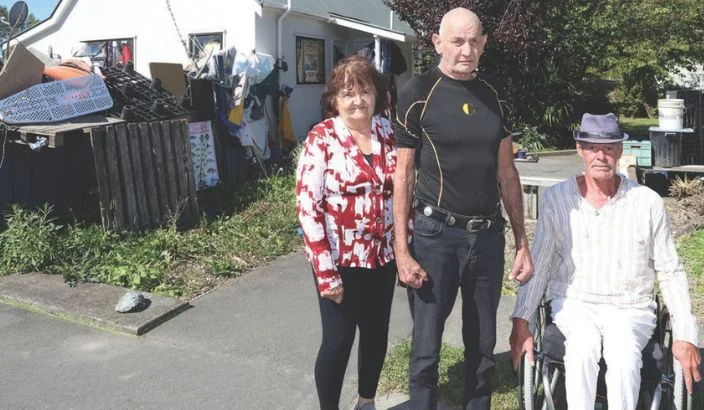
“Take the rotten apple out, or the rest of the apples will go rotten too”.
That’s how Sydney Allen describes the tenant living opposite him - sick of his chaotic, disorderly behaviour making him sick, along with his wife Diane Maher and mobility-impaired next-door neighbour Russell Turner.
For more than three years at a Kāinga Ora complex on Weka St, they’ve been embroiled in their neighbour’s menacing remarks, loud noise, a large, reeking outdoor rubbish heap, and rubbish, and - more recently - dead rats hurled onto their properties.
The ordeal has exacerbated their physical and mental well-being and daily activities, and the trio in their 60s and 70s are frazzled that “nothing has been done” by Kāinga Ora, Nelson City Council, or police, despite repeated pleas.
Sydney, who has pre-existing asthma and chronic obstructive pulmonary disease, even placed a dead rat found on his front lawn onto the counter of Kāinga Ora’s Nelson office last month, telling “stunned” staff: “That’s what I have to deal with”.
“[The rubbish stench is] affecting my breathing. The smell comes from the north‑east - it comes straight into the house - and you don’t know what toxins you’re breathing in,” he says.
“It’s like poo ponds, this is what this place is coming to, ‘poo-Weka St’.
“I have to open the windows when it gets too hot. I can't put [the air conditioning] on because it costs too much money.”
Sydney’s wife Diane gets nausea from the rubbish odour, and the neighbour’s early-morning “banging” causes sleep deprivation.
A doctor's note to Kāinga Ora, seen by Nelson Weekly, reads that the social and environmental stressors, including the “strong, unpleasant smell”, are “directly contributing” to a decline in Sydney’s health.
It links the neighbour’s behaviour to anxiety symptoms, chest pain, and an elevated heart rate, and the doctor wants Kāinga Ora to “urgently” investigate the matter to resolve the housing issues adversely affecting their patient.
Russell says the neighbour discards rubbish in his garden, and has been relentlessly threatening, including warning him that “your day is coming soon”.
“I don’t get to use my yard because of him. I get abused, threatened, and I’m sweating that [the neighbour is] going to come up behind me,” he says.
“My anxiety has gone through the roof, my blood pressure has been up to 220 over 125, my heart rate goes up to 190 plus — they keep waiting for me to have a stroke or a heart attack because of it.”
His doctor confirmed the health spiral was stress‑driven.
“Since [the neighbour has] been here I've ended up on three different types of pills for blood pressure, and I'm also now on heart pills because of the stress.”
Russell also claims the neighbour “pinched” a trellis gate at the end of his wheelchair ramp.
Although the trio say they’re grateful for the Kāinga Ora housing, they feel disappointed after approaching the social housing provider with photo evidence and seeing no timely or effective action.
“At one stage [Kāinga Ora] said for us to go,” Diane says.
“People take these homes because they are beautiful homes to live in. I'm not moving from here,” Sydney says.
“Why should we all move? [the neighbour] was here last and caused the most damage, threatens life, and mentally torments you - remove the problem.”
Requests to Nelson City Council (in regards to the rubbish buildup) and police over the behaviour have also been futile.
Kāinga Ora Nelson, Marlborough and West Coast regional director Julia Campbell says the organisation has “for some time” used Residential Tenancies Act tools, including applying to the Tenancy Tribunal for an order requiring the tenant to remove rubbish.
“When the tenant did not comply, and despite ongoing efforts to work with them, we have taken steps to end the tenancy,” she says.
“For privacy reasons, we are limited in what further we can say about this situation.”
Nelson City Council acting head of regulatory services, Chris Miles, says that complaints about the rubbish accumulation at the property were assessed, but no breach was identified because the material was “not readily visible from a public place or adjoining property”.
“Complaints about odour were also investigated, with no offensive or objectionable odour detected that would constitute a breach under the National Air Quality Plan rules.”
