
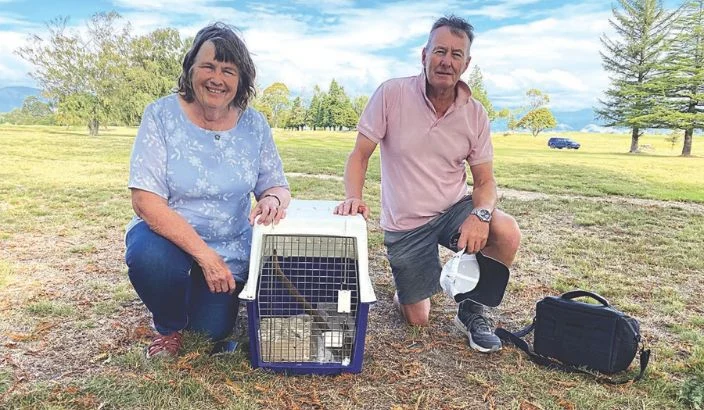
Two sets of luminous eyes peered out of a cage at Greenacres Golf Club last week as rescued Little Owls spread their wings and returned home.
The two owlets were found two months ago at the ‘Best Island golf course in the country’ when volunteers were clearing a huge old man pine that had fallen in a storm.
Volunteer Brian Bull says they had been chainsawing the fallen tree over a couple of weeks, including four hours on the day they discovered the Little Owls tucked into a crevice that was exposed to the elements after the tree fell. It was only once the machinery was turned off that they heard rustling and went to investigate.
Two tiny owlets peered up at them, looking frightened and in poor shape. Brian says they initially assumed they were moreporks and called the Department of Conservation which led to bird rehabilitator Jan Boyd. She has spent the past couple of months nurturing the pair back to health and raising them until they were old enough to return to the golf course.
“Little Owls have a lot of fluff and one of them had lost a lot of that. It was really not very well and weighed only 118gms. One had its legs really coated in faeces which had scalded the skin on its legs.”
The district nurse is well set up for the numerous birds brought to her care at her home near Tapawera and relies on community support to keep them fed through rehabilitation.
“It’s been a community effort because I’ve had people catching mice for them. I’ve had solar lights in the aviary in the hope they’ll be catching moths and now they’re mature and ready to go.”
The owlets even travelled with her to the West Coast at Christmas because they needed regular care. At any one time, she may also have tūī, kingfisher, kererū under her care, each requiring different food.
“You don’t want to look in my fridge!” she laughs. “Some years ago I had a patient shoot some rabbits for me from his bed, without getting out of bed – that was for owls.
“It’s a huge commitment because you never know when you are going to get birds.”
As with all birds in her charge, the owlets were handled as little as possible to prevent them becoming human-imprinted. They are not an easy bird to handle anyway.
“I’ve never come across a friendly owl – they can bite and have claws, so you have to be careful handling them.”
The two young owls have now flown the nest, and she says they have a good chance of surviving on their home turf.
