
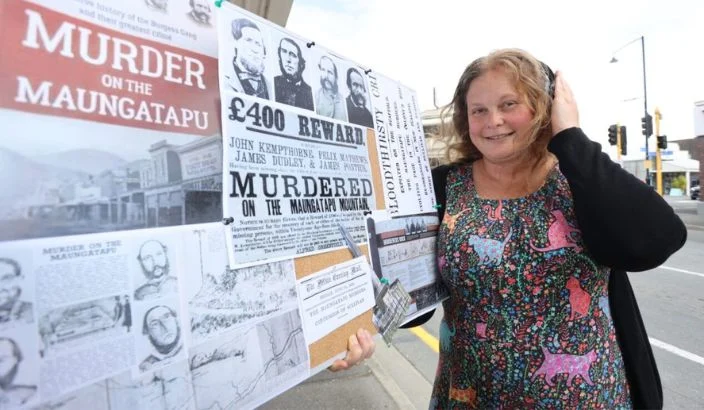
The movements of four scruffy goons on Bridge St in the days after their cold-blooded atrocities is now a permanent audio guide on this main drag where “Nelsonian pride” helped bring them undone. Officially launching on 5 March, the public can scan a QR code with their mobile phones at 1 Bridge St and be taken on the 45-to-60-minute sequential audio journey, A Bridge Too Far: The Maungatapu Murders.
The self-guided walk identifies key locations from one of Nelson’s darkest stories, which unfolded 160 years ago.
Headphones are recommended but not essential, and the entire guide can also be listened to from the comforts of home.
The project was fine-tuned by Make/Shift Spaces, with research by Nelson historian Karen Stade, narration by Mark Hadlow, and scriptwriting and digital image assembly by project manager Audrey Anderson.
Audrey says trial runs of the audio guide delivered positive verdicts by its guinea pig listeners, and she now hopes it will be a killer attraction for history buffs, locals and visitors as work gets underway on Bridge St as part of the Bridge to Better project.
While the street is closed to vehicles between Rutherford and Collingwood Sts, it remains open to foot traffic.
Audrey says the Maungatapu Murders centered on the Burgess gang, which included Richard Burgess, Thomas Kelly, Philip Levy and Joseph Sullivan.
They had robbed the pockets and lives of five men on the Maungatapu Track in 1866.
Hoping to evade capture, the gang had stayed at Bridge St but quickly aroused suspicion when locals noticed them frittering money away at various locations, which ultimately led to their arrest.
The case made international news and horrified Nelson.
“We came to the conclusion that if we're going to send a message about this, it would be about Nelsonians not letting criminals get away with murder, because the Burgess gang assumed they would when they came to town,” Audrey says.
“[The Maungatapu Murders] was a very well recorded story, because you got this text from the criminals themselves with very lengthy confessions, so you got their perspective, and then you also got the newspaper reports.
“The Nelson Evening Mail had just opened when the murders happened, and it got their business on the go.”
Audrey says those confessions were made at Albion Square, ending the Burgess gang’s rampage, and now the location for the end of the audio guide.
