
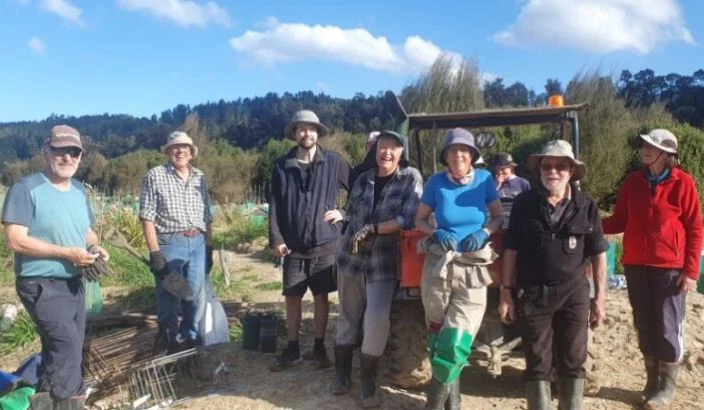
With 5000 predator pelts under their belts, the Otuwhero Wetlands Trust is ramping up its restoration work and calling for more volunteers as it forges ahead with planting and predator trapping.
Volunteer Anna-Kate Goodall says the Marahau-based group had plenty to acknowledge as it marked World Wetlands Day last month, including stronger birdlife, expanding trapping networks and the recovery of plantings damaged by last year's flooding.
The group was founded in 2011 by Roger Gasgill, who Anna-Kate calls “something of a connector of people”. The land itself was gifted by the Reid family and put into Department of Conservation estate.
Anna-Kate says predator control is delivering visible results. There are now more than 300 traps across the wetland and Nells Bush, and the trust recently reached a milestone 5000 predators trapped since the project began. Rats and mice are the most common catch, although possums and stoats also feature.
She says the ecological response has been encouraging. The trust has identified what she describes as "a heap of nesting fernbirds", likely one of the strongest populations in the region. Tasman Bay Guardians has noted increased inanga spawning linked to trapping work, while a wetland bird group says the site could support bittern, a nationally critical wetland bird.
Last year's flooding pushed sand and silt across a just-completed memorial planting in Roger’s honour. Many plants were smothered, but the group has spent much of the summer rescuing them, with the help of DOC’s trainee rangers.
"We were pretty lucky, considering," Anna-Kate says. "There were a few dramatic slips that came down in Nells Bush onto the Marahau road, and our planting for Roger had sand and silt cover it, but the plants were still there [after we cleared it] and hopefully they will still thrive."
Weed control remains the most time-consuming part of the trust’s workload, particularly gorse, blackberry, broom, willows and Himalayan honeysuckle. Volunteers carry out plant “releasing”, which means flattening the neighbouring pasture grasses to reduce competition. Heavier work has been funded by Marahau Ecological Trust, allowing contractors to be brought in where volunteer labour is not suitable.
The trust plans to increase planting numbers again after several years of reducing new plantings due to frequent flooding following ex-cyclone Gita. The goal is to complete the core planting programme by 2029, with some areas left to naturally regenerate.
The group currently has 32 volunteers, including 20 trappers, with up to 10 people attending each Friday morning planting and weeding session. Anna-Kate says it would be marvellous to get 15 or more each week.
The sessions run for about four to five hours. "They are very social," Anna-Kate says. “There’s a lot of chitchat, and it’s a lot of fun.”
More trappers are also needed, after the expansion of the trapline zones. Traps are checked in people’s own time rather than as part of a working bee.
For further information, contact trust coordinator Helen at lindsay.helen@xtra.co.nz.
