
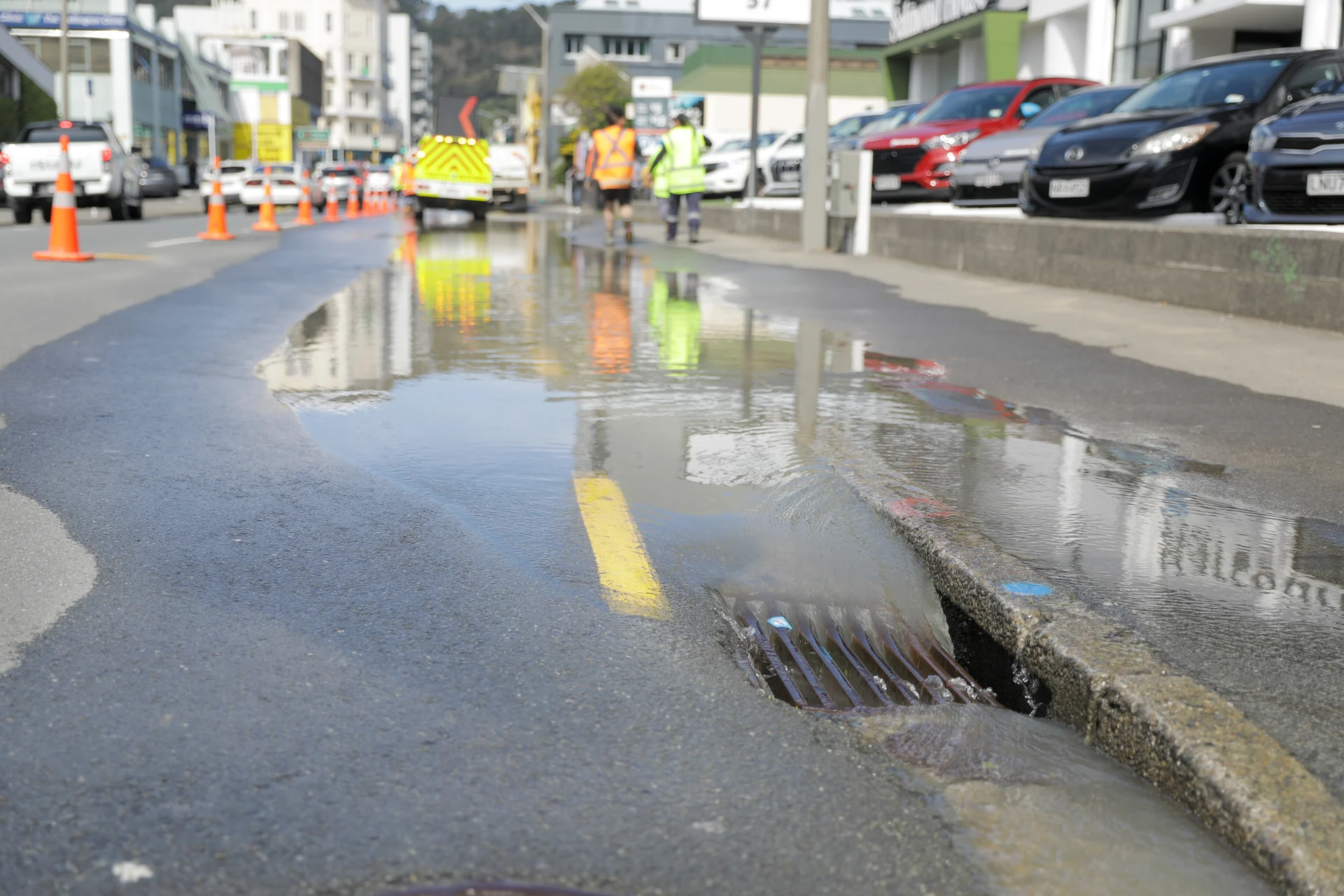
Repairing leaks and broken pipes costs Tasman District Council millions of dollars each year, but new approaches are beginning to reduce that spend.
Across all three water infrastructure areas – drinking water, wastewater, and stormwater – the total cost of reactive repairs for the current financial year is forecast to be $5,579,000.
Mike Schruer, the council’s manager for waste and water, says the figure can largely be attributed to the cost of repairing broken pipes.
The key items that made up a water repair bill are traffic management, extracting the material from around the pipe, replacing the pipes, and staff costs.
But two changes to how leaks are fixed have stemmed the flow of money from the council’s bank account.
The first was shifting to the new risk-based approach to traffic management.
“In the berm, we were getting to the point, with the full traffic management, that the cost of the traffic management was about twice the cost of the actual repair,” Mike says.
“Now… you can actually park a vehicle there with a light flashing and have two people on site. Whereas in the past, you’d have a team of three or four traffic management specialists and the repair team.”

That change had cut the cost of traffic management for those smaller berm-based jobs, which do not involve digging up the road or footpath, by up to a sixth – or 17%.
The second change was leaving minor leaks that were reported at night or in the weekend until the next working day to fix.
“Invariably, [breaks] seem to happen out of hours,” Mike says.
“So, you’re suddenly into overtime, and also then you lose your staff for the next day, because they’ve got to have time off… and other items, like routine maintenance, falls behind.”
Ensuring staff were active and responsive during work hours was essential when each day brings a couple of new leaks somewhere on Tasman’s expansive water network.
Without those changes, Mike says that $5.579m repair cost would be “a lot worse”.
He adds that a repair costs about 10 times more per metre when compared to a planned renewal cost.
Repairs are ad hoc, each requiring their own traffic management plan, and often did not take place during opportune times, unlike a full renewal which has one overarching traffic management plan and could be carried out when suited best.
“We’re increasing the rate of replacing ageing pipes in poor condition, but we’ve got a long way to go yet,” Mike says.
The next major water upgrade is slated for Murchison, with the $1 million replacement of its water main scheduled for the week of 16 March and expected to take three months.
That project has been brought forward after several significant breaks on the rural town’s network over the last year, including two burst mains, which collectively cost just over $31,000 to repair, and a separate full loss of drinking water across the entire town overnight and into the next morning in mid-February.
The next five to 10 years were expected to see an increase in the rate of water renewals to replace aged sections of the network and bring the pipes up to a modern standard, hopefully eventually reducing the number of breaks that need fixing.
But while there are positive trends in terms of scaling back the cost of water repairs, the ongoing cost of complying with modern water standards was another hurdle for Tasman, particularly its rural networks.
“We’ve got a long-term challenge there to get those up to standard,” Mike says.