
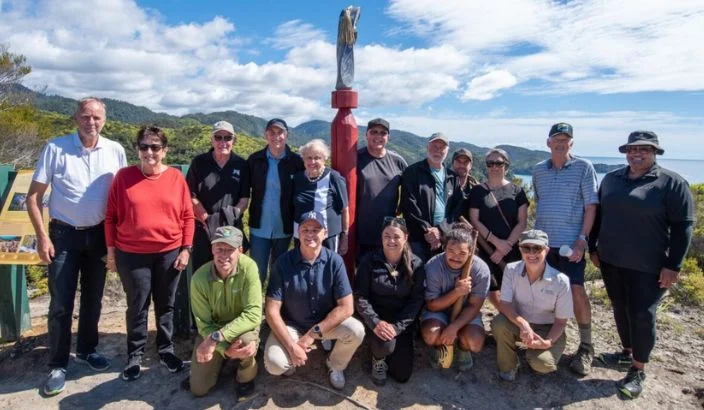
An extraordinary contribution to New Zealand conservation was acknowledged in the Abel Tasman National Park last month.
Representatives from Project Janszoon, the NEXT Foundation, the Department of Conservation, the Abel Tasman Birdsong Trust, Ngāti Rārua, Ngāti Tama and Te Ātiawa joined the Plowman family for the unveiling of a commemorative sign, seat and wheku just off the Abel Tasman Coast Track above Anchorage.
Project Janszoon, the first privately-funded landscape scale restoration project of its kind in New Zealand, has transformed the ecological prospects of the Abel Tasman. Its benefactors, Neal and Annette Plowman, have given more than $20 million to remove wilding conifers, educate young people in conservation, restore threatened habitats and reintroduce species including kākā, whio and kākāriki.
In June, Project Janszoon will hand its achievements to the Department of Conservation for long term management under the Tomorrow Accord, leaving a legacy of inspired rangatahi, thriving native birds and a skyline free of the scourge of wilding trees.
NEXT environmental advisor Devon McLean says the generosity and vision of Neal and Annette has been a remarkable gift for Aotearoa.
"The park is newly alive with kākā, pāteke, whio, kākāriki and robin. Project Janszoon’s investment in the control of weeds, including wilding conifers, and animal pests has revived the natural processes of the forest, exactly as envisioned 14 years ago when the project began. Witnessing the change here today with the Plowman family, Next Foundation trustees and members of our community is incredibly special."
Neal and Annette went on to launch the NEXT Foundation, which has funded conservation and education at scale across the country.
"The successful partnership model created for Project Janszoon has become a blueprint for several other transformational restoration projects already underway across New Zealand," Devon says.
Project Janszoon board chair Gillian Wratt says that seeing the original vision realised has been a career highlight.
"To be here today with the people who not only supported the idea, the dream, but who had the means and commitment to make it happen and see it through is truly memorable.
"This project has paved the way for extraordinary innovation and investment in conservation across New Zealand. Seeing the Plowman’s vision brought to life has been incredibly rewarding for all of us, board, staff, contractors and volunteers involved in Project Janszoon."
Aneika Young of Ngāti Rārua and Te Ātiawa, a director on the Project Janszoon board, says manawhenua iwi appreciate the scale of the restoration delivered on the ground.
"The project has brought people together to contribute practical knowledge, tikanga, hands on conservation work, bird translocations, restoration planting and education initiatives. These collective efforts are strengthening the mauri of this nationally treasured landscape so it can be enjoyed and cared for by future generations."
Aneika also acknowledges the Plowman whānau for their generosity and commitment, which helped turn a shared vision for the park into lasting action.
Department of Conservation director general Penny Nelson says the Plowman family’s vision and bravery in establishing Project Janszoon has been “incredible”, and the project has been a trailblazer for conservation.
"The ecological gains that have been made and community buy-in for conservation are remarkable. Forest birds can be seen in the lowlands after being absent for decades, and the massive collaborative effort to remove weeds, wilding conifers and ungulates has eased pressure on the ecosystem.
"DOC is committed to honouring the legacy Project Janszoon has created. We will be working with iwi, community groups, landowners and other supporters to sustain and build on these gains for future generations."
