
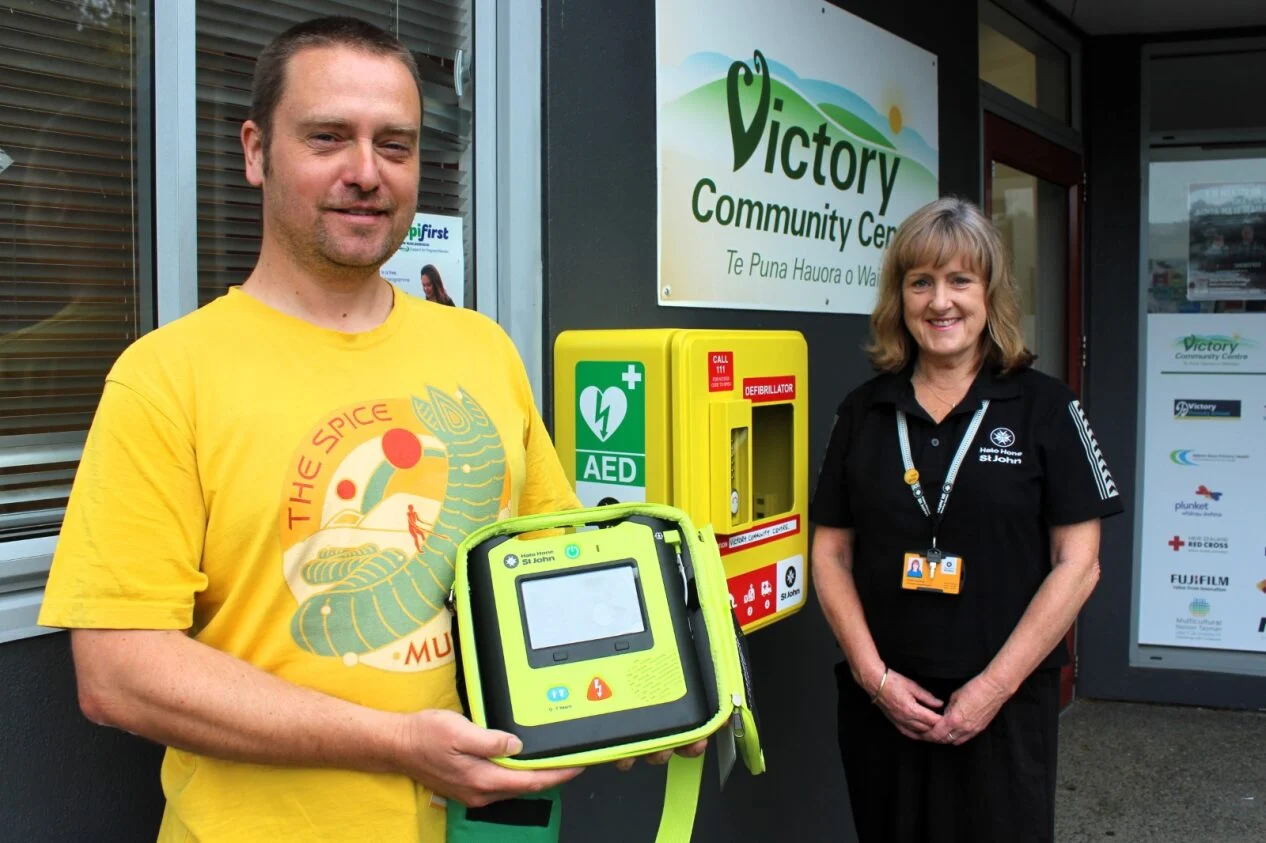
The chances of surviving a cardiac arrest in Nelson South have improved thanks to a new automated external defibrillator (AED) gifted by a local family trust.
The life-saving device has been installed outside Victory Community Centre on Totara St, giving the public 24/7 access.
Its installation followed a Hato Hone St John 3 Steps for Life training session held at the centre in October last year as part of the organisation’s annual Shocktober campaign. During the session, it was identified that the area would benefit from a publicly accessible 24/7 AED.
In January, an anonymous donor contacted Hato Hone St John after a family member suffered a cardiac arrest, and offered to donate an AED.
Chosen as the ideal location, the device and its protective cabinet were delivered to the centre earlier this month.
Victory Community Centre community coordinator Steve McLuckie says the centre already has an AED, but it is more than 10 years old and only available when the building is open.
Looking at maps, Steve says the area did not have sufficient coverage for a 24/7 AED and they are “stoked” to now have one.
“Hopefully we never have use it and it just sits there for years, but knowing it's there in the event that might save someone's life… that’s an amazing outcome,” he says.
“I would particularly like to acknowledge the anonymous donor on behalf of the community centre and really express our appreciation for this amazing gesture that’s making a difference for Victory.
“It’s just nice to know there are people in the community that have the means and want to support health of the community.”
He also thanked Hato Hone St John community engagement co-ordinator Sarah Carpinter for helping to make it happen.
Sarah says they are planning another training session at the centre so people can learn how to use the new AED.
In its latest Out of Hospital Cardiac Arrest report, Hato Hone St John found that in the past year 2,466 people were treated for cardiac arrest by ambulance officers across the country, which is almost seven each day.
The report found 72 per cent of cardiac arrests occur in the home, followed by public areas on 16 per cent. Early defibrillation from a bystander can more than double a person’s chance of survival.
While 24 per cent of patients survived to hospital, only 12 per cent survived 30 days after the event, and just six per cent received defibrillation from an AED before an ambulance arrived.
People wanting to learn how to respond in a cardiac emergency can sign up for a free 3 Steps for Life session here.
