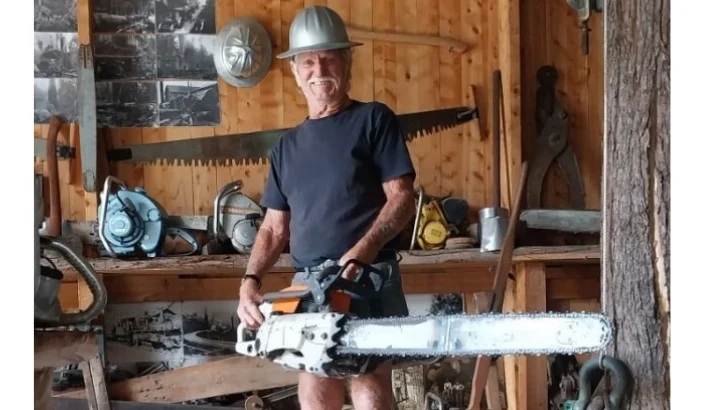
Rex Kelly’s life has been, in his own words, all about logs and saws. It is a fitting summary for a man carrying on a family tradition that spans generations, including a surprising link to Australian bushranger Ned Kelly.
Rex’s great uncle was Ned’s father; a connection he says is simply part of the wider Kelly family story.
Rex’s collection of 115 chainsaws is a striking record of forestry history. Housed at Higgins Heritage Park in Wakefield, it includes rare pieces such as the 1948 Sankey Aspin, which weighs about 16kg.
Imagining a 10-hour shift swinging that around makes today’s forestry work look very different. There is also the Dolmar Sachs rotary chainsaw, which Rex describes as “temperamental”. Unlike a standard looping chain, its mechanism spins differently - a rotary - making it a rare and unusual machine.
Alongside the saws are other items from the region’s forestry past, including the old metal hard hats known as lemon squeezers.
“You could tip your lemon squeezer upside down and boil water for a cuppa in it over the fire,” Rex recalls.
Logging runs deep in his family. Rex’s father, grandfather and several uncles logged, and following tradition are his son Nigel and grandson Josh.
Rex left school at 15 to join his father in Bottle Lake, Canterbury, working in an era far removed from today.
“We logged with two horses, which would pull the logs into rows and help load the truck - a truck, not a trailer. The horses got so good at what they did we didn’t have to lead them.” Horses took turns resting, and Rex says they were well cared for as they couldn’t do the job without them.
In those days, it was native timber being felled for local mills to turn into boards for houses and sheds.
One thing that still frustrates Rex is the lack of photos from his early days logging with horses.
“It brasses me off,” he says. “You just didn’t lug a camera around with you in that environment, it's most unfortunate.”
Before mechanised sawmills, timber was cut with two-man whipsaws over saw pits. Dense rimu, totara, kahikatea, matai and kauri demanded real skill.
Rex has preserved this part of history with a whipsaw display and two mock figures showing how it worked.
“It would take two men a whole day to cut one log with a whipsaw,” he says.
Rex says that his drive to preserve the history of forestry is simple - there are many people with knowledge that is disappearing.
“It needs to be done, otherwise it’s lost. I’m all for preserving forestry history, not enough people are doing it.”
His collection also includes Kelly axes. Despite the name, they are not linked to his family but to American axe maker John Kelly, who forged high quality axes in the late 1800s. Durable and dependable, they were essential logging tools before machines dominated the industry.
In 1967 Rex married a Tasman local and moved to the area, taking work with his uncle’s logging operation before eventually starting his own crew and contracting to Baigent’s. Over time the crews grew, and Rex also spent part of his career training new entrants to the industry, many of whom are still involved in forestry today.
Now retired, Rex reflects on how much has changed.
“Logging was a dangerous industry with lots of fatalities; it's turned around, its nowhere near what it used to be.” Rex says. “Machinery and technology have changed site set-ups and increased the volume of wood that can be harvested and processed.”
These days Rex spends most of his time at Higgins Heritage Park, the 11-acre site dedicated to local history. For him, it is still all logs and saws, as he splits firewood to help fund the park.
He enjoys sharing stories and adding to his collection, but asks anyone donating a chainsaw to “call in and see me first. Don’t just leave it at the shed door.”
For Rex, Tasman’s forests represent far more than timber. They are a lifetime of work, family, mates, stories and gear worth preserving.
Higgins Heritage Park is open to the public every second Sunday. Full details are available on its website and social media pages.
