

Windthrown logs from Tasman’s winter storms have bolstered Port Nelson’s revenue over the last year while fuel prices may cause headwinds for Nelson Airport.
The two companies gave strategic presentations to a combined committee of the Nelson City and Tasman District Councils on Tuesday morning.
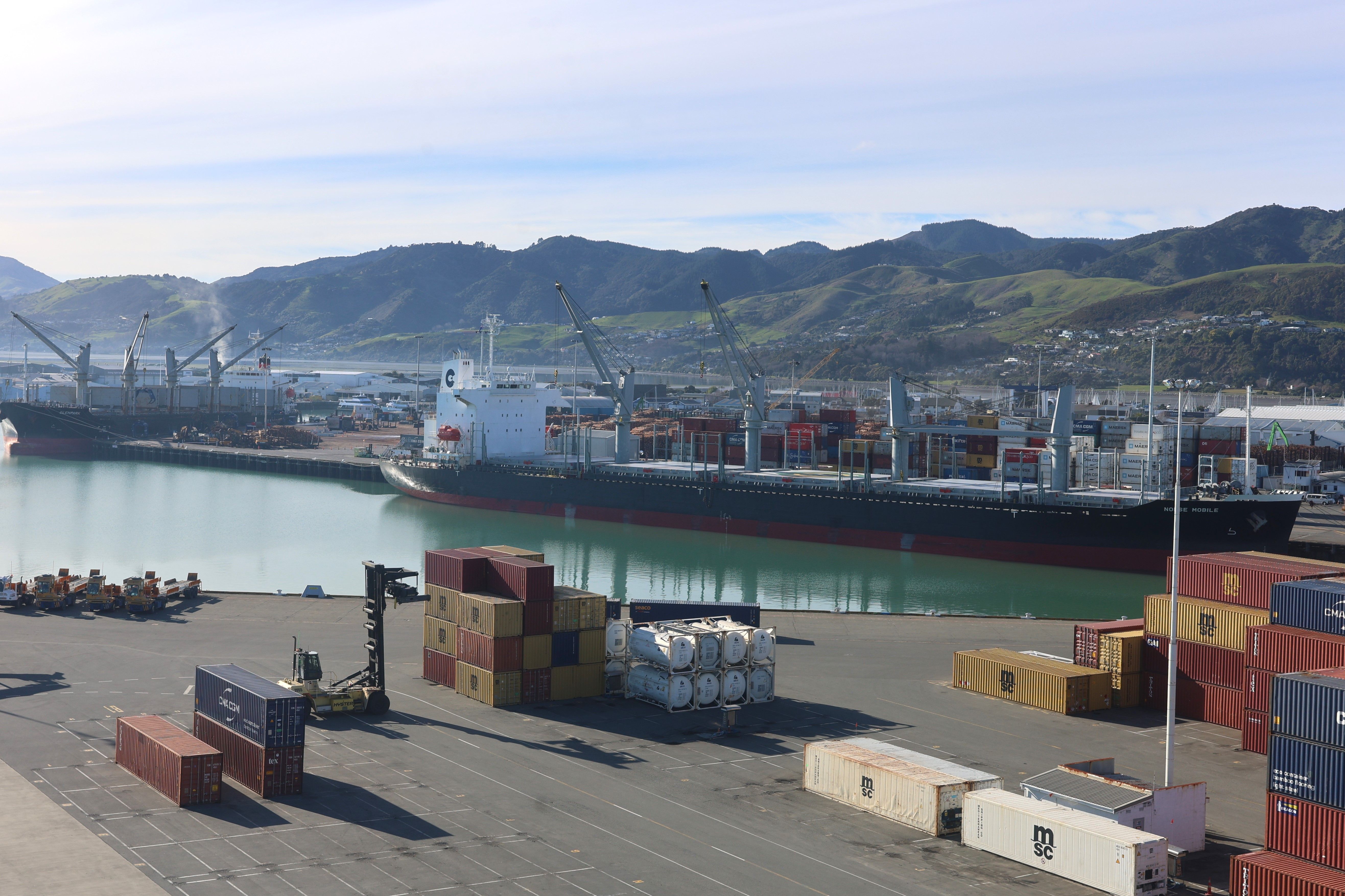
Port Nelson’s year could be condensed into a single sentence: “less timber, less revenue from Sealord, and a heck of a lot more logs”, said chief executive Matt McDonald.
Nelson Tasman experienced significant industrial closures last year, with the Carter Holt Harvey sawmill in Tasman and Sealord’s coated fish factory in Nelson shutting down, seeing 190 jobs lost and impacting port revenue.
But the thousands of trees that toppled during Tasman’s July storm and are being salvaged have seen a “huge increase” in log throughput at the port, more than offsetting those other losses for the time being.
“At 31 December, [we were] pretty much 50% ahead of our budget and 50% ahead of the same time last year,” Matt said.
By the end of February, 1.1 million tonnes of logs had been through the port.
“Our forecast for the year… we’re assuming we’ll be in the order of 1.6 to 1.7 million tonnes, so a really significant event, not just for the region, but for the port.”
He said it was probable that it wouldn’t be until the 2027/28 financial year when log numbers returned to normal.
The six months to the end of 2025 saw the port’s net profit reach $6.3 million, more than double the $3.0m from the same period the year before.
Matt said that port pricing played “an important part” in that increase, “but you certainly see the impact of increased log volumes through there as well”.
“More cargo equals more profitability.”
The next three years were projected to continue to see steady profit growth, up to $7,000,000 for the 2028/29 financial year, albeit with a drop next financial year after the bulk of the logs were through.
In response to questions, Matt said the port was not currently seeing disruptions caused by the ongoing conflict between the United States and Iran.
“Nelson, relatively compared to most other ports in New Zealand, has a small amount of cargo going to the Middle East.”
The same story could not be said for Nelson Airport.
Board chair Quentin Hall warned that Air New Zealand’s flight cancellations between 16 March and 3 May had impacted 7,000 seats, equating to about 5% of the airport’s capacity.
“That is ultimately going to result in an increase in costs for the consumer,” he said.
“We are still working through the ongoing impact for us, and we are still not aware of the long-term position of Air New Zealand.”
Long-term passenger growth was now also forecast to slow compared to earlier estimates.
The current financial year’s passenger count was forecast to be in the order of 800,000, which was expected to repeat next financial year.
Last year, the airport had signalled a return to its 2022–2024 highs of more than 900,000 passengers by the 2027/28 financial year.
But current estimates have since pushed that milestone out two years to 2029/2030.
Answering questions, chief executive Brendan Cook said that smaller airlines Originair and Sounds Air had not yet reduced their schedules like Air New Zealand had.
“We are expecting them to sort of fill that gap a little bit, but they are under the same cost pressures as the others.”
Top South Now has reported that Originair was considering cost-cutting measures including cancelling weak schedules, reducing flights, increasing fares, or reducing the number of discounted fares if the fuel crisis was not short-lived.
While Nelson Airport’s passenger numbers were down marginally for the six-month period to the end of 2025 compared to the year before, net profit was “considerably up” by $450,000 due to changes in the airport’s interest payments.
Executive officer for Infrastructure Holdings Limited – the holding company for Port Nelson and Nelson Airport – Mark Loveard said the company had been previously expecting a “fragile recovery” for the regional economy.
“The past few weeks’ events have put an absolute damper on that.”
IHL and the two councils will need to have a “hard look” at its future forecasts and plans “in light of a radically different global environment”, he said.