
As the cost of petrol continues to rise, earlier eBus services could soon provide an alternative option for early-morning commuters.
However, higher fares are also on the way for passengers using the BeeCard.
Commuters travelling on Routes 1 and 2 between Richmond and Nelson have previously had few options, with the earliest stop at the Nelson interchange being at 7.09 am while Richmond’s was at 7.55am.
But last Thursday, the joint transport committee for Nelson and Tasman agreed to add one additional service for each route to get commuters to Nelson before 7am, and to Richmond before 7.30am.
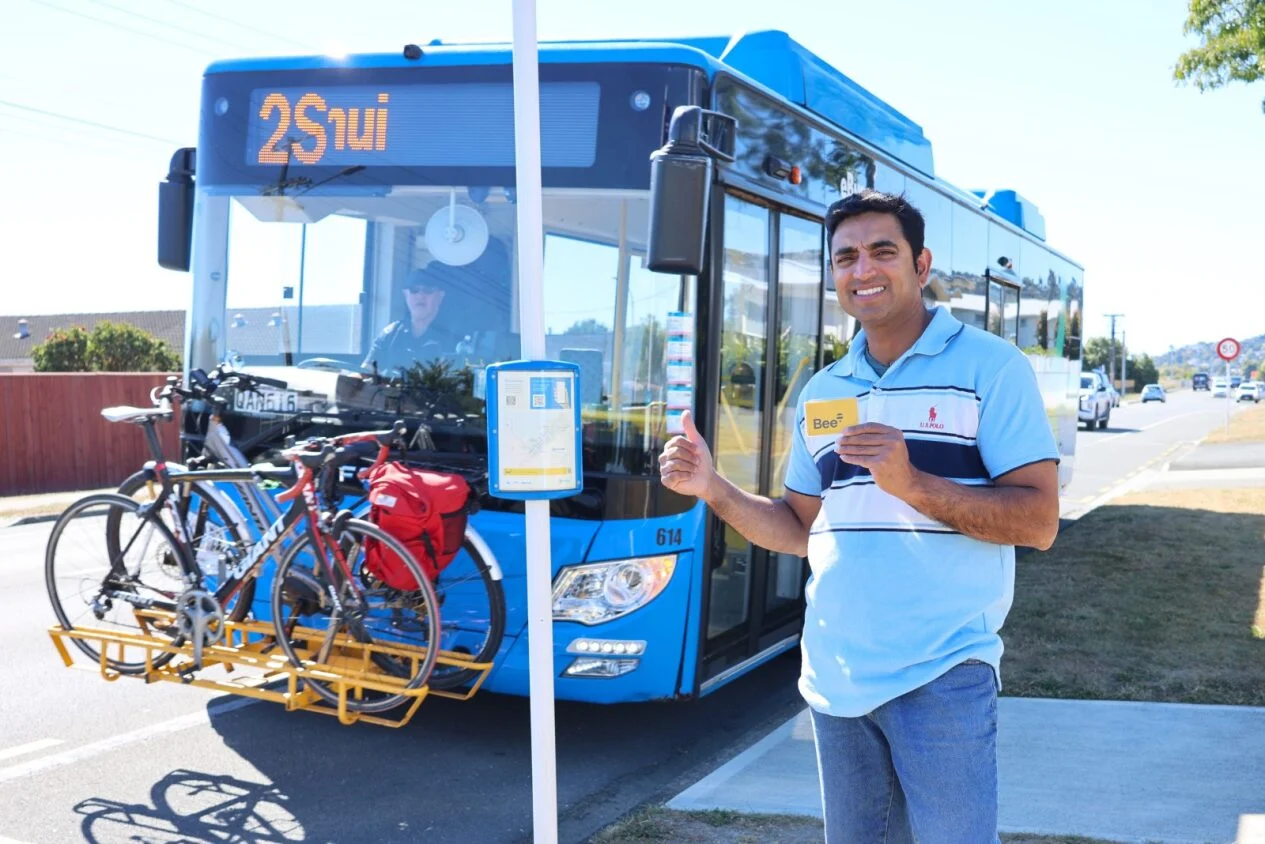
Stoke resident Vivian Coaster has been wanting earlier services for a couple of years, having previously submitted in support of the services.
He often takes the bus to his Nelson workplace, but it does not get him there as early as he would like, a sentiment he says is shared by many of the early-morning bus passengers.
“That’s really great news for everyone who starts early… It’s really nice that the council heard what the people want, and it’s a win-win, I think, for everyone.”
Once the earlier services are implemented, Vivian expects to catch the bus more often.
“I always felt like using public services is the best mode of transport and should be used,” he says.
“There is a lot of savings as well, using public transport, particularly now as everyone feels the bite when you go to the fuel station.”
The fuel crisis and the potential increase in bus patronage was highlighted by public transport proponents Mark Rosser and Nelsust’s Peter Olorenshaw during Thursday’s committee meeting.
Peter specifically said, dropping earlier morning services when the NBus transitioned to the expanded eBus service had been a “mistake”.
“In the current affordability crisis and fuel crisis, [earlier services] just make buses more viable for more people,” he says.
The fuel crisis drove elected members to seek the implementation of the earlier services “as soon as possible”, rather than from 1 July as had been the original plan.
“The level of pressure that our public is experiencing from the petrol prices, it would be good to get it started earlier,” Nelson Mayor Nick Smith said.
Council staff indicated that it would take “weeks” to implement the earlier routes and could not be completed by 1 April.
Running the earlier services will cost an extra $78,000 a year but can be met within existing budgets.
The additions were also expected to drop the current subsidy per passenger from $5.09 for Route 1 and $5.60 for Route 2 down to $4.87 and $5.42 respectively.
But while earlier services will soon be on their way, so too will be higher fares.
The committee on Thursday also agreed to increase fares for passengers using the BeeCard by the Public Transport Cost Indices from 1 July, provided the increase is below 4%.
The indices are updated quarterly, and if the next increase was greater than 4%, the committee might seek to meet again ahead of the fare increase implementation date to figure out a way forward.
“In the middle of a cost-of-living crisis, when families are under even more pressure with [cost] increases, if the PTCI moves by 6 or 7%, I am going to be sweating,” Nick indicated.
The fare for BeeCard users will remain lower than cash fares, which isn’t being increased because of the difficulties caused by small denominations of cash change.
Currently, travelling within one zone costs $2.16 with the BeeCard or $3.00 for cash fares.
About one third of passengers pay with cash.