
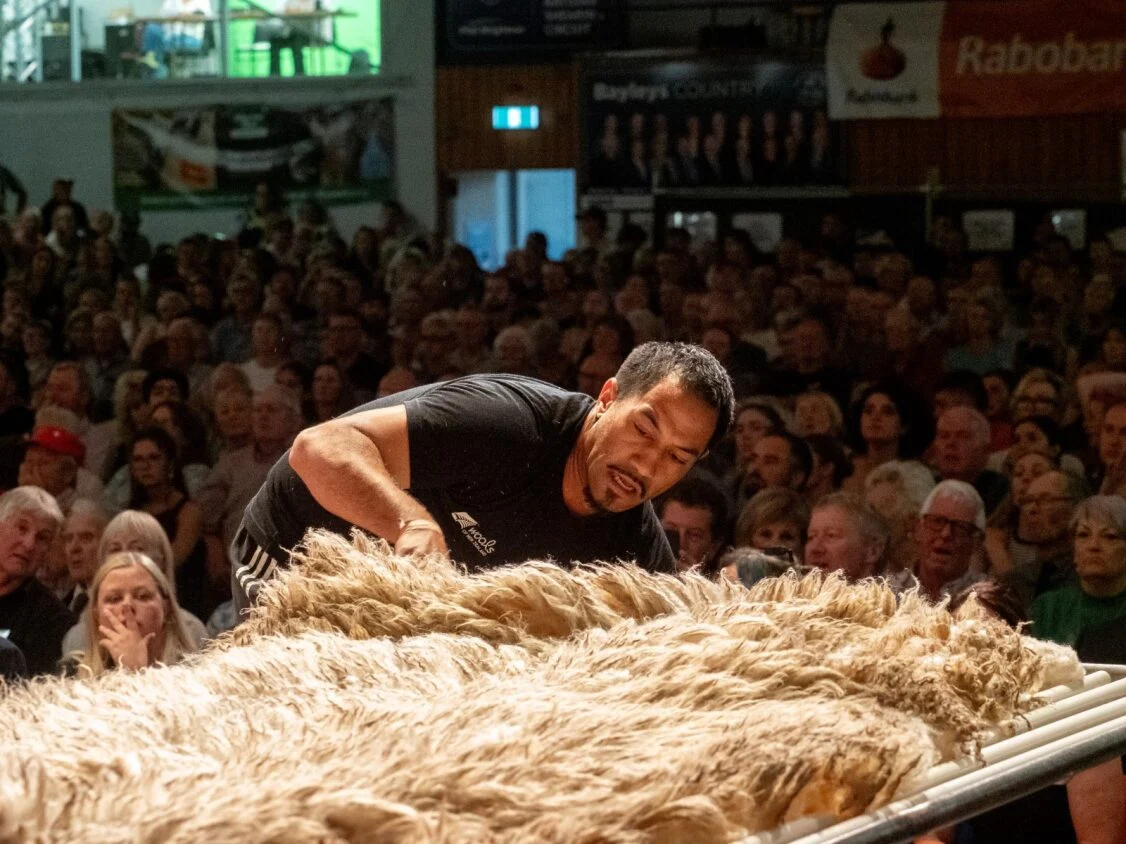
A bit more than a year ago, Motueka man Joel Henare was living in his car under a tree and could not imagine ever regaining his title as a champion wool handler.
Now he is a 12-time Golden Shears open woolhandling winner and a three-time world champion, crediting the local Salvation Army with helping him get his life back on track.
Earlier this month, Joel completed a rare team and individual double at the Golden Shears World Shearing and Woolhandling Championships in Masterton.
New Zealand claimed an unprecedented five wins from six events at the championships, beating competitors from 19 countries.
“It’s all the greatest people of the shearing industry all around the world, the ones that are not only skilled but passionate about it,” Joel says.
Originally from Gisborne, Joel grew up in Cromwell, and a shift north to support a family member brought him to Motueka six years ago.
Wool has always been part of his life. His mother worked in wool sheds and his great-grandparents were shearing contractors.
“Pretty much all the way back to the first sheep that came here with Cook, someone in my family’s been doing shearing.”
Joel has been volunteering at the Motueka Salvation Army Family Store for about a year and can be found there three times a week.
“Prior to that, I came out of homelessness. Salvation Army were right there behind me to help me to get my foot into emergency accommodation.”
The organisation then helped him into a Kāinga Ora home in Motueka with his children.
“That’s when things started getting better for me. In my living situation, my family situation, I’ve always had the skill, but recently, well, with the circumstances that I’ve been faced with, Salvation Army have been there for me and my family,” he says.
“That was just great, because I just took a whole relief off and I was able to be on the circuit.”
This year, Joel travelled the length of the country on a gruelling New Zealand circuit, competing for one of only two spots to represent the country at the world championships.
To win the Golden Shears title, he had to beat 79 other competitors across 20 heats.
To become world champion, he first had to finish among the top two in New Zealand, then compete against the best woolhandlers in the world.
Joel says the value of wool comes down to quality, with fibre thickness, colour and contamination all considered in split-second decisions.
“It’s just about being onto it, being well prepared, and well organised,” he says.
“I just put it down to just lots of practice, years and years of experience of working with those types of wool.
“There’ll be certain characteristics that I’m looking for within that type of fibre that’ll tell me exactly what it is, and I’ll know that doesn’t belong there, it doesn’t match. If in doubt, take it out. It’s been one of the oldest sayings.
“I’m lucky that I’ve made all the mistakes earlier on, a long time ago.”
White fleece is especially valuable, Joel says, because it can be dyed many colours, while yellowed wool is far more limited.
“Water does that, colours the fleece, makes it go yellow. So then it limits the opportunities or options you can do with that wool.”
He explains that different parts of the sheep produce different types of fibre.
“The back end of the sheep is normally the strongest part, strongest in the way of micron, the fibre diameter. But the front half of the sheep is the finest part.
“So that’s where you’ll get nice, softer wools, rather than rougher, coarser wools.”
Those differences determine where the wool ends up.
“Some could be made for wearing next to your skin, and the other end for walking on for carpet wool.
“So it’s knowing the difference between the whole body of the sheep and the structure of the animal to be able to sort it into where it’s going to end up. Will you be walking on the wool or wearing it.”
Despite his success, Joel says being world champion does not guarantee a place at the next championships.
If he chooses to compete again, he will need to return to the New Zealand circuit for selection. In the meantime, he has put his name forward to become a judge.
“I’ve been competing for 23 years now.”
Joel hopes his journey sends a message to his three children, who watched the championships online.
“It was just to show them that just because I’m a volunteer, and it doesn’t look like dad does so much, when you get those opportunities you get up, you take it full on and aim high.
“You never know, as long as you try, you might just get there.
“That’s dad’s little thing to them, so hopefully in life, they can look back and go, ‘well, you know, all you have to do is try’.”
