
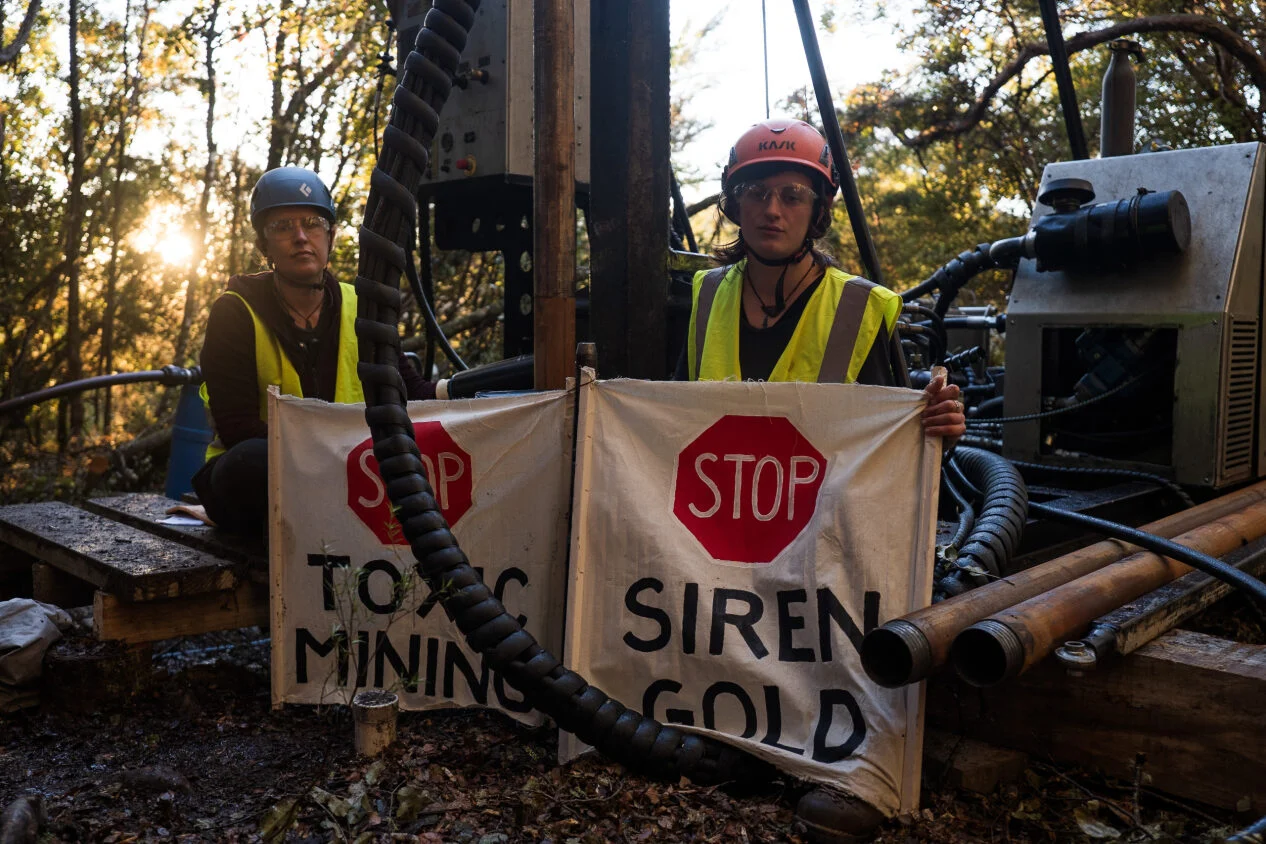
Opposition in Golden Bay to a controversial gold mine at Sams Creek has flared over the weekend after several activists briefly occupied a drilling site.
Freelance documentary filmmaker Timothy Firkin announced on Monday afternoon that he and several Golden Bay residents had scaled the remote site in protest of the potential gold mine.
On Friday evening, the group trekked into the bush from the Cobb Valley before they initiated their direct action before dawn on Saturday.
Two women chained themselves to one of the drills while another group unfurled a banner that read ‘Stop Toxic Mining’ on the roof of a field office.
The activists have since left the site, though they speculate that the banner remains in place.
Siren Gold is currently drilling at Sams Creek to gather a more comprehensive picture of the gold deposits in the area.
The Australian company lodged an application for a mining permit last year.
But the potential mine has proved contentious in Golden Bay, largely due to the environmental risk posed by the toxic arsenic tailings produced during the gold mining process.
The mine would be located above the porous marble aquifer that gives much of the Tākaka area its water and feeds the tapu Te Waikoropupū Springs – some of the clearest water in the world.
“I think this is a very stupid gamble for something that is very important to a lot of people,” one activist said.
“The fallout would be huge if that arsenic gets out of that rock, it doesn’t go back in,” said another.
Firkin said the group of “normal, everyday community members” felt compelled to take the non-violent direct action because of the lack of community engagement.
“Siren Gold is pushing ahead without genuine community consent, and the residents here have pretty much had enough at being silenced,” he said.
“We think it’s absolutely ridiculous that they’re considering doing this in a place that should be part of the Kahurangi National Park.”
He added that the group acknowledged the legal risk and were “willing to put themselves on the line”.
Firkin said the action was “completely independent” of local groups opposed to the mine.
Save Our Springs coordinator Kevin Moran said the group had previously organised training sessions for non-violent direct action but had not known about the plan.
“The community just got together and organized this,” he said.
“It’s amazing; it’s a total surprise.”
While not every person in Golden Bay was opposed to the mine, he said the majority “don’t want it”, and there was a subset who appeared to be prepared to take direct action.
He thought Siren Gold should “go away”.
“The longer they stay here, the more that this is likely to happen.”
Sams Creek Collective member Axel Downard-Wilke said the group was not involved.
He didn’t know enough about the incident to say whether it was appropriate but said that any direct action taken should be non-violent.
“Non-violent action is good… For example, vandalism [is] totally unacceptable.”
Downard-Wilke, also a member of the Golden Bay Community Board, said many who were informed about the mine were concerned about storing the tailings in a dam.
A dam failure would jeopardise the entire Tākaka area, with the community and industry taking their water from the aquifers below the potential mine area, he said.
“There’s short-term profit, that goes to Australia mostly, and the long-term consequences, they will stay locally.”
Siren Gold has been approached for comment.
Former chief executive, Victor Rajasooriar, has previously told Local Democracy Reporting that he understood community frustrations with the limited information.
“However, until the experts have completed the detailed investigations, technical and environmental studies, we will not have sufficient certainty with respect to the proposed final mine design to allow an informed community consultation process.”
The storage of tailings would also be a key aspect of the detailed site investigation.
“We are very conscious of the understandable sensitivities with respect to the environmental impact of a potential mining operation… and will take these matters into consideration as investigations progress.”
A mining permit would need to be gained before other approvals, such as resource consents, could be lodged.
John Buick-Constable, national manager petroleum, minerals, and offshore renewable energy at the Ministry of Business, Innovation, and Employment said the minerals mining permit was currently under assessment.
“There are no statutory timeframes for assessing or deciding a permit application. Each permit application brings its own complexities, and there also may be times when more information is required to progress an application.”