
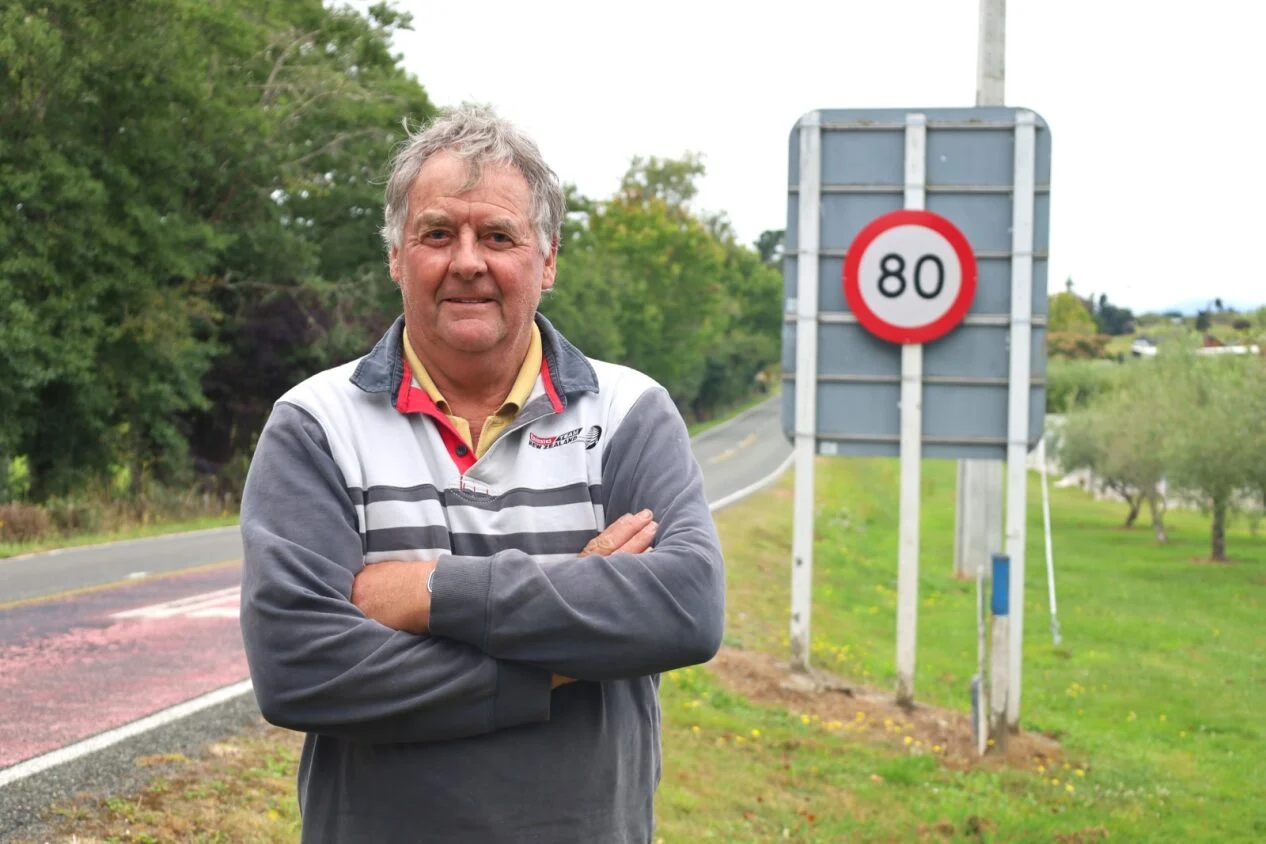
The number of speeding tickets issued on Tasman’s Moutere Highway has skyrocketed by more than 1700%.
The high-risk rural road one of several that had its speed limit lowered by Tasman District Council last year as it conducted a comprehensive review of local speed limits.
Most of the road had been 100km/h but it was dropped to 80km/h in August 2025.
From 1 September 2024 to 28 February 2025, police recorded 47 speeding infringements on the Moutere Highway.
In that same six-month period a year later, after the speed limit had been lowered, 848 speed infringements were recorded – an increase of 1704%.
The total face value of the fines issued also leaped from $4480 to $72,590.
Long-time Upper Moutere resident Hadyn Ellis said the increase was “unbelievable” and showed that people were not happy with the lower speed limit.
Ellis had previously started a petition to increase the speed limit on the route to 90km/h – a “compromise” between those who want the road at 80km/h and those who want 100km/h.
“[The increase in tickets] says to me that the 90, what we’re proposing, would be a more fair and realistic speed, because people feel as though they’re being held up.”
Since Ellis’ petition was reported on in early March, the number of verified signatures on Change.org has climbed from 200 to almost 1800.
He was not sure how many signatories were from out of the region, though he speculated that “at least half” were locals.
“I’ve just been amazed; it’s just kept on climbing. I’m really surprised it’s got as high as it is.”
Chair of the Automobile Association’s Nelson District Council, Kyle Lightfoot, said the ticketing increase was “astounding”.
He now used cruise control when driving the route because it was easy for drivers’ speed to exceed the new, lower limit.
“However, we should all try to abide by the law, and the law is an 80km/h speed limit, at the moment,” he said.
“But it’s unfortunate that it is such a huge increase.”
He highlighted that speed limit signs were regularly repeated – national guidance was for 2.7km intervals between the signs on 80km/h roads.
“It’s not through lack of telling people that the speed limit is 80km/h, because it’s blatantly there in front of them, so whether it’s just old habits die hard, I don’t know.”
In its submission to the council on the speed limit changes, the local AA branch supported the 80km/h limit on the “quite dangerous” stretch between the villages of Upper and Lower Moutere but had sought 100km/h to be largely retained between Upper Moutere and State Highway 60.
Lightfoot said the AA was aware of Ellis’ petition, but he was not sure if increasing the speed limit to 90km/h would reduce the number of speeding tickets.
Mike Kininmonth is the only incumbent Moutere-Waimea councillor who also sat on the council last term, when it voted on the speed limit changes.
He said he was “surprised” by the “huge” increase in speeding tickets.
“I’m disappointed that there’s so many drivers exceeding the speed limit. It’s been well signposted, it’s been well advertised, it has been done for a reason: to reduce accidents and harm.”
He was not convinced that the speed limit should be increased again and would want to see more evidence, such as updated crash statistics and next year’s ticket data.
“We get petitions every now and again, and a lot of it is emotional. I just need to see the evidence before I change my mind,” he said.
“Speeding is going to get you somewhere a few seconds earlier than you normally would have, but would you have been safe?”
Tasman road policing manager, Inspector Marty Tunley, has said that police did not patrol roads more than usual after their speed limits were reduced.
“We understand it takes time for motorists to adapt, or become aware of these changes, meaning we often take an educational approach to areas where the speed limit has recently changed.”