
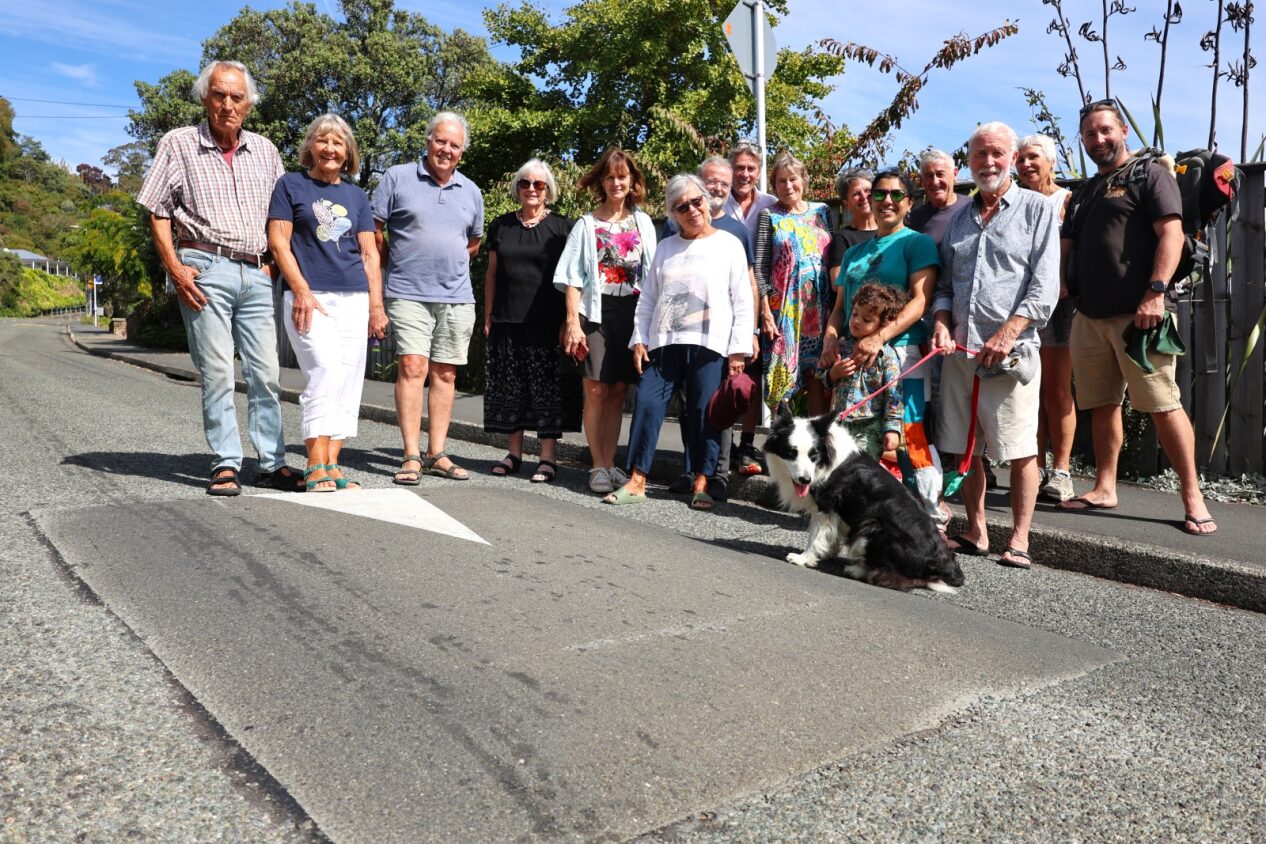
As some residents celebrate the removal of speed bumps from the Tāhunanui Hills, others worry for the future of their neighbourhood.
At the beginning of March, Nelson City Council voted to remove speed cushions from Moana and Bisley Avenues.
They were installed as a trial to reduce driver speeds, crashes, and through-traffic after residents complained about traffic conditions.
Speed cushions only occupy part of a traffic lane, allowing larger vehicles to pass largely unaffected, unlike speed humps which stretch across the entire lane.
The cushions worked, with data showing that they slowed most drivers by 5–12km/h, saw traffic volumes fall by about a quarter, and reduced crash frequency in the trial area.
However, they were unpopular with many local residents, with council surveys showing almost two-thirds opposition and more people reporting feeling unsafe.
Residents opposing the cushions celebrated their removal after the vibrations caused by buses driving over the bump were likened to jackhammers.
But for local supporters of the speed cushions, the memory of the roads before their installation is not a pleasant one.
Pauline Puklowski says she frequently responded to crashes outside her property.
“I used to… think I needed an emergency kit in the lounge so that if something happened, I could quickly grab [it]… and go. That might sound sensational, but that was how I felt.”
The “clatter” of some vehicles travelling over the cushions was a non-issue for her.
“It’s not enough to upset me, whereas the volume of traffic and risk of accident upset me.”
Roger Sanson adds that pedestrians frequently cross the road along the route because the footpath is only on one side.
“It was really a case of the quick or the dead. I’ve seen some very, very close calls, and I’ve had some myself, because of the speed of the traffic… having the slower speed has made an immense difference to that.”
Simon Allison remembers broken nights caused by speeding racers.
“Hour after hour, all you could hear was the screaming hoons coming up and down the hill… Since the speed bumps have gone in, we’ve never heard one.”
They are concerned that the roads will return the earlier status quo once the cushions disappear.
“What we don’t want to do, after the speed bumps are removed, is to have to go and scrape people off the pavement,” says resident Steve Green.
“The council’s decision making has simply ignored the safety issues involved.”
Many of the residents who want the cushions kept acknowledge that some specific properties might be impacted by vibrations of buses travelling over the bumps.
However, they are concerned by a lack of potential compromises, such as relocating or removing just the problem cushions, or modifying their shape to soften the descending sides so it was less of a jolt for vehicles dismounting them.
Shona Nelson highlights that people’s perception of feeling more unsafe did not match with the reality of proven reduction in the number of crashes.
“Reconsider and look at the data,” she urged the council.
Council staff had recommended to elected members that the speed cushions remain, saying that they were unable to identify suitable alternative options to address the traffic concerns.
The New Zealand Transport Agency has sole responsibility for safety cameras, and currently there are no fixed safety cameras across the entire Top of the South.
The agency’s criteria for installing speed cameras typically requires a history of serious and fatal crashes, high traffic volumes and speeds, and tends to exclude local streets.
Head of driving regulation, Chris Rodley, confirmed that, based on an initial assessment, neither Moana nor Bisley Avenues meet NZTA’s current consideration for fixed safety cameras
“We continue to look at future expansion opportunities in line with road safety objectives. But, at this stage, no sites are confirmed/planned for the region.”
National rules also prevent reducing the speed limit along the route.
“Because no suitable replacement traffic calming devices have been identified, no funding has been set aside for that purpose through the Annual Plan process,” confirmed Nelson City Council’s executive director delivery Alec Louverdis.
He added that smoothing speed cushions would be an uncommon approach as they were specifically designed to only affect a single vehicle axle at a time, unlike speed tables which were wide enough to support both axles at once.
The cushions will be uninstalled at a $70,000 during the next resealing season, which begins in October. Their installation cost was about $73,500.