
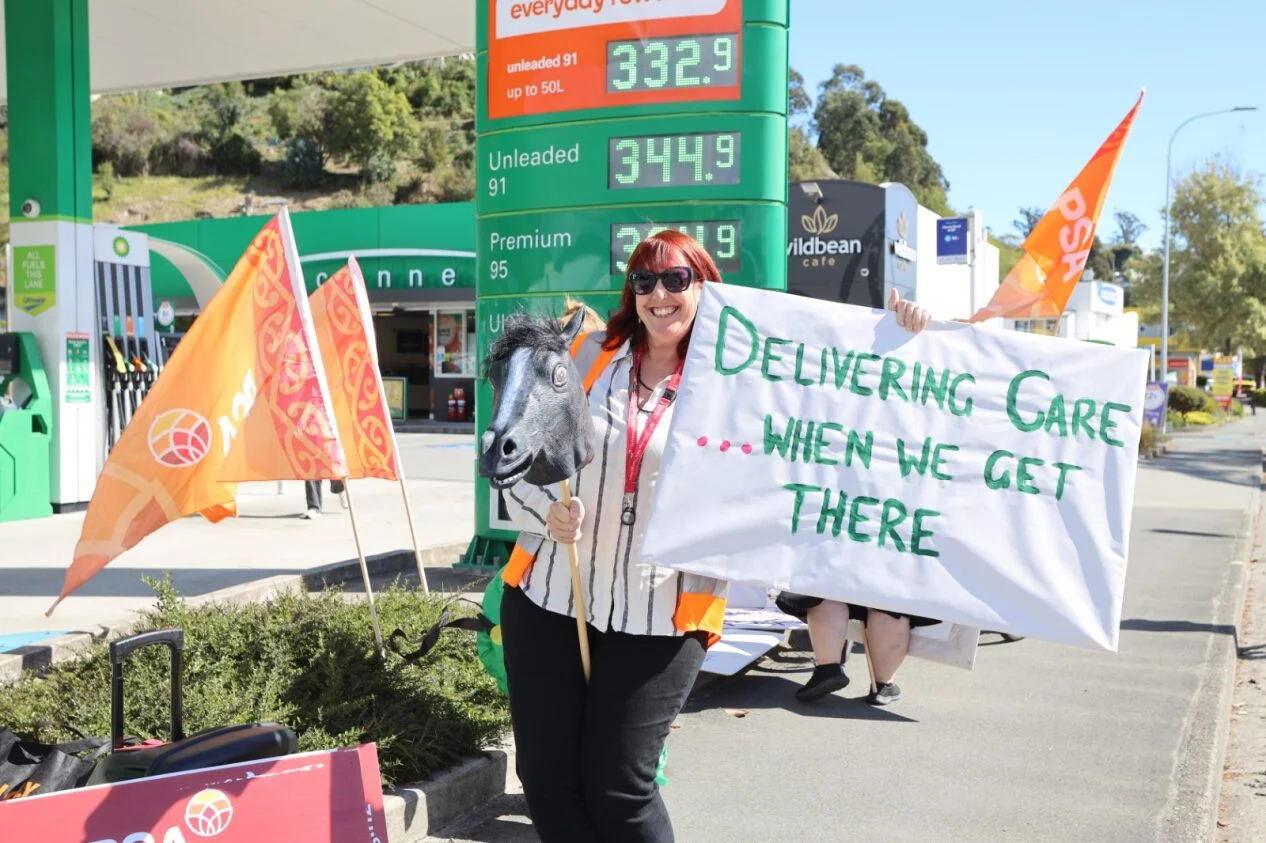
A temporary boost to mileage payments for home support workers is being welcomed locally, but workers say it falls well short of what is needed as fuel costs continue to bite.
Last Wednesday, local home support workers staged an action outside BP Haven Rd, calling for a complete overhaul of how in-between travel is calculated.
Health Minister Simeon Brown announced on Thursday that home and community support workers will receive a temporary 30 percent increase to their mileage rates to help offset rising fuel costs.
The increase lifts the rate from 63.5 cents to 82.5 cents per kilometre for travel between clients. It will remain in place for up to 12 months, or until the price of 91 octane petrol drops below $3 a litre for four consecutive weeks.
“This is a positive step forward for home support workers who have been subsidising our public health system with their own vehicles and their own wallets for too long,” Public Service Association Te Pukenga Here Tikanga Mahi national secretary Fleur Fitzsimons says.
“This is a win for these low paid workers doing essential life-preserving work in clients’ homes all over New Zealand. They campaigned loud and strong for an increase, but this must be just the beginning of the support they need.”
Support workers receive a set payment of $2.35 to travel between clients up to 15km apart, which has increased to $3.05 under the temporary change. The allowance was designed to average out at 63.5 cents per kilometre, based on an assumed average distance of 3.7km between clients.
However, the calculation means workers covering longer distances remain significantly out of pocket. A worker driving the full 15km receives just 20 cents per kilometre under the increase, while those travelling shorter distances can be paid up to $1.52 per kilometre for a 2km trip.
Current Inland Revenue reimbursement rates for business vehicles sit at $1.17 per kilometre for petrol vehicles and $1.26 per kilometre for diesel vehicles.
Local home support worker Laura Lusk, who has swapped her car for a moped due to fuel costs, says she cannot understand why workers are not paid a flat rate per kilometre.
She says covering rural areas such as Māpua, Kaiteriteri and the Moutere often means travelling 14km between clients, leaving workers effectively paying to do their jobs.
“They know where the clients live, so they should be able to easily work out the travel distance and pay per kilometre,” Laura says.
“They should bring us up to the same rate as IRD, which is what anyone who is self-employed gets. They’ve brought in all these computer systems, why can’t they calculate the travel for us?”
Local support worker Carena Scott points out that the increase is still not near what IRD sets as a mileage allowance for vehicle reimbursements.
“It’s a start but it needs addressing still. Again, it’s women who are disadvantaged and ripped off.”
