
The dogs serving our community
We all know dogs are experts at making us smile but some of our local four-legged legends are doing far more than chasing tennis balls and perfecting the art of the afternoon nap.
While most pups are clocking up couch time, a select few are clocking in for duty. Around our community, these clever canines head off to “work” in classrooms, hospitals and rest homes, out on search and rescue missions, and even helping track down criminals. From soothing nervous young readers to standing steady beside their handlers in high-pressure moments, they bring more than wagging tails and hopeful eyes. They deliver comfort, courage and connection in abundance.
Adrienne Matthews introduces four local working dogs and the humans proudly holding the lead.
Bell the reading buddy
When Helen Macdonald retired from her career as a physiotherapist, she knew two things: she wanted to give back to the community, and her clever young dog needed a job.
Belle, a striking black standard poodle, is not the sort of dog content with a quiet stroll and a nap on the couch. Bright, energetic and highly intuitive, she thrives on stimulation, so Helen began exploring pet therapy and soon found her way to Canine Friends Pet Therapy, a national organisation that supports trained dogs and handlers working in the community. “I very deliberately set about preparing her,” Helen explains.
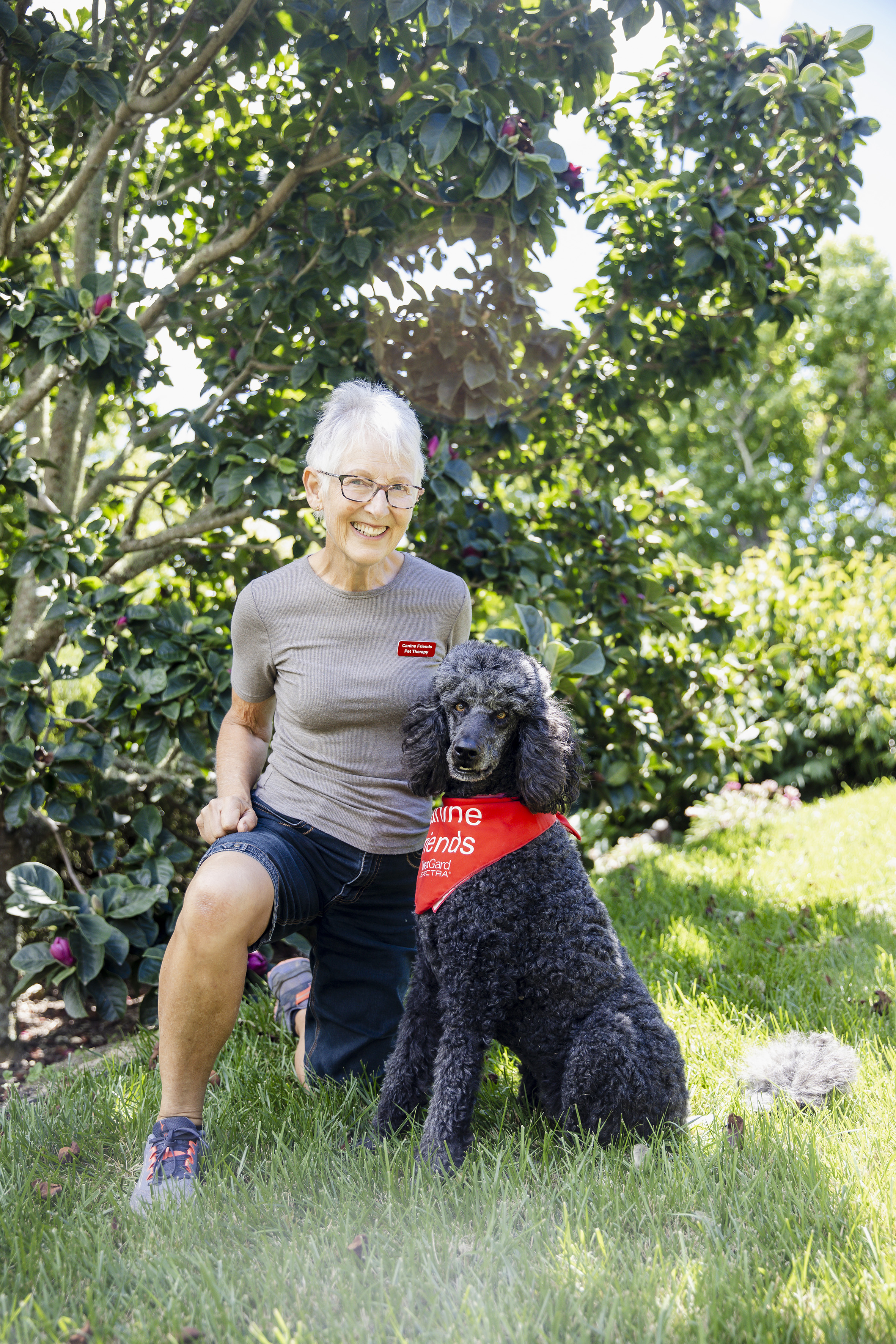
From puppyhood, Belle attended dog training club, worked through obedience and dog sports, and completed her Canine Good Citizen qualifications. The goal was simple: to ensure she was calm, confident and well-adjusted enough to step into environments where people might be vulnerable.
Today, Belle is best known at a local primary school, where she serves as a reading therapy dog for a year two class. Once a week, selected children spend one-on-one time reading aloud to her. The teacher identifies students who may lack confidence, be on the neurodivergent spectrum, or simply need extra encouragement with their literacy. “The children read to Belle, not to me,” Helen says, “and she is completely non-judgmental.”
For some, the year begins tentatively. A few are unsure about dogs, sitting stiffly at first, but Belle has a gift. Naturally calm and endlessly patient, she settles beside them, soaking up pats and offering the occasional gentle nudge. Over time, hesitant hands become confident ones. Children who once shrank back begin asking, “Can I lead her? Can I cuddle her?”
Helen sees the transformation not only in their comfort around Belle but in their reading. “The progress over the year is phenomenal,” she says. “By the end, I’m thinking, wow, look how far you’ve come.”
Belle, now five, seems to instinctively understand her role. Helen recalls her first therapy visit to a rest home at just two years old. “She was a bouncy adolescent outside. But the moment we walked through those doors, her whole demeanour changed. She just knew.”
To become Canine Friends Pet Therapy team members, both handler and dog undergo assessment to ensure they are suited to public and sensitive environments. For Helen, the structure and support of the organisation are reassuring.
For the children who curl up with a book and a glossy black poodle each week, Belle isn’t just a therapy dog, she’s a friend, one who listens carefully, never interrupts, and always believes they can do it.
Partners on the frontline
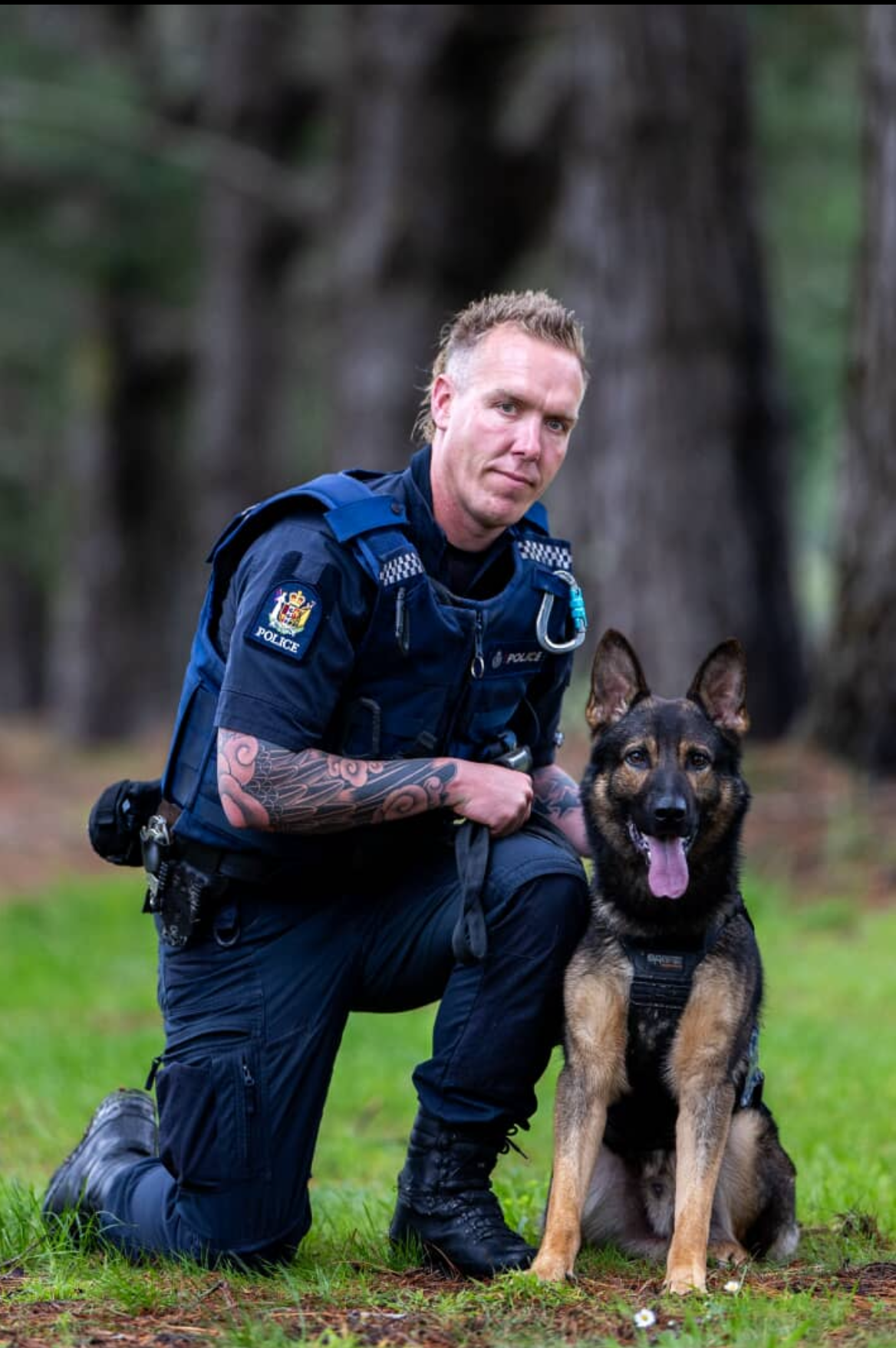
At just 22 months old, Banksy is already proving himself as a valuable member of the Tasman police team. The energetic German Shepherd works alongside Senior Constable Dan Waluszewski.
Dan’s primary role within the police is as a dog handler and Banksy is his fourth dog. He works alongside an AOS tactical operator, forming a specialised tactical dog team trained to respond in high-risk situations. While the uniform may look familiar, the work is anything but ordinary. Police dogs are bred and trained specifically for frontline duties at the national training centre (DTC) in Trentham, from which half graduate as fully qualified patrol dogs.
At eight weeks old, the puppies are fostered into districts, where basic training and assessment begins. The qualities required for police dogs are drive, energy, determination, strong nerves and good health. “If they’ve got lots of energy and can go all day like a five-year-old on sugar, that’s what we’re looking for,” Dan says with a smile.
Banksy came to Dan at 11 months old. By then he had begun foundational training, but he was still very much a work in progress. “He doesn’t have a stop button,” Dan laughs. “He just goes and goes.” That relentless drive is exactly what makes a strong patrol dog. From tracking human scent to building searches, police dogs must be versatile and confident across multiple environments.
Training is a team effort. “It takes a village to raise a child, and it takes a team to train a police dog,” Dan explains. Decoys are needed for tracking, bite work and building searches. Hours of repetition build reliability and control. Over time, dog and handler have to graduate from three major courses before qualifying as a patrol dog team.
The trust between handler and dog is something Dan describes as special. “Knowing your dog has your back is a very unique feeling.”
In dangerous situations, that trust is critical. The presence of a barking police dog can often defuse tension immediately. “A lot of the time, our clients behave themselves when the dog starts barking,” he says.
Tasman currently has five operational police dogs, each working with their handler whenever they are on duty. Unlike family pets, these dogs are purpose-bred working animals and are kennelled when off shift, however, Dan makes time for Banksy to simply be a dog, with swims, hill walks and play all part of maintaining balance.
Police dogs typically work for six to eight years, depending on the region and the physical demands placed on them. Daily health checks are part of Dan’s routine to ensure Banksy remains fit for duty. When retirement comes, most handlers adopt their dogs permanently.
For Dan, the role brings immense satisfaction. He recalls tracking and locating an armed offender in the middle of the night with a previous dog, a moment that reinforced the importance of their work. “It’s about keeping the community safe,” he says.
And for Banksy? The excitement is unmistakable. The moment the police vest goes on, and the patrol car door opens, he knows it’s time. He loves his job and in serving alongside Dan, he is already playing a vital role in protecting our community.
A gentle giant with a Hospice heart
On Thursday mornings, if you wander through Kensington Rest Home or the Nelson Tasman Hospice, you might spot what looks like a small pony padding quietly down the corridor. At 80 kilograms, Riot the Leonberger is hard to miss but it’s not his size that people remember, it’s his gentleness.
Riot belongs to Jane Pordon, a retired registered nurse who clearly wasn’t ready for a quiet retirement. She also has a background as a qualified canine hydrotherapist and spent 10 years rehabbing dogs.
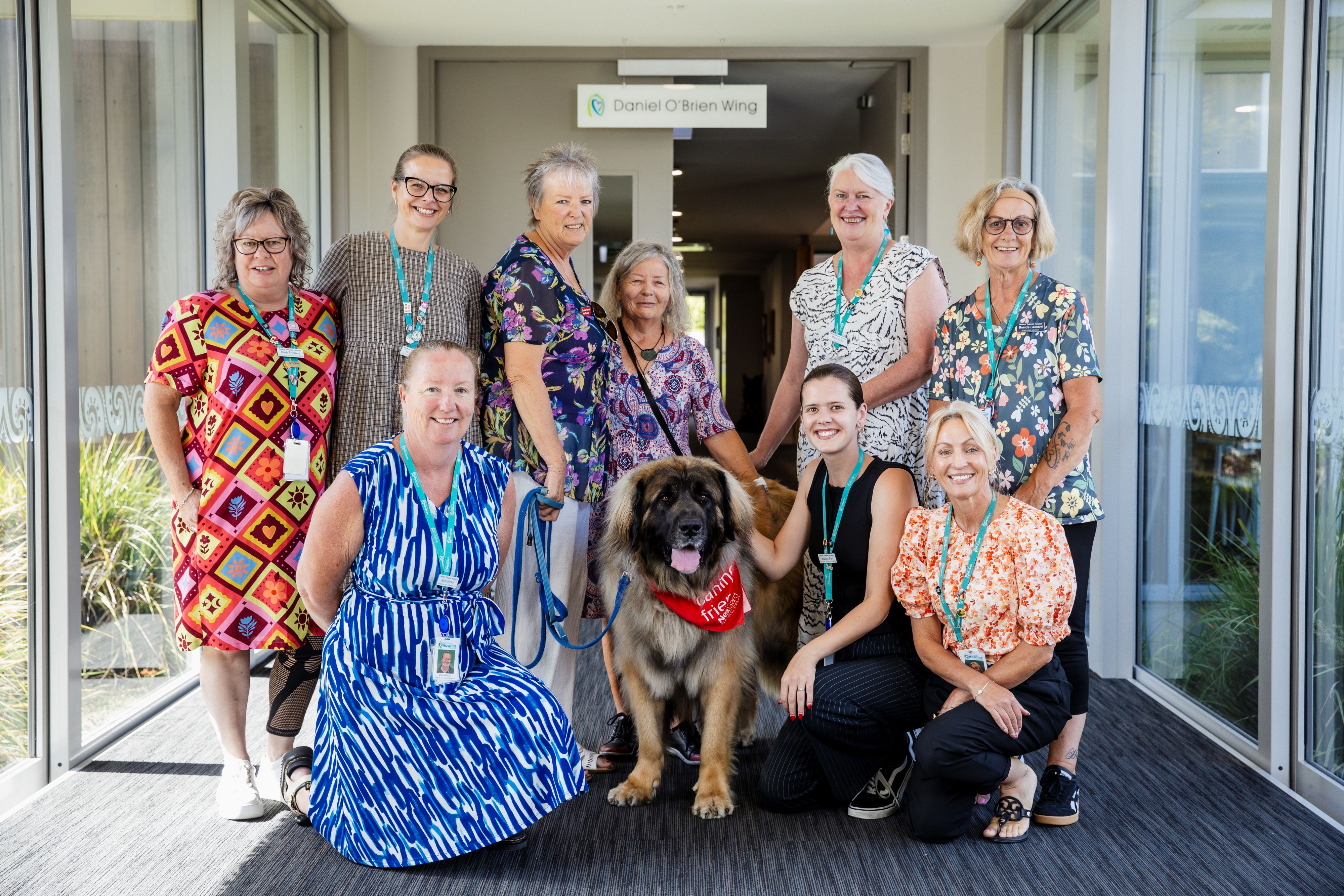
Having previously volunteered with Canine Friends in the North Island alongside her beloved Leonberger Rosie, Jane knew firsthand the difference a calm, intuitive dog could make in healthcare settings. “Rosie just seemed to know,” Jane recalls. “She instinctively understood how long to stay with each patient.”
When Jane looked at Riot one day and thought, ‘You’re such a gentle soul, perhaps we can do something similar,’ the seed was planted. She contacted Canine Friends, arranged an assessment, and Riot passed with flying colours. “He just lay down at their feet,” she laughs. “If we stop talking in the street for more than two minutes, he lies down anyway.”
Now, once a week, the pair visit Kensington first, carefully navigating walking frames and chairs so residents can reach out to pat him. Some are lifelong dog lovers; others simply enjoy the spectacle of such a magnificent animal lowering his great mane-covered head into their lap.
Then they head to the hospice. It’s here that Riot’s presence feels so profound. Jane tells of knocking gently on one patient’s door. The woman was asleep, but her husband invited them in. “He said, ‘She’s asleep,’ and Riot just wandered over.” The husband woke his wife softly. “There’s someone here to see you.” She opened her eyes expecting a person. Instead, Riot’s enormous head was resting beside her.
“The smile that spread across her face was just beautiful,” Jane says. “Even if I get one smile, he’s done his job.”
On another visit, a note on a patient’s door read: No visitors please — unless it’s Riot.
Jane believes dogs belong in every long-term ward. “They make people smile, no matter what.” Riot, a natural “leaner,” happily sidles up to visitors for affection, cuddling up with love.
He is Jane’s fifth Leonberger. She knows their lives can be heartbreakingly short, but she focuses on the present. “You just have to enjoy them while you’ve got them.”
And for the people who meet Riot each Thursday, that joy arrives on four enormous, very gentle paws.
The search and rescue dog who never quits
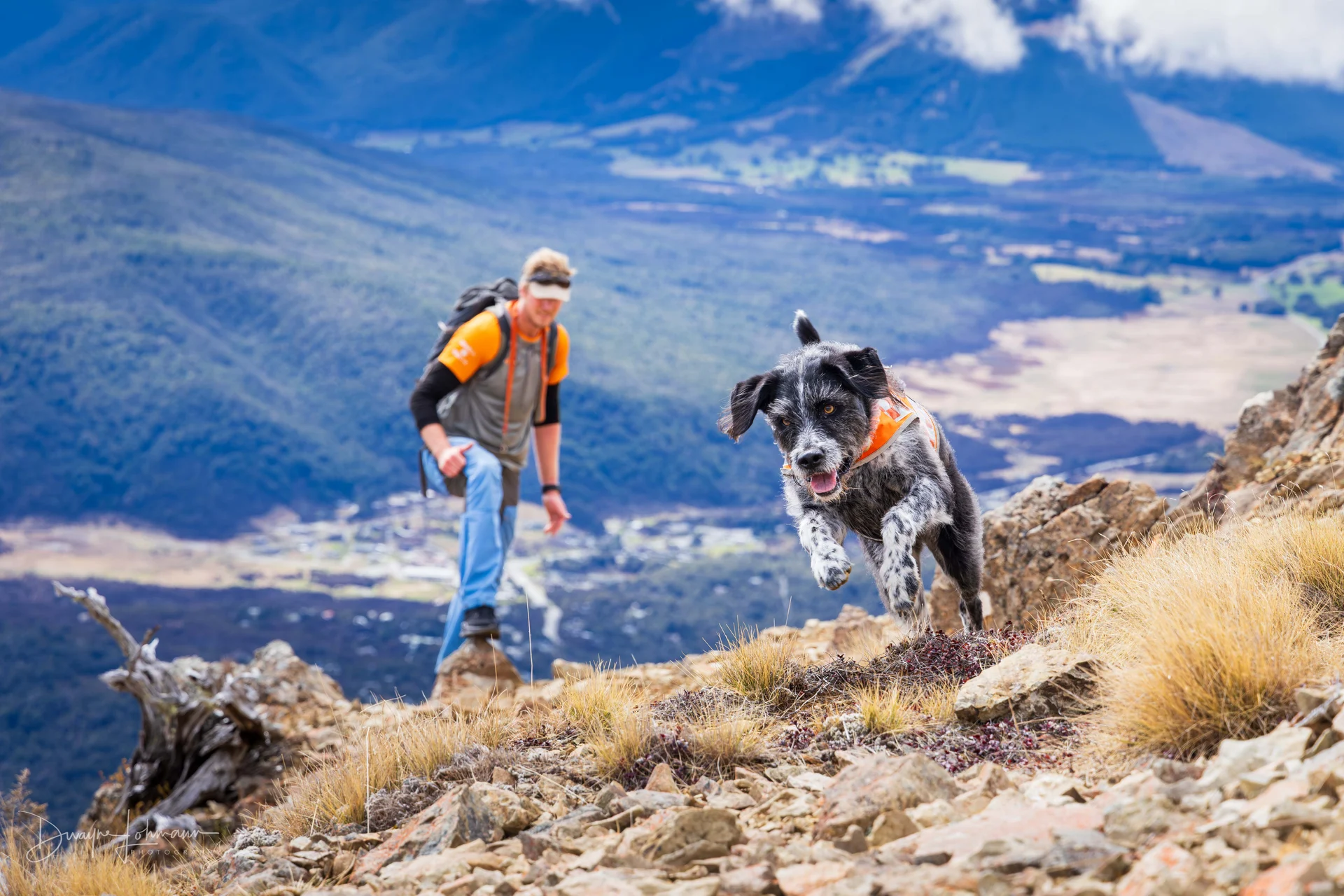
Jonny Fris is a Senior Constable in the local police force but through the years has also been involved in volunteer roles. “In my police job we are incident controllers and coordinate search and rescue operations, but I really wanted to stay active on the ground and build genuine rapport with the volunteer teams,” he explains.
“My wife Jenni and I have been in volunteer Urban Search and Rescue teams, and we became keen to do some sort of work with a service dog,” he says. “I was inspired by the sight of a dog working when I was at a training camp in Invercargill.”
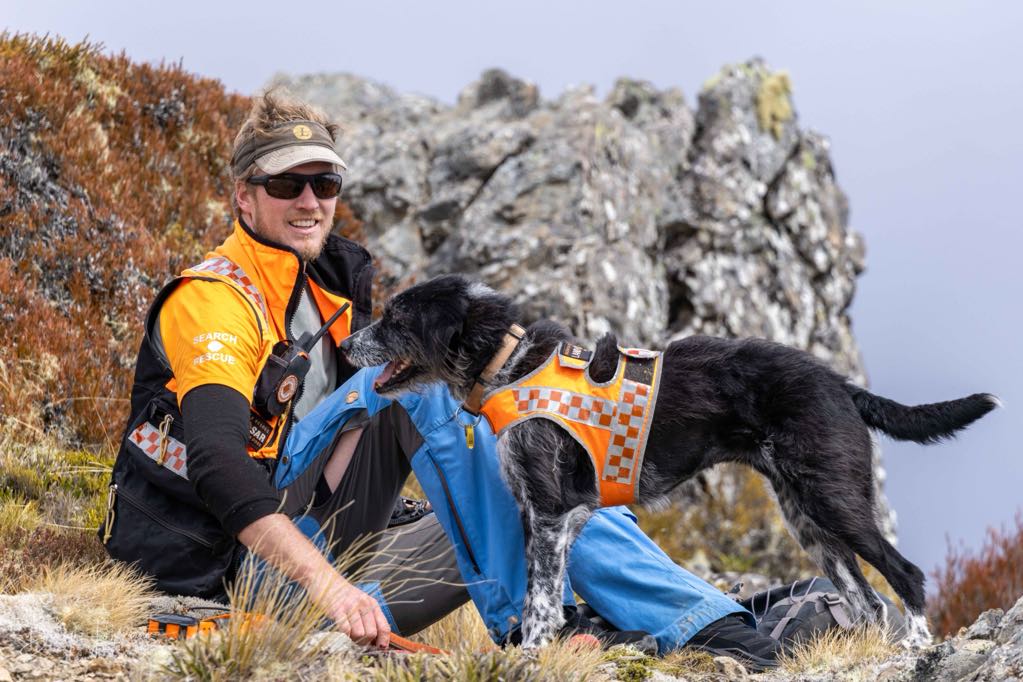
Enter Pixel, a high-drive mix of German shorthaired pointer, bearded collie and heading dog.
“Pixel came from hunting lines and was bred to work. The idea was simple: she had to fit our adventurous lifestyle first and foremost which included biking, kayaking, paddleboarding and trail running. If she failed search and rescue, she still had to succeed as a family dog,” says Jonny.
While his paid job in the police force involved helping coordinate searches, he trained Pixel in his own time as a volunteer, and during police operations would continue to work as a police officer but deploy with Pixel.”
“I wanted to understand firsthand what it meant to be the one pushing through bush, climbing ridgelines and covering valleys and to build those relationships and skills on the ground that are needed when you’re doing that sort of work,” he explains.
Training was relentless, including three or four sessions a week. It often involved persuading friends to hike into remote bush and hide. “People gave up a lot of time sitting in the rain or snow waiting for us,” he says. “You can’t train a search dog without a community.”
Sometimes the pair would commandeer international tourists who they came across in the wilderness. “I would ask them to go off and hide so Pixel could locate them. They loved it,” he laughs.
Pixel didn’t just succeed as a family dog; she excelled at her search and rescue role as well.
Area search dogs work off lead, sometimes ranging 100 to 500 metres away, sweeping large tracts of land. Pixel would run up and down hillsides, drop into gullies and follow airborne scent. If she located a person, she would sit and bark until Jonny reached her, even if that meant holding position for ten minutes or more.
“She absolutely loved it,” Jonny says. “For her, it’s one big game. You jingle her collar and she’s fizzing.”
Many searches involved missing or overdue trampers. Jonny describes her as unstoppable once she locked onto scent. “She was like a little freight train who would crash through gorse or over rough terrain without hesitation. On one occasion, after falling several metres and injuring her leg during a demonstration, she disappeared, only to be heard minutes later barking triumphantly. Three-legged and bleeding, she had still found her target.”
That drive came at a cost. After a decade of service Jonny made the decision to retire her at ten years old.
“She’d given everything,” he says simply. “I wanted her to enjoy life while she still could.”
Now nearly twelve, Pixel still joins him on trail runs and backcountry adventures, just without the search vest. Over the years she has visited schools, marched in parades and helped raise funds, inspiring others to volunteer.
“It’s never just you,” Jonny reflects. “It’s the people who hide for training, the volunteers who drop everything to help someone else. Pixel just allowed me to be part of that in a really meaningful way.”
