
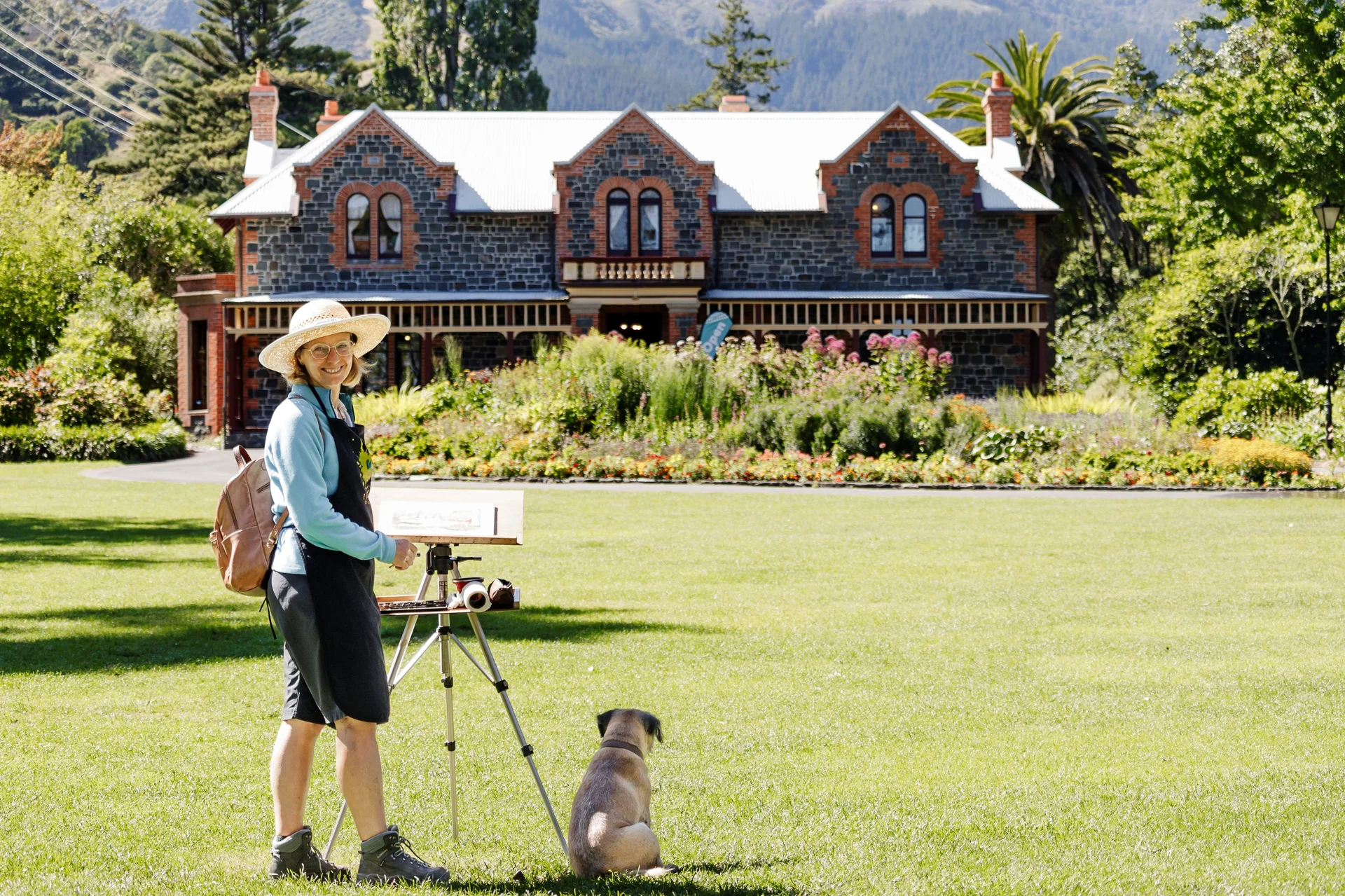
Painting outdoors is about more than what ends up on the canvas. For the Plein Air Painting Nelson Tasman group, it’s a mindful practice rooted in place, light and shared experience.
Words: Catherine Milford
It’s a beautiful day at Isel Park. The flowers are a riot of colour and texture and the tuī and bellbirds are in full song, while leaves gently rustle on swaying branches in the light breeze.
Dotted around the grounds of the heritage house, several people are painting – some sitting with a sketchbook on their knee, others painting on canvas on an easel, but all deeply engrossed in what they are doing. Some are capturing the English-style brick house; others have chosen to portray a particular flower or tree. Celebrated local marine artist Paul Deacon is painting the white dovecote to add to his travelling painting journal, while long-time plein air painting group member Barbara Doig is trying a more abstract style that’s different from her usual detailed close-ups of flowers and botanicals. This is the Plein Air Painting Nelson Tasman group.
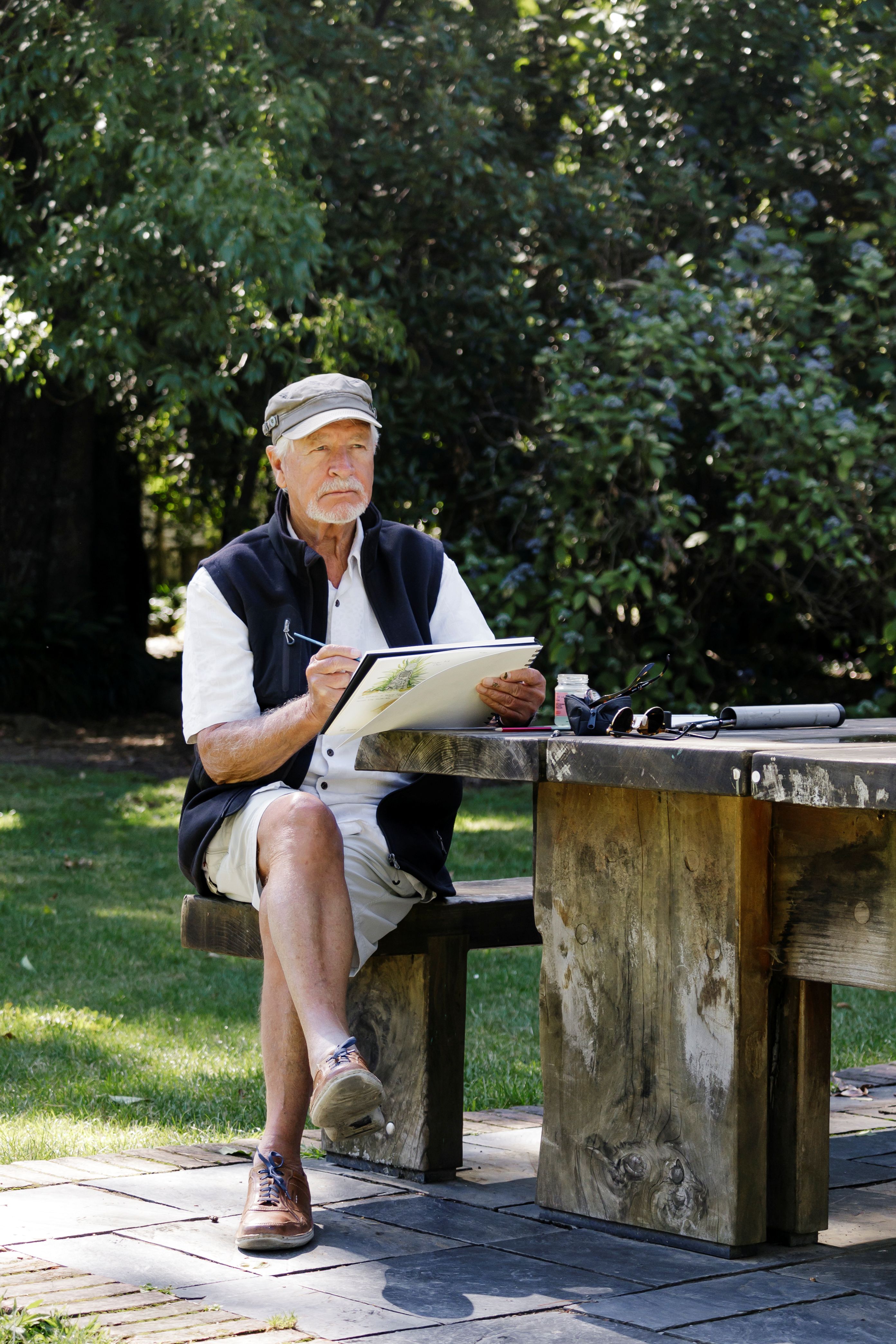
“Plein air painting is painting outside. It can be drawing, watercolours, oils, acrylics – it doesn’t matter. The only task is to sit down and observe your environment and start focusing on something that grabs your attention, and then paint or draw it,” explains award-winning artist Nicole Russell, who organises and coordinates the weekly event at various locations in the Nelson Tasman area.
‘En plein air’, or plein air painting – from the French phrase meaning ‘in the open air’ - is the art of completing entire pictures outdoors, directly in front of an object rather than in a studio. The primary goal of plein air painting, which became popular in the 19th century, is to capture the spirit and essence of a location, and artists are encouraged to focus on capturing the changing effects of natural light, atmosphere and colour.
There are a number of differences between indoor and plein air painting styles. “Once you start painting outside, you begin to see some of the detail you may not realise is there if you’re working from a photograph,” explains Nicole. “For example, in a photo of a certain area with trees and shadows, sometimes you can’t actually see the tree trunk because it merges with the shadows and it all looks black. But there’s no such colour as a pure black in nature – those areas can be a very dark brown-black, or a cool green-black, but the camera has translated the colour and changed it so it’s easy to understand.”
It’s not just the act of creating the picture that sets plein air painting aside from other styles. “Because you’re outside, rather than being in a studio, you experience your environment quite deeply in a way you don’t if you’re inside,” says Nicole. “For example, when I go home after this, I will have my painting in my journalling book, but I will also remember hearing the cicadas, feeling a cool breeze on the back of my neck while I was painting even though it was a calm day, experiencing the heat of the sun… these are beautiful memories that I connect with, that stay with me. That’s what plein air painting does – it draws you in a way that makes the experience more than just a painting. You remember how it was all created.”
That feeling of connection is all part of this type of painting, and there’s an unmistakable aura of tranquility that’s infused throughout the group as they work. “It’s a very mindful way of being,” explains Nicole. “When you’re holding a brush outdoors it’s just about you; you lose the chaos, turn off the troubles of the day and become very anchored to where you are.”
That feeling of leaving the chaos behind is a familiar one to Nicole, who only discovered her artistic streak in 2003, after a stressful career as a stock exchange lawyer in her home country of Germany. “I worked 24/7, and I’d constantly be cancelling on friends for work. My world changed when the stock market crashed in 2002; I ran out of billable hours, and that was when I realised if I carried on that way I’d have a huge bank account by the time I was 40, but no friends and no family.”
She learned to become a boat skipper and joined a crew on a boat, where she met the love of her life. “Brian and I got engaged six weeks after we met. We had our first daughter and bought a house within a year,” she smiles. Work took the family to Annapolis, near Maryland, USA, where Nicole joined an art class, specialising in drawing and watercolour – a decision that kick-started her second career.
“We sailed a lot as a family, and when we left the US to travel to the Mediterranean and back through the Panama Canal to New Zealand, I’d paint outdoors from the cockpit of our boat, which is where my love of painting outdoors comes from.”
While Nicole makes it clear she doesn’t ‘lead’ the plein air group – “I don’t teach; this is about being able to paint outside in a safe environment,” she says – there’s no doubt the group members are learning from the experience.
“This is something I’ve been doing with Nicole for years – we’ve exhibited together at the Suter Society, even though we have very different types of art,” tells Paul, who regularly attends plein air meets despite already having a successful career as a marine artist. “I get a lot of inspiration from coming here; being outside also takes you to places you might not have given much thought to. I didn’t know when I came here today that I was going to paint this dovecote, for example; I just wandered over and there it was.”
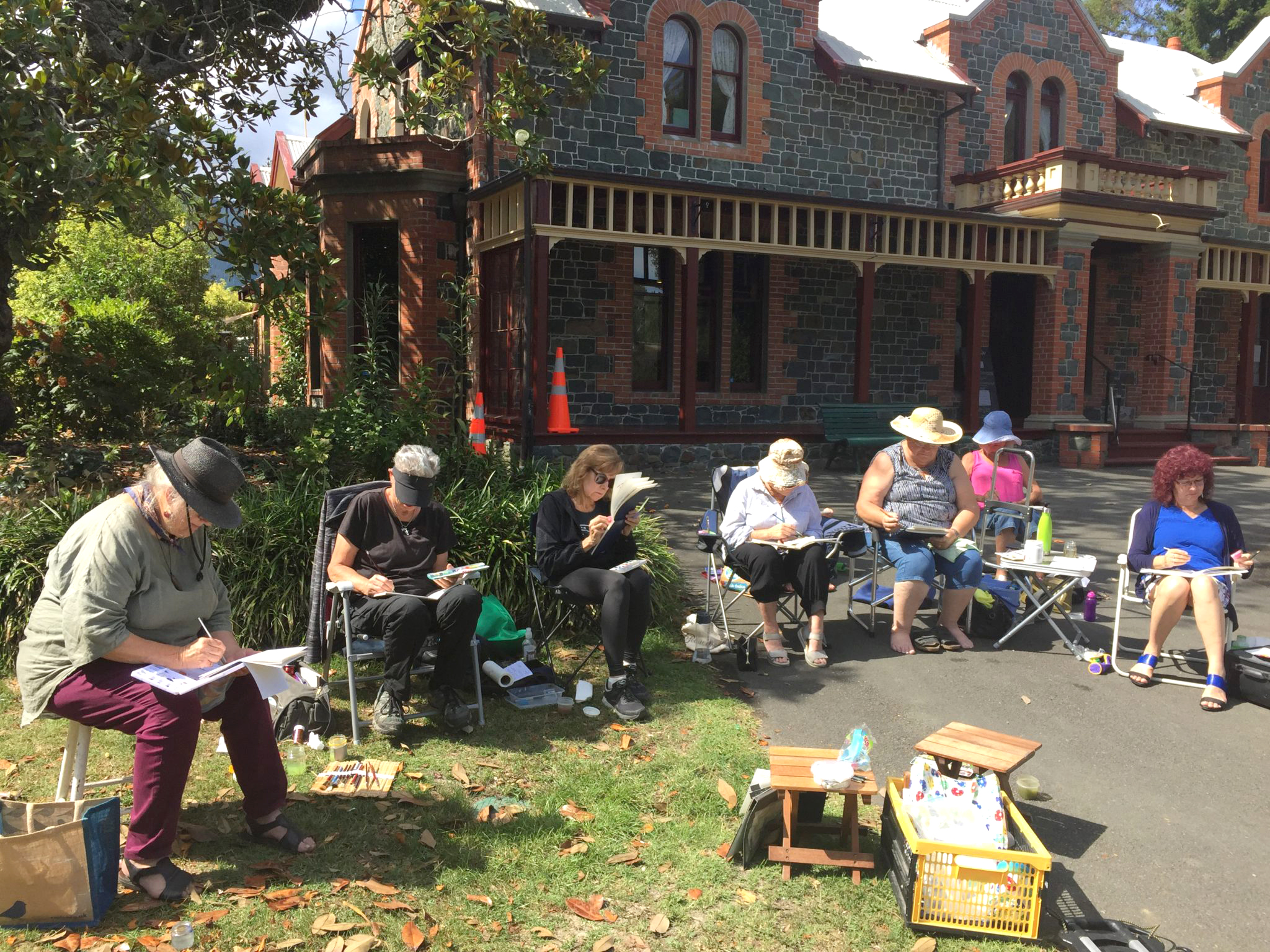
“Coming to this group changes my focus and refreshes me in body, mind and spirit,” agrees Barbara, who has been a member for over 20 years. “It’s taught me a deep appreciation of the beauty of Nelson, and of colour, plants especially. It’s also fascinating to see how everybody in the group sees something different – we can all be looking at the same scenery, but the result on the canvas is completely different. It’s absolutely wonderful.”
Plein Air Painting Nelson Tasman group meets weekly on Wednesday mornings. For more information visit nicolerussellart.com/plein-air-painting/
