
SUSAN FENEMOR
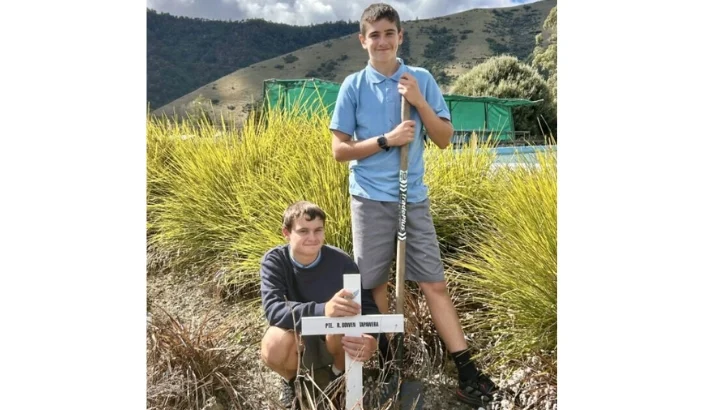
Crosses bearing the names of local soldiers line the edge of Tapawera’s secondary school pool area, a quiet but powerful reminder of the cost of war.
Put up by Year nine students ahead of Easter, the crosses are intended to prompt early reflection ahead of ANZAC Day for people travelling along the nearby main road.
Each cross carries the name of a local serviceman who died during World War I or World War II. The names were taken from the three war memorials within the school bus perimeter at Kohatu, Tapawera and Stanley Brook.
In 2018, schools across New Zealand were provided with sets of crosses as part of the nationwide armistice commemorations. Wanting the tribute to better reflect the local community, the school secured funding so that every local soldier listed on the monuments could have an individual cross.
The crosses are stored at the school and erected each year by students, alongside large red poppies.
As the local social sciences teacher, the organiser of the project has woven the memorial into classroom learning, using it as a starting point for deeper discussions about conflict, sacrifice and remembrance.
Year nine students write their first formal essay on the Battle of Gallipoli during World War I, while Year 10 students focus on World War II, with a particular emphasis on the Battle of Monte Cassino. Students are given a choice of battles to research, and this year one student has chosen to examine the current conflict in the Middle East.
Understanding why ANZAC Day holds such significance in New Zealand is a key part of the learning, the teacher says. Beyond being a public holiday, the day offers an opportunity to explore the ANZAC spirit and how it continues to shape the country’s values and identity.
The teacher has attended an ANZAC service at Gallipoli, describing it as a pilgrimage for many New Zealanders during their overseas experience. While Australia and New Zealand alternate hosting duties for the service, the importance of recognising the people of Turkey as the guardians of the land is also emphasised.
