
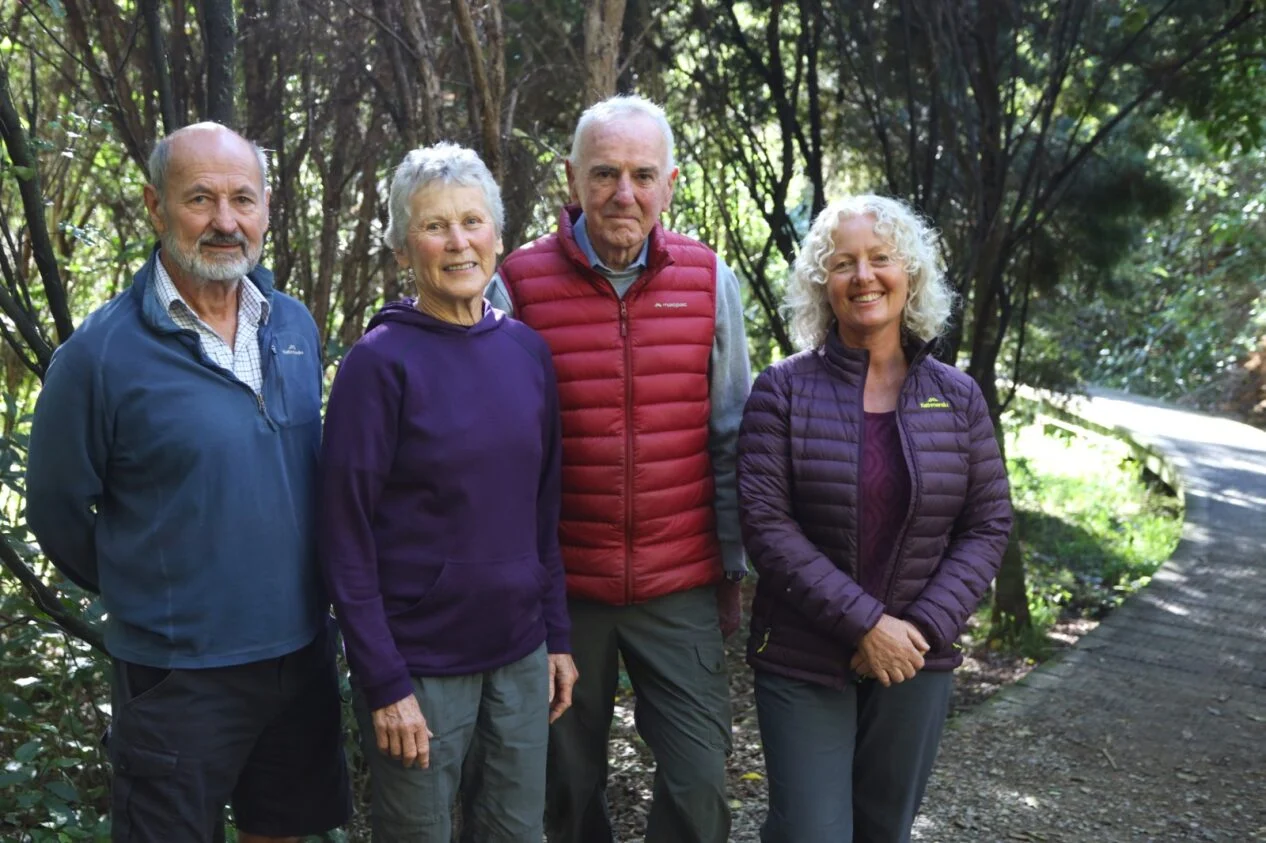
Outdoors groups are banding together to protect public access to a historic track in southern Tasman.
Tasman District Council is planning to sell the Howard Forest, a forestry plantation it owns in the Howard Valley, to create a diversified resilience fund.
But the Louis Creek Goldfield Track runs through part of the forest and the prospect of losing access to the area raised alarm for regional tramping and mountainbiking groups.
Liz Eskrick, a trustee of the Mountainbike Trails Trust, says the track dates back to 1915.
“It’s been a gold fossicking track for years,” she says.
“It’s got bush, it’s got history, it’s got a historic cottage… It’s not a museum where you go to see all these bits and pieces – it’s actually there.”
While the council has agreed to legalise Monument Road, which leads to the Miners Monument and ties back into the track, concerns remain for the more rugged, off-road sections of the trail.
“Who travels all that way to bike on a forestry road?” asks Liz.
Currently, a stretch of the track runs roughly parallel to the road, through a protected gold-fossicking area along Louis Creek within the Howard Forest, until it reaches private land.
The track continues uphill from the creek, through private land for about 400 metres until it curves back around to rejoin Monunment Road within the council-owned Howard Forest before entering the Department of Conservation-managed Glenhope Reserve.
The landowner had previously given approval for the track to go through private property but, reportedly due to changing circumstances within the landowner’s family, that access is no longer assured.
The outdoors groups want to build a new section of track, just a few hundred metres long, through the Howard Forest while it was still council-owned, to replace the section through private land with the expectation that conditions guaranteeing public access were included in any sale agreement.
Graeme Ferrier from the Nelson Tramping Club says the region had the highest proportion of recreational walkers and cyclists nationally, so it was “critical” to have a wide variety of tracks.
“Once access is lost, we’ve compromised the future for the next generations.”
Liz and Graeme presented their request to Tasman District Council last month alongside Ange van der Laan, Top of the South regional field advisor for the Outdoor Access Commission.
They were supported by the Waimea, Motueka, and Marlborough Tramping Clubs.
Ange says it is “fantastic” the council is legalising Monument Road and creating some reserves around the immediate waterways.
However, she adds, the new track was needed now that accessing the privately-owned land is no longer viable.
“We haven’t got a track to legalise anymore… It’s pretty pointless to protect something unless it’s continuous.”
Ange says it is “very common” to have public tracks through private forestry land, and it could be provided for through several different legal mechanisms.
She hoped the council would agree to some arrangement to build the track before the Howard Forest, which is currently on the market, is sold – a process that could take up to 18 months.
“Councils and other authorities need to be thinking about the public interest in land holdings before they sell them.”
Tasman District Council’s enterprise portfolio team leader, Stephen Batt, says $80,000 has been invested in surveying the area, upgrading the road, and providing additional parking.
As such, the council considered the request to guarantee access granted.
“The council will support even further access provided it is well thought out, and any additional survey fees and legalisation costs are covered,” he says.
“As an active mountainbiker and hiker, I feel consideration to both the costs and the number of potential users of any proposed tracks is prudent.”
He adds that public access through a production forest must consider the practicalities around health and safety in harvest operations.
The Mountainbike Trails Trust has indicated its willingness to hand-build the track in a way that won’t harm the recently replanted pines in the forest.
However, Liz highlights that the trust is made up from volunteers and did not have the resources to fund another survey that was needed for “enduring access”.
“We’d love to meet with [the council] and say, ‘Well, what can we do to reconcile this?’”