
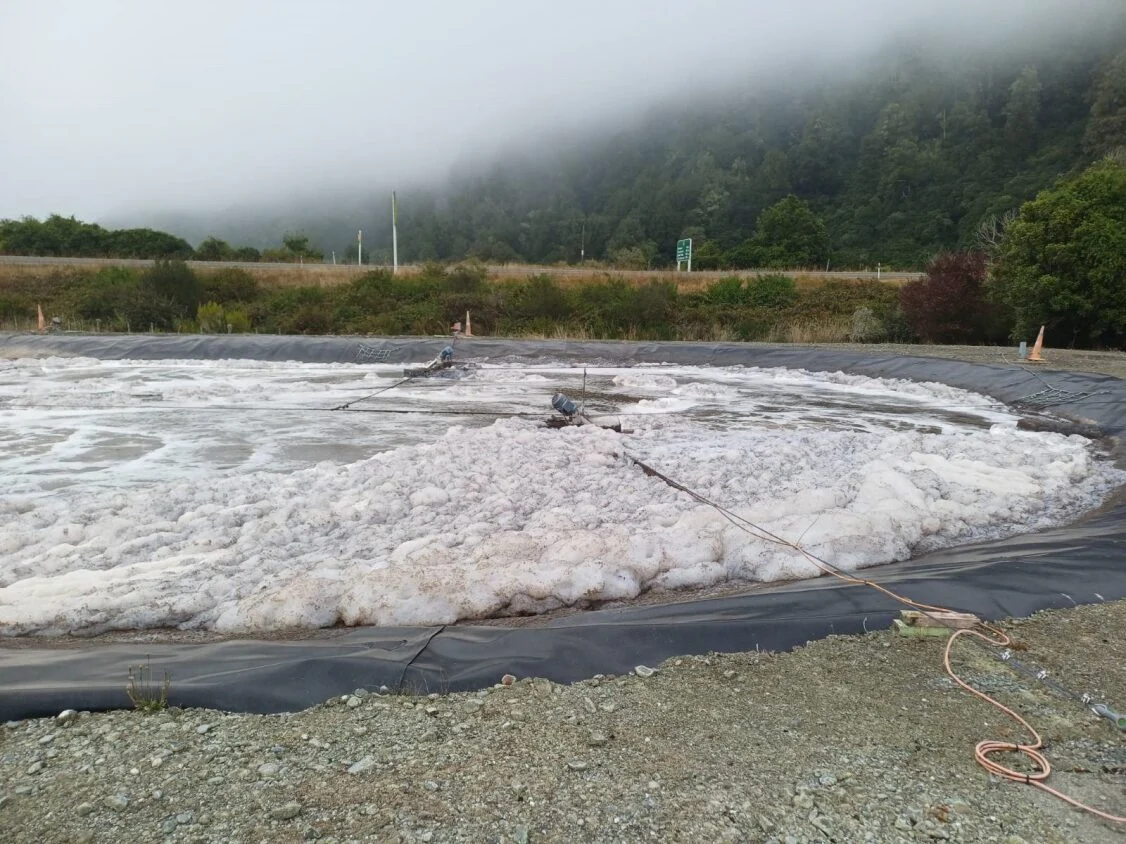
You might want your bath to be full of bubbles but excessive foam at Murchison’s wastewater treatment plant could impact the rural town’s sewerage processing.
Wastewater operators have observed 14 instances of excessive foaming over the last 18 months, but more may have occurred when no one was present.
The foaming is caused by disruptions to the treatment system’s microbial balance, likely caused by unusual discharges into the sewerage network.
Recent investigations by Tasman District Council have identified wastewater with “very high” pH of 10+ entering the treatment plant, which is believed to be the source of the problem.
The problem is not new to Murchison, with the foaming having previously occurred in the past.
Council waters and waste manager Mike Schruer says the origin of the past foaming issue was suspected to be a meth lab, but that was never confirmed.
“From time to time we work with the police and do sampling and testing of our waste stream, but [it’s] really hard to track down.”
The source of the high pH discharges has been traced to a group of about six homes, but access issues onto private land and intermittent foaming and discharges complicate further tracking efforts.
pH is a scale that specifies how acidic or alkaline a solution was, with low pH indicating acidity and a high pH indicating alkalinity.
New monitoring equipment is being installed to build a clearer picture of the discharges.
Wastewater engineers at the council say the effect of the foaming thus far has been “relatively minimal”, largely resulting in additional cleaning and monitoring.
That involves sending a boat and extra wastewater operator to Murchison to assist, taking them away from their normal tasks and creating additional travel costs for the council.
However, the engineers warn that the issue could further destabilise the aeration pond, in the worst case causing its ecology to “crash”.
A crash has not yet happened, but would reduce treatment capacity, resulting in poorer-quality treated wastewater and potential odour issues, and would take a long time to fix.
“Think Christchurch, just on a much smaller scale.”
If the foaming is present for an extended time, it can also flow on from the aeration pond to the oxidation pond and upset the balance of algae and bacteria in the pond.
That has happened once in the last 20 months.
Similarly to the aeration pond, if the oxidation pond is impacted, wastewater could be treated to a lower quality before it was discharged from the treatment plant.
While these challenges are believed to be caused by a high pH environment, wastewater with a low pH can also bring risks.
Low pH discharges can release significant amounts of hydrogen sulphide gas into the headspace of wastewater pipes.
The gas is toxic and can cause death at relatively low concentrations in addition to causing reactions which will eventually corrode wastewater infrastructure.