
Dana Carter - Motueka Catchment Collective
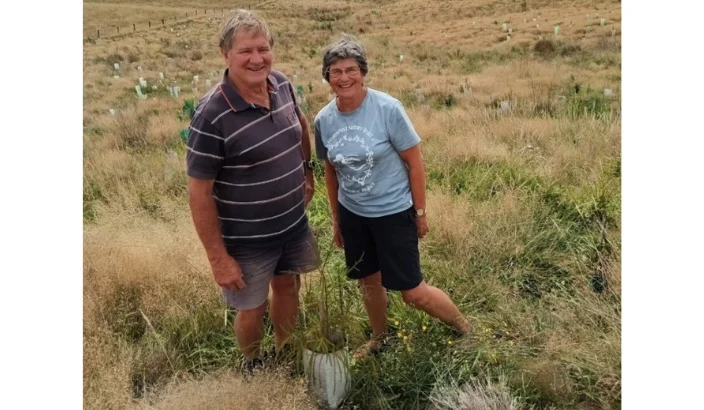
Philip and Jenny Leith have spent the past decade steadily restoring their 150 hectare Moutere property, gully by gully. Now in their seventies, they have personally planted most of the 44,000 native trees that are stabilising slopes, improving water quality and reconnecting habitat across the farm.
When I arrived at their place at Harakeke, they rolled out a large, annotated map across the kitchen table. It showed wetlands, ridgelines and more than 20 fenced planting blocks stitched together over time. Each area had been approached as opportunity allowed, with careful planning and a long term view.
As we drove around the property, the scale of the work became clear. Wetlands, steep ex forestry gullies and exposed ridges are now increasingly cloaked in native vegetation. What stood out wasn’t just the transformation of the land, but how it has been achieved.
Philip digs. Jenny prepares plants, guards and stakes. Together they return for at least two years of follow up spraying.
“It’s most efficient with two,” Jenny said. “One planting, one prepping.” The land was previously in pine forestry, most recently under Carter Holt Harvey. When the trees were harvested around 20 years ago, the hills were left completely bare—including the gullies. Heavy rain quickly moved sediment downhill into the stream at the base of the block.
“Everything went,” Philip said. “Even in the gullies there was nothing left to hold the soil. We had to do something to combat that.”
They began by fencing and planting behind a dam built for orchard water storage and gradually expanded from there—fencing, planting, trapping and restoring wherever it made sense. Over time, individual projects started to link up, creating connected corridors between wetlands, gullies and ridgelines.
Most of the restoration has been self funded, but support from the Billion Trees programme, Trees That Count, the Provincial Growth Fund and the Moutere Catchment Project helped accelerate progress by contributing plants, fencing and funding.
Today, more than 20 hectares of wetland are fenced and largely planted, including one of the few remaining remnant wetlands in the Moutere Valley. Twenty major and minor gullies have been restored, with further planting continuing each winter. In 2025, the Leiths established a new podocarp block with tōtara, kahikatea, rimu and mataī, planted at wider spacings and filled with shrubbier species.
A trapping network has expanded from 30 to 150 traps, with around 300 pest catches in the past year. The property also includes a public “Weka Walk” through the wetland, and the Leiths regularly provide planting and maintenance opportunities for Whenua Iti Outdoors and local schools.
The gully plantings serve dual purposes—stabilising erosion prone slopes and creating continuous bird corridors across the farm. Some areas are now regenerating naturally. Tōtara are self seeding, and coprosma are carrying heavy berry loads.
“That’s when you know the system’s starting to work,” Philip said. Over the years, the Leiths have trialled a wide range of species and techniques. They favour practicality over strict ecosourcing.
“This land’s been cleared of natives for at least a hundred years,” Philip said. “We plant what fits, what survives, and what helps bring the birds back—with an eye to what may have been here originally.”
Alongside restoration, the Leiths run around 200 cattle, breeding Welsh Blacks and continuing to develop soil fertility, pasture and infrastructure. They have also established exotic forestry blocks as part of their long term land management.
Their native planting programme sits alongside farm production, not in place of it—and shows what is possible when restoration is approached steadily, practically and over time.
