
Nelson Trout Fishing Club
Over 370 years ago English angler Sir Izaak Walton wrote: “Is it not an Art to deceive a Trout with an artificial fly?” Today that is paraphrased by trout fly fishers into a well-worn quote: “Fishing is a Sport, but Fly Fishing is an Art!” However, Sir Izaak, author of the book The Compleat Angler published in 1653, was by no means the first writer to mention fly fishing with artificial flies.
Nearly two thousand years ago, Roman poet Marcus Valerius Martialis (40–104 AD) wrote in his Epigrams (published 86–103 AD), about the “Scarus” fish being caught by “fraudful flies” (fraudulent or artificial flies). A century later Roman Claudius Aelianus (175–235 AD) described the practice of Macedonian anglers on the Astraeus River: “They have planned a snare for the fish and get the better of them by their fisherman’s craft. They fasten red wool around a hook, and fit onto the wool, two feathers which grow under a cock’s wattles, and which in colour are like wax. Their rod is six feet long … and they throw their snare. The fish, attracted by the colour, comes straight at it to gain a dainty mouthful. When, however, it opens its jaws, it is caught by the hook.”
Today the ‘art’ of fly fishing for trout is a popular recreational activity in the Nelson area enjoyed by numerous fly fishers, many of whom are members of the Nelson Trout Fishing Club. Founded in the mid-1970s, the club meets every third Wednesday of each month, at the Nelson-Marlborough Fish & Game building, 66-74 Champion Rd, Richmond.
Club President Don Clemenson says the club is dedicated to sustainably preserving local trout fishing rivers, streams and lakes for future generations; and to helping fishers of all ages to learn the skills of The Art.
“In addition to our meetings, at which we have interesting guests speakers, we have informative workshops, fly tying classes, exciting fishing trips, and fun social gatherings,” Don says.
He says fly fishing for trout is different to traditional fishing with a bait, jig and hook in many ways. “Fly fishing requires tramping up and across rivers, from one pool or run to another – often covering several kilometres a day,” he says. “Unlike sitting in a boat or standing on a beach surf casting, it’s a very healthy exercise. You are also out there at one with Nature among deer, fantails, tuis, kereru and other native wildlife.”
“Fly fishing is also mentally challenging because trout regularly change what they are feeding on – depending on what bugs, flies, caddis, larvae, minnows etc are present in or on the water at any time. You can be catching trout on one fly and suddenly its useless, and you have to figure out what their new food source has become.”
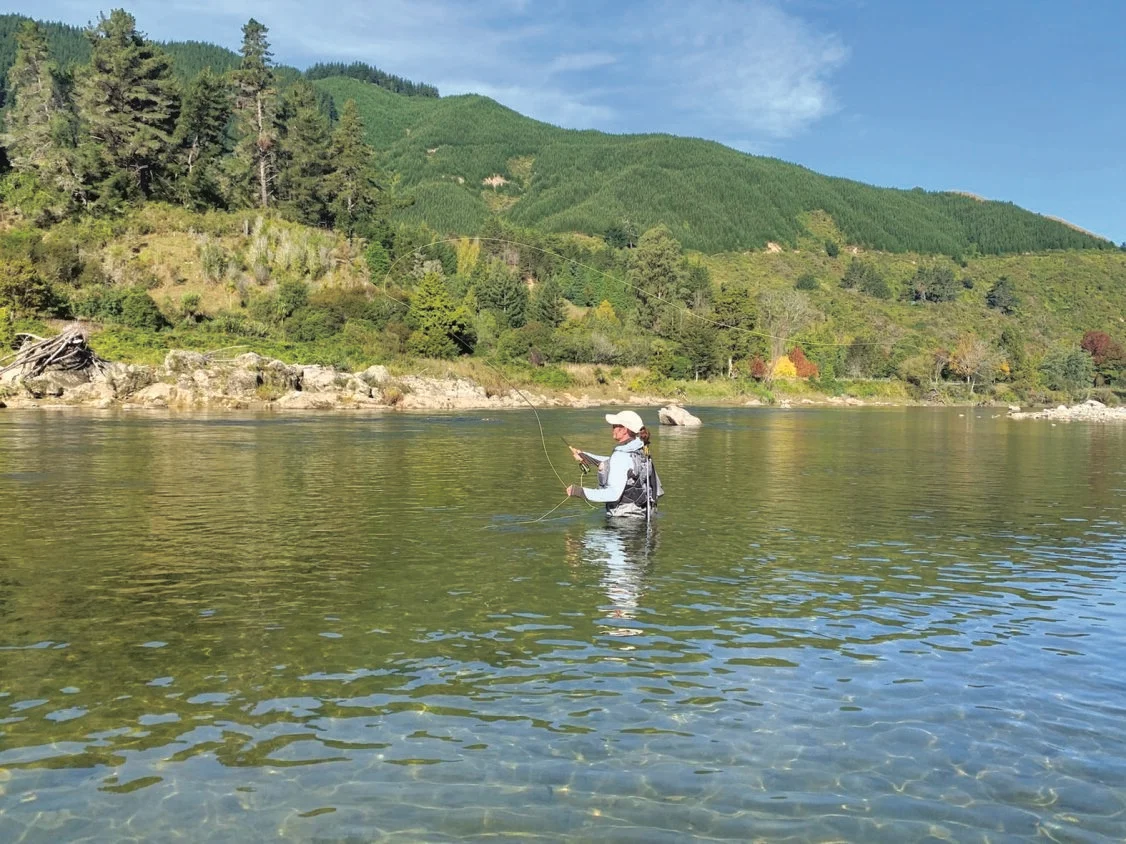
Unlike other rod fishing, where a forward cast is paramount, the art of fly fishing depends greatly on the back cast. This is because there is no sinker or weight on a tapered plastic fly line of about 30 metres. This is attached to a light nylon or fluorocarbon leader/trace of about 3m to which imitation flies are attached. “Fly casting is like wielding a lengthy bull whip – landing a fly softly on the light leader/trace in front of a trout, with the heavy fly line behind it so as not to frighten the fish,” Don explains.
He says the club has regular training sessions for newcomers who can read about activities at www.nelsontroutfishingclub.com
