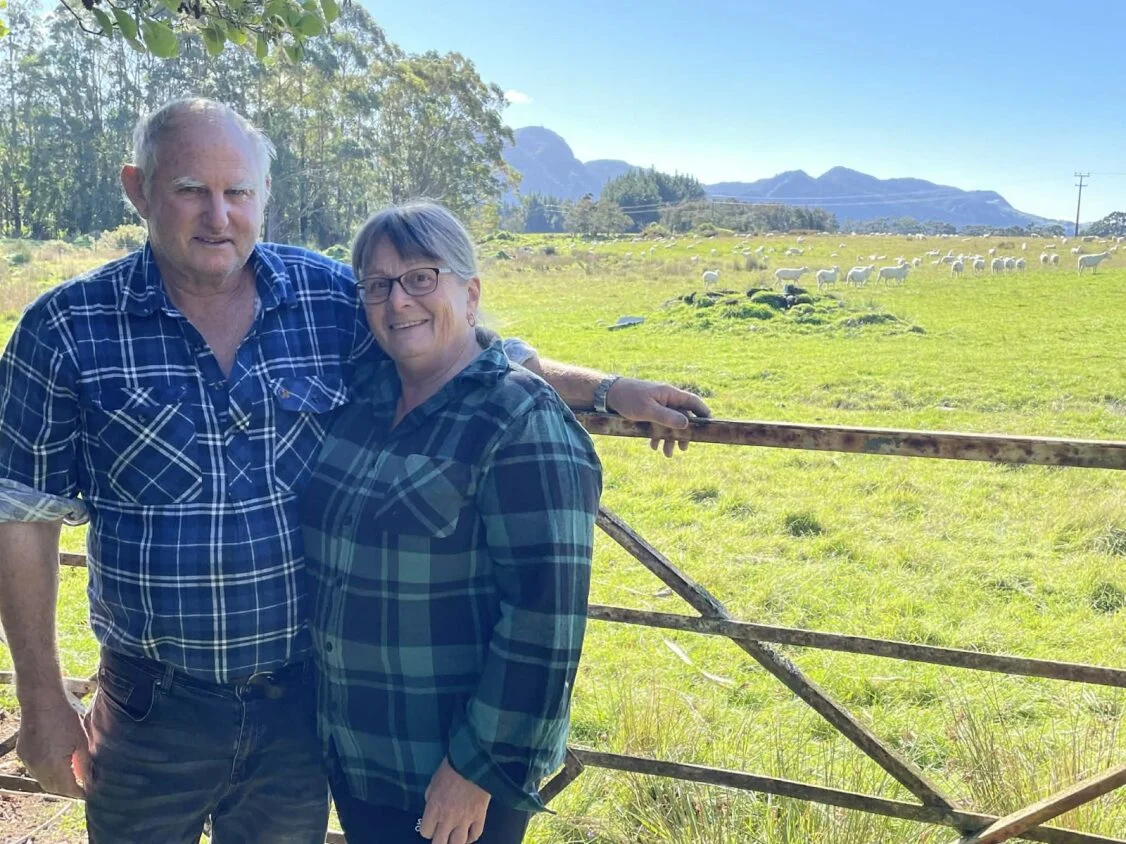
Tucked into scrubby country south-west of Tākaka, just a few kilometres from Collingwood, Len and Cheryl Win have spent more than five decades building both a farm and a life from the ground up.
Their Pakihi property, bought by Len’s father in the early 1970’s, was once open, wet and heavily overgrown, a far cry from the productive sheep and beef unit it is today.
“There was a lot of scrub, 300 hectares of gorse and mānuka,” Len recalls. Development was slow and demanding. With an underpowered tractor and ageing equipment, they have worked tirelessly to clear and improve the land.
“We borrowed a huge amount of money for the land being developed,” the couple say. “We rotary slashed and hand sprayed and lately helicopter sprayed.”
Originally a run-off block, the property evolved and today, the Wins run about 1,100 breeding ewes and 100 cattle and replacements in a district now dominated by dairy farming.
Len’s farming roots stretch back to Sandhills Creek about five kilometres south of Paturau still in Golden Bay, where he grew up.
“Like all young guys, I wanted to be a commercial diver, but I was told by my family, ‘no’. I did some sheep shearing for about eight years, then carried on farming with the family,” Len says.
Alongside farming, he has continued to enjoy recreational diving. The opportunity to farm also allowed Len to build a life with Cheryl, who had spent time away nursing before returning to the district.
The couple took over the farm in the early 1980s, at a time when wool was king.
“About 64% of our income came from wool back then,” Cheryl says.
Today, the picture is very different. While wool prices have shown some improvement, covering costs remain tight. Cheryl notes that growing awareness of wool as a sustainable, natural product is encouraging.
Careful management has delivered high lambing percentages, including twins and triplets, supported by good ewe condition pre tupping and long-term breeding decisions. Rams have been sourced from Hawke’s Bay for more than 33 years, valued for their consistency and suitability.
Survival rates have also been strong. Experience has taught them how to match stock to paddocks.
“We keep the twins in paddocks with lots of shelter. And over the years, they’ve got to know which paddocks work best for singles, twins and triplets,” they say. “Scanning is key and knowing who is having what.”
Like many farming families, their journey has not been without hardship.
“We’ve had to work for everything we’ve got,” Cheryl says. “It wasn’t handed to us on a plate.”
There were times when they wondered how it would all work out, something many on the land can relate to. Len says they pushed through.
Now in their 70s, Len and Cheryl are considering their next steps. They say it is time to ease back on stock numbers, freeing up time, though both still enjoy the day-to-day of farming.
Their three daughters are keen to see the farm retained, though none are currently in a position to farm it. For now, the couple are content to keep going.
“We’re still fit and able,” Cheryl says. “We’ll farm as long as we can.” Rising costs, recently fuel, remain a challenge, with diesel affecting everything from cartage to fertiliser and contractors.
“We’re price takers. We just have to take whatever comes.” they say. “We can’t keep everything on the farm. It’s just not an option.”
Their sheep go to the freezing works in Stoke via Alliance, while cattle are sent as far as Levin.
Farming has changed over the years. Cheryl points to the growing burden of compliance and paperwork.
“When you’re sitting in front of the computer, you’re not actually farming, you’re doing paperwork,” she says.
Through it all, their partnership has remained central. They have never employed staff, instead working side by side and bringing in contractors when needed. "We work really well together.”
“Over the years there have been many highlights,” Len says, but one that never fades is seeing good lines of stock heading off the farm. You look at them and think, ‘They are cool – we bred that.’”
Cheryl agrees, saying working together as their own boss in a remote setting has been one of the most rewarding parts of their farming life. “It’s never boring.”
With the beach and bush just minutes away, it is a life that balances hard work with quiet rewards, one Len and Cheryl Win are not quite ready to give up.
