
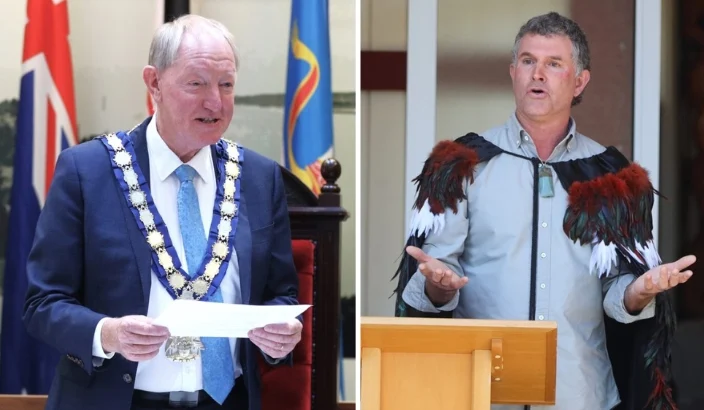
The amalgamation of Nelson and Tasman might now just be a matter of time.
The Government has given councils a three-month window to develop their own re-organisation plans.
Resource Management Act Reform Minister Chris Bishop and Local Government Minister Simon Watts outlined the reform last week.
They intend to see the two-tier local government structure that was predominant across the country disappear, with district and city councils joining together to create unitary authorities.
Unitary authorities are councils which have the responsibilities of territorial authorities, like other district councils, but also those of regional councils.
For councils that did not participate in the process, the alternative was having the Government decide for them.
The potential mergers are being touted as ways to increase efficiency in local government by streamlining their functions, reducing duplication, and improve decision-making.
While Nelson and Tasman are both already unitary authorities, the region’s two mayors reckon change could be coming soon.
Nelson Mayor Nick Smith is a long-time supporter of amalgamation.
“The case for the reform of Nelson and Tasman’s councils is stronger and more obvious than any other part of New Zealand,” he says.
“Town and country is better together.”
Residents of the district and city were each dependent on each other, while the “artificial boundary” of Champion Rd, which split the Nelson-Richmond urban area in two, hinders development, Nick argues.
“The risk for Nelson and Tasman, particularly when we’re all under such strong financial pressures, is that other councils in other parts of New Zealand get ahead of us and that we are left behind.”
He assured rural Tasman residents that he understood their representation concerns and would want a strong rural voice present on an amalgamated council.
“Regardless of government, the winds of change are so strong that reform is inevitable. It’s only going to be a question of whether it's driven locally or from Wellington,” he says.
“The ball’s in Tasman’s court.”
Tasman Mayor Tim King said the decision whether to engage with Nelson on a reorganisation plan lay with his council, and the council will consider the option “relatively soon”.
He says that he supported the Government making its expectations clear and supports rationalising local government to make it more consistent, but he did not think the ultimatum was directed at Tasman.
“We’ve got so much else on, around Local Water Done Well, implementing the new RMA, just managing our business-as-usual – to put [us] into a three-month process, trying to do a reorganisation when we are already unitary, I don’t know if it’s a good use of time.”
However, he thinks that it is “quite likely” that the region will be told to amalgamate if the Government returns to power after the general election.
“Then it’s my job to get the best possible outcome for the Tasman district.”
Tim has long preferred closer sharing of services with Nelson over a full integration and warns that amalgamation was not a “magic bullet” in the face of rising costs.
That view was shared by the Taxpayer’s Union, which recommends councils “stop chasing costly amalgamation” in its report ‘103 Ways to Save Money in Local Government’.
A 2022 Infrastructure Commission report found that there was little evidence of cost efficiencies for larger councils when compared to smaller ones.
Nelson and Tasman previously voted on amalgamation in 2012, where it got the support of 57 percent of Nelsonians but 74 percent of Tasman voters rejected the proposal.
An estimate from 2012 forecast savings of between 5.5 and 6.1 percent of the councils’ yearly operating and capital expenditure if the two districts merged.