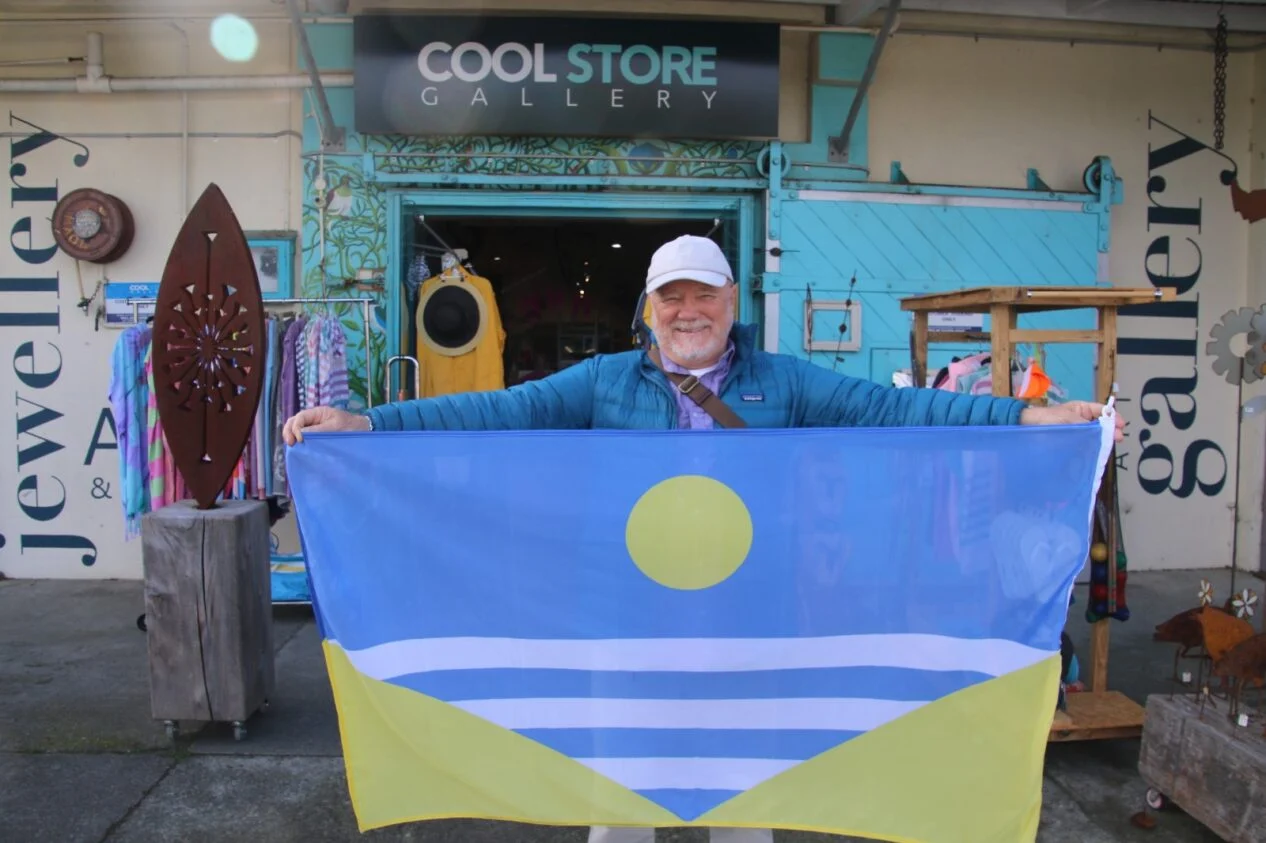
Andrew Damerham isn’t just flying the flag for Māpua, he’s invented it.
A long-time vexillophile, or flag enthusiast, Andrew wanted to offer locals a way to show a shared identity for the Māpua and Ruby Bay area.
His design, dubbed the Sun Flag, Te Rā, is now on sale at The Coolstore Gallery for $85, with an initial screenprint run of 10 flags.
The flag is divided into two parts. The top represents the area’s long sunshine hours and clear blue skies, which have “created a region of vineyards, orchards and a sun-kissed coastline”.
The bottom features a golden V representing Tasman Bay, intersected with six blue and white stripes to show the maritime communities of the bay. These include Māpua and Ruby Bay, as well as Kaiteriteri, Marahau, Motueka and Nelson.
The stripes echo the blue and white wavy lines of the Nelson flag, “but we’ve made ours calm”, Andrew says with a smile.
He reckons a good flag design needs to be meaningful, simple and distinctive.
“It’s got to be two or three colours,” he explains. “It’s got to be simple enough that people could, if they wanted to, draw it.”
Andrew cites Marahau’s Wally Bruce and Otago’s Neville Peat as inspirations and supporters, saying they were instrumental in establishing local flags for their own areas and happily shared their knowledge with him.
He has lived in the Nelson region for almost two decades, most of that time in Māpua. He hopes the flag will help foster a collective sense of identity, saying it would be nice if, on special occasions, “Māpua could find itself festooned with its own flag”.
The former art appreciation teacher says a surprising number of people already have flagpoles – his cost him $150, plus a bag of cement, a few years ago.
There is no obligation for anyone to get on board, but “if they like the idea, and they like the design, they can buy one”.
Although there is no official comprehensive list, it appears only about six cities and a similar number of districts in New Zealand have their own flags.
Andrew reckons it would be wonderful if every community had one, imagining them flying outside council buildings like a localised United Nations.
