
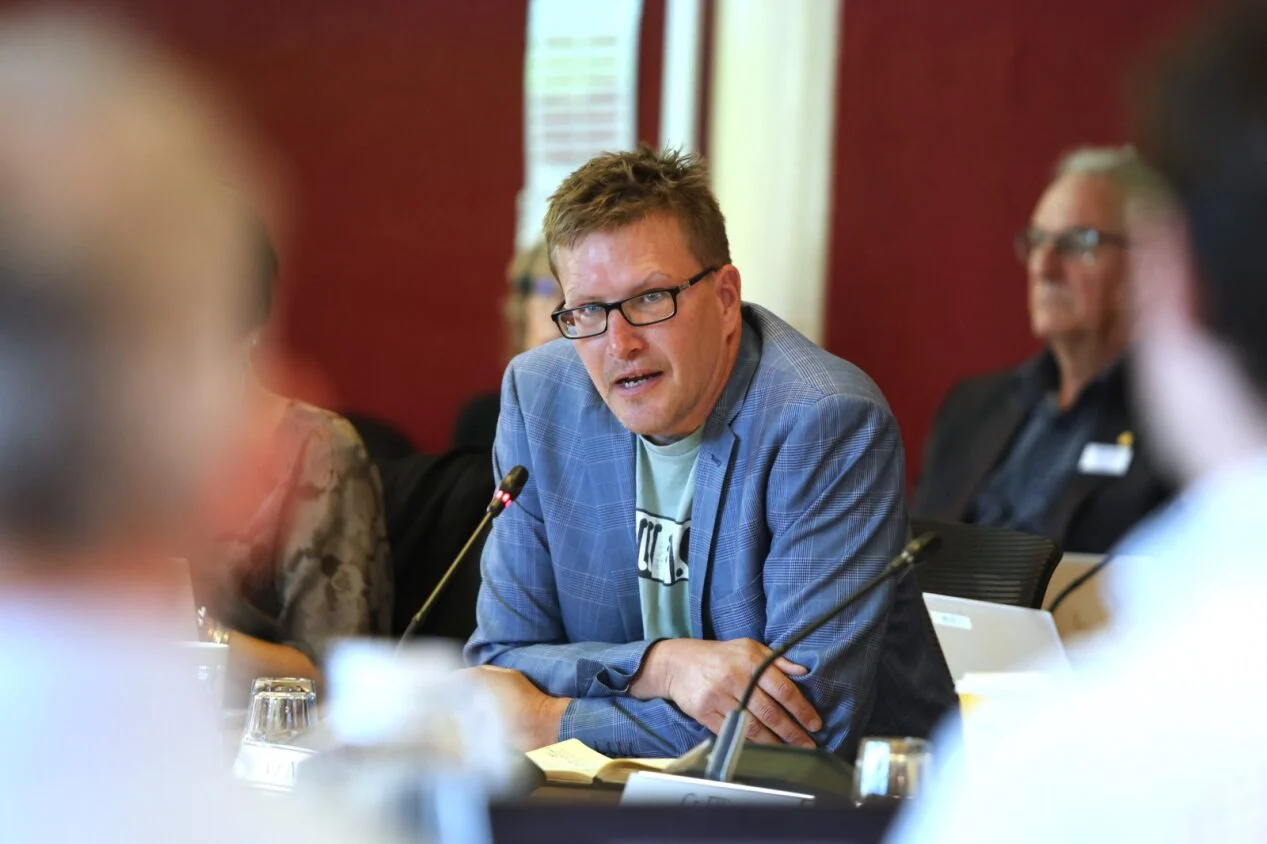
It’s uncertain what Tasman’s greenfield growth will cost ratepayers over the long term, but council staff aren’t estimating any extra bills for the general population.
On Thursday, the district’s elected members got an update on several council projects, including several growth-related infrastructure projects and Plan Change 81 – a proposed suite of planning rule changes that are intended to enable more than 4000 new homes.
But the extent of greenfield growth is a concern for councillor Timo Neubauer, a long-time advocate of intensifying housing in existing urban areas.
He tallied more than $150 million of growth-related infrastructure projects being undertaken by the council so it could eventually provide services to communities that don’t yet exist.
Affordability was a key concern for the first-term councillor and he often enquires about the long-term operating costs of planned council facilities.
Timo said he had asked council staff if the revenue from the future houses enabled by the growth projects would cover the new infrastructure’s total lifecycle costs, including their construction, operation, and eventual renewal.
“I received an answer from planning [staff] on this, that we currently don’t have this visibility. We don’t know.”
He wanted assurance that the growth projects would not negatively impact the council’s financial viability.
“Quite frankly, if the costs outweigh the revenue generated by the growth, then someone’s going to pay for it, and that will be rates or debt. So based on that uncertainty, that is really a big red flag for me to proceed with a plan change that enables this growth.”
Tasman District Council’s strategic planning and enterprise manager, Dwayne Fletcher, said initial construction costs were paid by developers, through levies on all new properties.
“That doesn’t cost the ratepayers.”
He said Tasman had been the second-highest growth region over the last 30 years but was in the bottom third of all councils when comparing rates bills per capita and per rating unit.
Under the planning rule changes outlined in Plan Change 81, Dwayne said that future greenfield growth would have a “much higher” density than Tasman’s historic trends and that the new subdivisions might end up subsidising the existing, less dense, neighbourhoods.
“I don’t think our growth programme creates a burden to existing ratepayers. The opposite is true.”
Council staff also estimate that Richmond’s rate of intensification will quadruple – from 15 new intensified homes per year to 57 – under the proposed planning rules contained in Plan Change 81.
They have previously described the updated rules as “the most cost-enabling intensification regime, probably, in the country”.
Dwayne added that many growth projects, such as the upgrade of the trunk water and wastewater main between Richmond and Wakefield, also renewed old, existing infrastructure.
Timo thought the situation was “a little bit more complex” than that.
He asked elected members to support his motion that requested staff report back, at a high level, on if the financial sustainability of the region’s planned growth forecast through Plan Change 81, before it was expected to be notified for public submissions midway through June.
“This is a significant gap that still exists at the moment, and if we are being asked as part of the consultation process as to how this stacks up financially, and we just have to shrug our shoulders and say, ‘Well, we don’t know at the moment’, that is not a good outcome.”
“I think we owe that to our ratepayers. A lot of us have been elected in for fiscal responsibility,” Timo said.
Though he said his intent was not to impede Plan Change 81, several councillors voiced such concerns and committee chair Kit Maling later deemed that Neubauer’s motion had been lost after an oral vote on the matter.
A subsequent request from Timo for a show of hands was shot down by Kit, who said the against votes “clearly” outnumbered those for.
Technical difficulties had prevented councillors Kerryn Ferneyhough and Paul Morgan from attending the beginning of the meeting via video call.
Email correspondence mentioned ahead of the vote revealed an attempt by Paul to support Timo’s proposal that was also declined by Kit on the basis that he was not present.