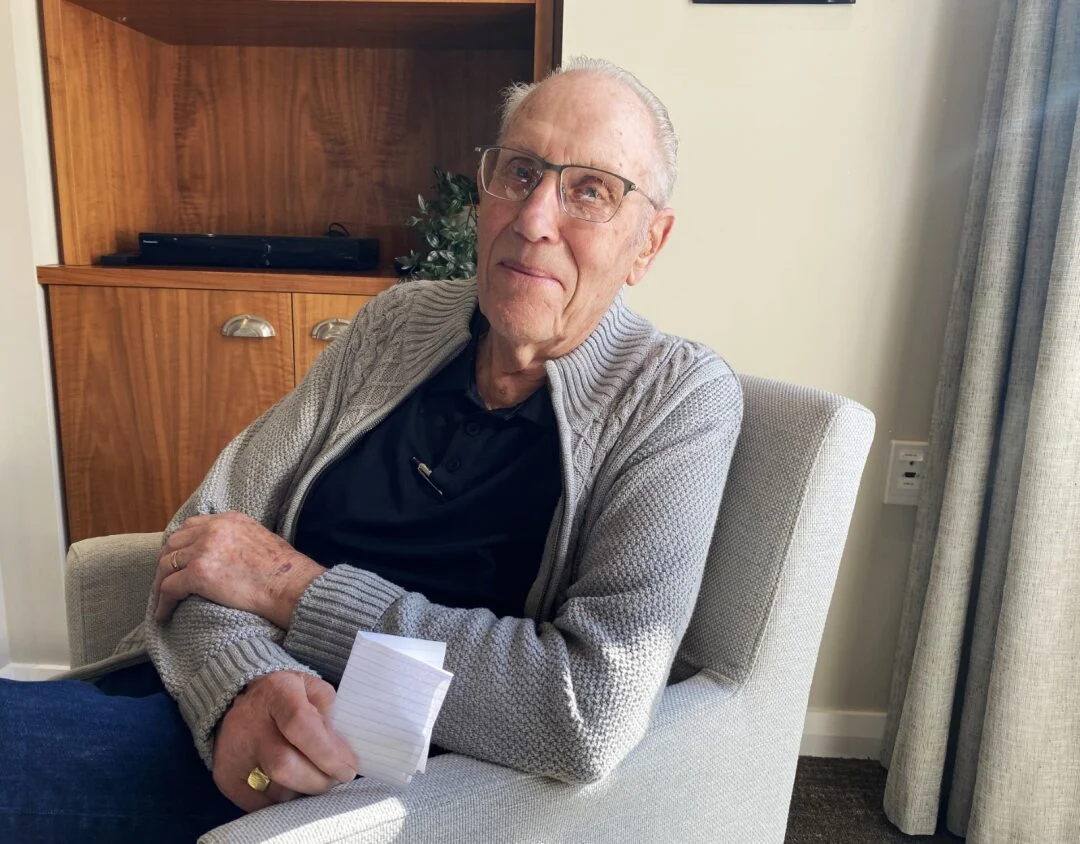
Henk Kokay was just nine years old when he began delivering messages for the underground resistance in a war-torn Holland, oblivious to the danger of being caught.
Back then, he was a kid on a bike with a note in his pocket, taking messages between different uncles working in the underground. He also knew the sideboard in the family home was where one uncle sometimes had to hide.
Now 91, living in a Richmond retirement home and just back from an Australian tour, he remembers Dordrecht being liberated from German occupation on 10 May 1945 and members of the underground, like his uncles, quietly stepping back from their wartime mission.
Nine uncles were involved with the underground, ferrying messages across the 1.6km-wide river at night.
“We had underground everywhere and the only way to get a message was delivering it on a piece of paper,” Henk says. “I knew that if my uncles did it, they could be picked up by the Germans – I knew it was dangerous for them to be outside. So, I’d get on my bike, and the Germans never seemed to stop children.
“Messages were coming back from areas that had been freed and I’d deliver them to other outposts. As a child, you didn’t think too much about it – you just delivered a piece of paper.
“That was my little contribution to the resistance without really knowing.”
At the time, Henk remembers SS troops, known as Blackshirts, as a constant threat who were holed up in a local hotel and train station.
Though unaware as a youngster, Henk later came to understand, through stories told after the war, the importance of those handwritten messages carrying intelligence across the river via the underground.
“We knew where they were holed up and so we’d try to get the message across the river where they were. And one Sunday morning a Spitfire came across and blasted the hotel.”
Through the war, young uncles hid from soldiers to escape being sent to Germany’s labour camps and factories. One of them lived with Henk’s family where a wooden sideboard had the shelves cleared out to create a hiding place for him.
“If anything ever happened, he hopped in there. There was always someone to warn you soldiers were coming.”
His father was a skipper on a boat that travelled up the river, bringing home slivers of wood from the boat’s beams to burn in the small wood stove as there was no electricity or coal. By lending the boat’s washing motor to a local farmer, the family sourced potatoes and wheat to survive through the war and Henk’s job was grinding that wheat into flour.
Children missed out on schooling in the last year of the war, and to catch up schools set up intensive programmes after liberation. Henk had to study 14 subjects at high school including three other languages, and he says it was worth it.
At 91, his life continues to be full of experiences. He is just back from an Operatunity Tour to Australia, got as far as Stewart Island on an earlier tour this year, heads to Holland in August and plans a Chatham Island tour in December.
He reckons he has been pretty lucky.
“When you look back, it’s interesting. I’ve been lucky in life. It’s amazing how some of the things that could have been a disaster, turned out to be the opposite.”
