
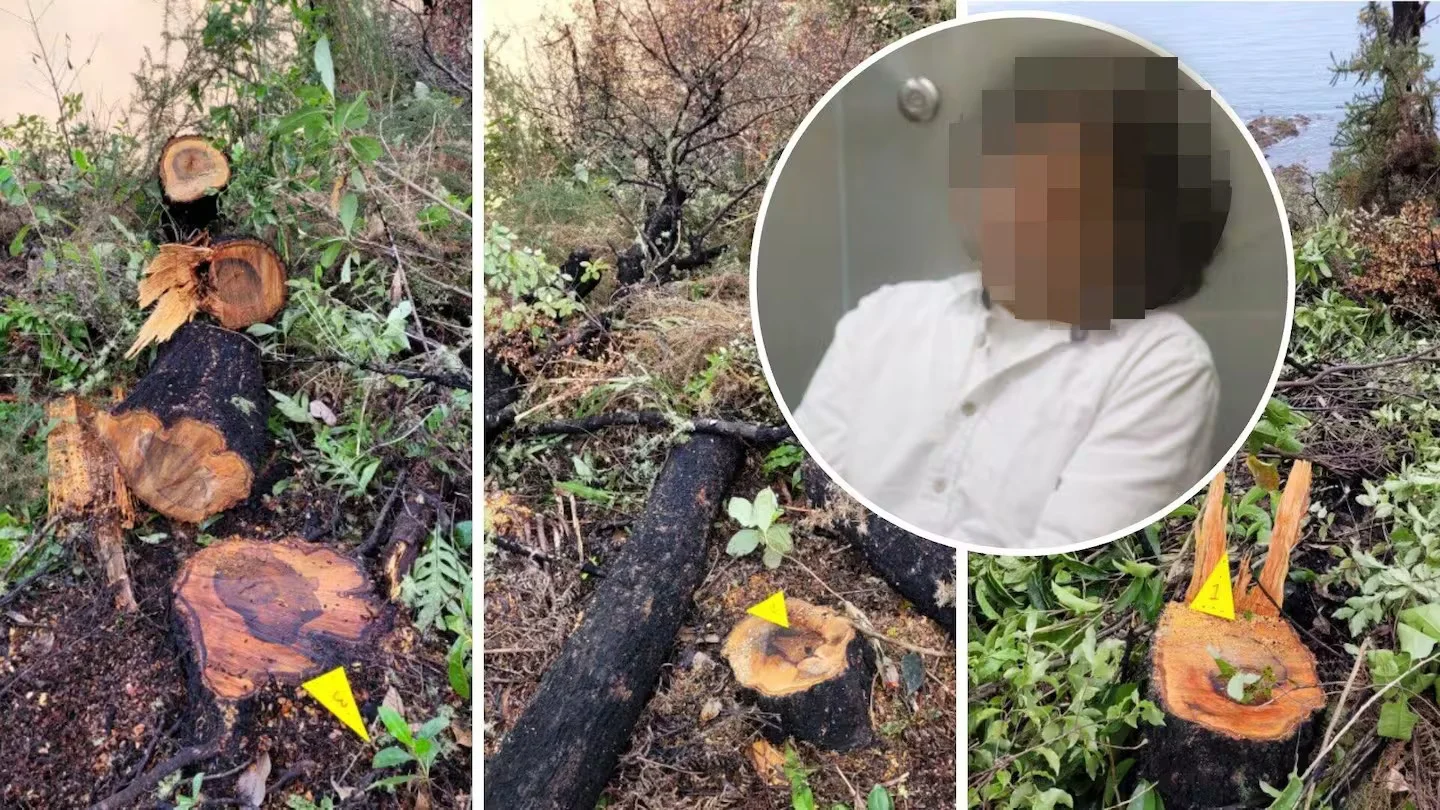
A businessman who claimed to be a guardian of native flora and who supported principles of conservation has been penalised for cutting down native trees on public land bordering his luxury property.
The 62-year-old admitted Department of Conservation (DoC) charges last year for felling five native black beech trees and other vegetation on a strip of land in Tasman.
He claimed the beech trees posed a fire hazard to the seafront property and that DoC had granted permission years earlier.
But the state-run conservation agency said it had never given him permission, while Fire and Emergency New Zealand said in an affidavit to the court that beech trees did not burn particularly well.
In the Nelson District Court on Thursday, the businessman was granted a discharge without conviction on charges described as taking plants from a conservation area without authority.
The offence carried a maximum penalty of two years’ imprisonment, or a fine not exceeding $100,000, or both.
However, Judge Tony Snell said his decision did not minimise what had happened and that consequences were warranted.
The defendant was instead ordered to pay reparation of $7200 to DoC for the damage, plus $5000 in costs imposed on DoC when he questioned the boundary, which then needed to be surveyed.
The man planned to defend the charges at a judge-alone trial, but changed his plea to guilty just before the scheduled trial.
His application for permanent name suppression was declined but he cannot be named as his lawyer indicated an appeal was likely.
The name of the property was suppressed to protect third parties involved in it, Judge Snell said.
The Department of Conservation administered the area of public conservation land on a coastal strip bordering Tasman Bay.
It said the strips were important for maintaining water quality, aquatic life and natural values, and also provided public access and recreation along the coast.
On July 8, 2024, DoC received information about recently felled trees on the strip adjacent to the man’s property.
A DoC ranger visited the site that afternoon and found five freshly cut down native black beech trees, which had been growing 6m to 14m from the man’s boundary, plus vegetation cleared from the strip.
About two weeks later DoC rangers spoke with the man under caution.
He admitted cutting down the beech trees and clearing the vegetation, and that he considered he had permission.
DoC said in its summary of facts the man had been spoken to by rangers in 2007 and 2010 and he had also been sent a letter informing him of protected marginal strips and the need for DoC approval before undertaking any vegetation removal.
He had also been issued a $300 infringement notice from Tasman District Council in December 2006 for felling vegetation on the same property without resource consent.
It was followed by another $300 infringement notice from the TDC in November 2013 for felling vegetation without resource consent on a different property.
However, his lawyer claimed the former nurseryman had an inherent respect for the environment, including native trees such as beech that he recognised enhanced his property.
At today’s lengthy sentencing hearing, Judge Snell traversed reasons for his decision to grant the man a discharge, which was based on the consequences of a conviction being out of proportion to the gravity of the offending.
He noted the prosecution’s concerns about unanswered questions around why the trees, which were some distance from the boundary, were felled.
Judge Snell said the defendant, in admitting he had cut down the trees, maintained there had been “some form of informal agreement” with DoC and Fire and Emergency over the trees, but there was no evidence that was the case.
“In fact, it’s the opposite. He had been warned he should not clear vegetation from the marginal strip.
“He was effectively on notice he should not be chopping down trees on that strip,” Judge Snell said.
He also said the defendant, who was initially self-represented, raised a number of potential defences that increased costs to the prosecution.
Judge Snell described the offending as “modest”, involving a small number of trees, but they were New Zealand natives cut down by someone with a “possibly misguided view of entitlement” and who “should have known better”.
DoC was the central government agency responsible for the conservation and management of New Zealand’s natural and historic heritage.
It had powers under the Conservation Act to manage and protect natural resources for the enjoyment of the wider public, and to safeguard areas for future generations.

