Just days out from New Zealand’s return to the FIFA World Cup finals, a Kiwi trailblazer is hopeful his modern-day counterparts enjoy the challenge as much as he did in 1982.
At 23, Blenheim-born midfielder Peter Simonsen was one of the younger players in the 22-man squad which became known as the All Whites during its quest to qualify for the footballing showpiece in Spain.
“I guess, looking back now, it was a fantastic experience. I don’t think any of us ever expected to go to a World Cup” recalls Peter, who has lived in Nelson for the past 40 years.
After starting out in Christchurch, he was brought to Nelson by player-coach Kevin Fallon in 1977 and was part of Nelson United’s shock 1-0 win over a star-studded Mt Wellington in that year’s Chatham Cup final.
A New Zealand call-up followed, and Peter scored a goal on his A-international debut in Singapore in 1978 and became part of the squad that made history by qualifying for the 1982 World Cup.
“In a lot of cases, we younger players had to drop our jobs to attend training camps in Auckland. So then we had to pick up whatever work we could,” says Peter, who had left Nelson to join Gisborne City and had become a freezing worker.
After the divisive 1981 Springbok rugby tour, the country got behind the round ball underdogs.
“We were short of funds to travel to Singapore for the tiebreaker play-off match against China, so the coach John Adshead went on the radio. I wouldn’t say he pleaded, but he asked for funds to help. Within 48 hours, he had to go back on the radio and say stop sending money. That was the sort of climate we were in,” declares Peter.
“We were up against it. The crowd was largely backing the Chinese and the heat and humidity in Singapore were oppressive.”
Peter subbed on just before half-time and, out on their feet, the Kiwi outfit lasted to win 2-1 and secure the 24th and final spot at the World Cup.
“The final 20 minutes of that game summed up our team’s ability to hang in. Our main goal was just to qualify, and immediately after we did there was a strange feeling of what do we do next,” reveals Peter.
Competition for places became even fiercer.
“John and assistant coach Kevin Fallon told us that some of us were unlikely to see any game time in Spain.
Peter proved one of the unlucky seven players.
“We were all training as hard as we could, trying to impress. But it was different back then with only five reserves and just two of them able to sub on. So, it was all about continuity and you couldn’t argue with that coaching philosophy. We were very disappointed but just had to accept it.”
And watch elite footballers from the sidelines!
“Seeing those world class players in the flesh, they were even better than I thought they would be.”
First up was Scotland with some of the game’s biggest names – Kenny Dalglish, Joe Jordan and Graeme Sourness, but the All Whites had them anxious when they closed within a goal before losing 5-2.
Then the USSR.
“They were phenomenally fit, organised and had the best goalkeeper in the world. A good friend of mine, Kenny Cresswell, missed a header in that match and I still remind him of that. Then came Brazil, our most difficult challenge, and with players like Zico and Falcao, they were favourites to win the cup. “
The South American superstars won the final pool game 4-0 with veteran sub Brian Turner coming closest to nabbing a goal for the Kiwis.
“The ball came across the six-yard box and Brian probably couldn’t believe it, and for some reason his legs didn’t move quick enough.”
But Peter sure did, as he returned home with a treasured momento.
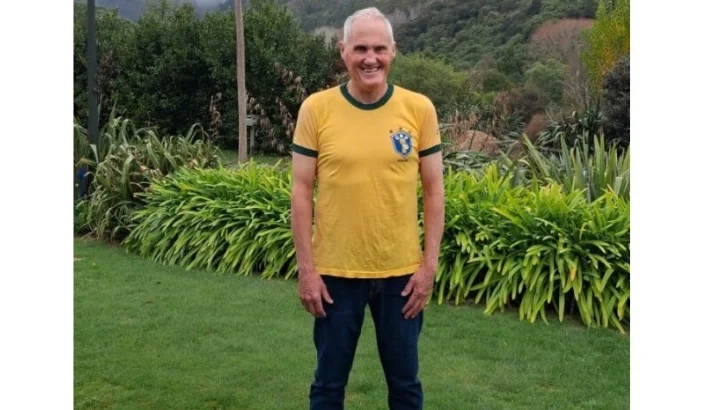
“One of the Brazilian subs swapped shirts after the game. He got mine, the poor soul, and his still fits me,” laughs Peter.
Football really took off in this country after the gutsy World Cup campaign.
“But then it went through a bit of a malaise. I don’t think the powers that be knew how to take the game to the next level.”
Injuries and waning interest saw Peter’s international career conclude in 1985, after 28 appearances, and he returned to Nelson the next year.
“Looking back, I probably should have carried on.”
After 30-odd years in landscaping, the now 67-year-old is a casual orderly at Nelson Hospital, but his passion for World Cup football remains.
The 1982 team had a big 20th reunion in 2002 and earlier this year they gathered with the 2010 squad and the 2026 contingent for a dinner at an Auckland hotel before the All Whites match against Chile.
“They put some of us old buggers on tables with the younger players. They asked for our opinions. It was really good.”
So, after the 1-0 loss to England and 4-0 defeat to Haiti in warm-up matches in the United States, how does Peter think the current crop will fare at the World Cup.
“They are in a harder group than people imagine. Iran will be difficult first up and Egypt and Belgium won’t be easy either,” warns Peter with his punter’s hat on.
Nelson will be represented at the 2026 World Cup by Callan Elliot, the Scotland-born right back who began his career with Tasman United, while former Nelson Suburbs forward Jeremy Brockie was in the 2010 squad that went to South Africa.
