
Samantha Gee of RNZ
*Correction: This story has been updated to clarify comments made by Dan Burrows
Fishing boats that can function without crew and be controlled remotely are being developed by a Nelson-based business, with plans to have prototypes out on the water within five years.
Uncrewed boats - called autonomous vessels - are used for research and surveillance in the world's oceans, but they are not being used to catch fish.
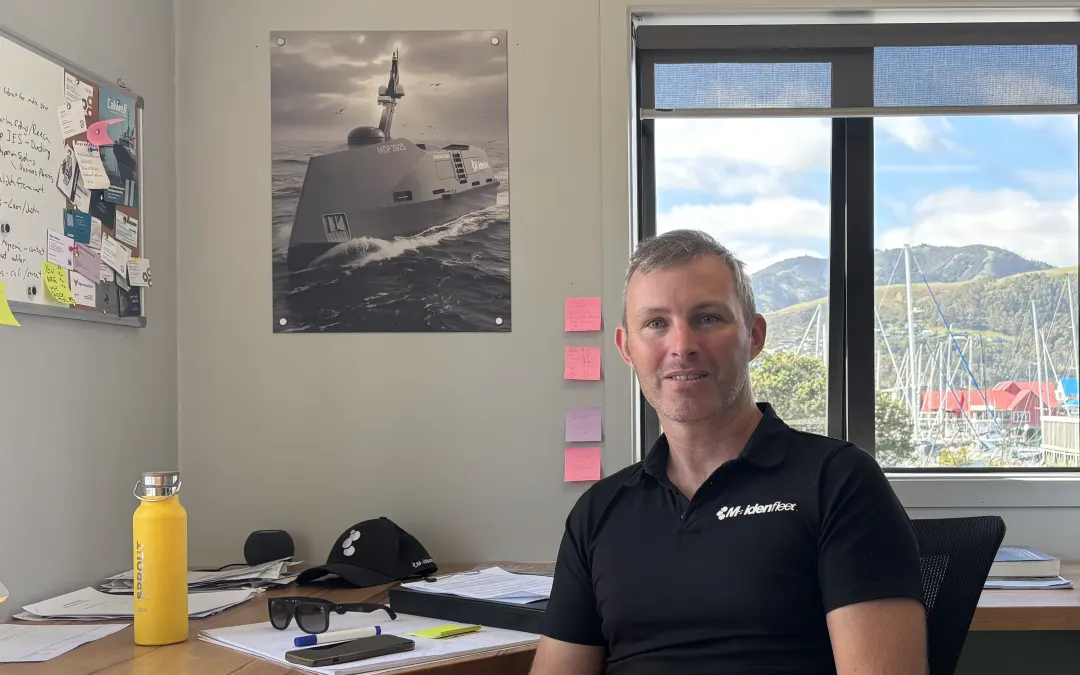
Maidenfleet chief executive Dan Burrows said it was a new, ambitious approach to inshore fishing that could address some of the pressures facing the industry.
His interest in the maritime world grew as a child in South Canterbury watching the America's Cup. He became a boat builder by trade, worked on super yachts in the Middle East and later spent time working in high performance racing with SailGP Technologies.
The idea for Maidenfleet took hold during the Covid-19 pandemic. Burrows and his family were living in Auckland, the centre of the boat building scene, where he had been working in the composites industry.
Having worked on the fringes of the fishing industry, he said he had noticed scope for better efficiencies and was working to redesign the traditional fishing boat by automating key harvesting and vessel functions and reducing the need for crew to be physically present at sea.
"Our technology is designed to reduce the industry's dependence on crew by automating a number of harvesting and vessel functions that are becoming increasingly difficult to staff," he said.
Burrows says Maidenfleet was not simply about removing people from boats. It was about improving safety, addressing labour shortages, enhancing fisheries data collection and reporting, reducing environmental impacts, and creating a more sustainable operating model for commercial fishing.
Up to half of the space on a fishing boat was taken up by features designed for people, Burrows said.
"When you take someone off a vessel you can eliminate all of that so you can use 100 percent of that internal space for storage or working equipment areas and in doing so you can reduce the size of that vessel. So you've got less capital outlay, less vessels out there doing the same job."
Burrows said he was often asked about job losses if fishing boats could function without crew.
"I just tell people, when was the last time technology ever removed any jobs? It might take two jobs off a boat, but we're going to create five on shore, so it's that old chestnut," he said.
He said prototypes were in the early stages and looked entirely different to traditional fishing boats.
"If you think sort of stealth military technology, think F-35 fighters but on the water, it kind of looks like that," he said.
"What's really sped up our development is there's a lot of existing technology from other industries that we can cherry pick, we're not reinventing the wheel in most cases. It's applying existing technology, boxing up and putting it into the fishing industry."
Burrows had self-funded the work and established a marine maintenance business in Nelson, Shipwright Services, which does marine carpentry, composite repairs, structural work, interior fit-outs and finishing.
He estimated there were several years of research and development ahead and it would be three to five years before vessels were on the water, although that could happen sooner if funding allowed.
Obsidian Systems chief executive Philip Solaris said the robotics company's research and development arm - X-craft - specialised in building uncrewed boats and aircraft.
It had trialled uncrewed boats that could detect illegal fishing, help with search and rescue by deploying life rafts and assess cyclone damage to remote islands by launching aerial drones.
Solaris said the sea was often described as more challenging than outer space.
"It is an incredibly aggressive, difficult environment to work in and what I mean by that is that it's fine if you just want to pop a boat into the water for a couple of days but to get it reliably operating over a long period of time with with anybody on board is quite a challenge," he said.
Solaris said X-craft had developed software that let multiple unmanned boats work together.
"We're talking about collaborative robots, boats working with each other and then humans being there on call to make overall decisions if needed," he said.
Solaris said wider adoption of the technology relied on investment and extensive trials in order to demonstrate safe operations at scale.
As for autonomous fishing boats, Solaris said he would "never say never in the robotic realm".
"I would have to say that when we look at autonomous systems, we want to ask the question, is this doing something better than humans can do and is there value in doing that rather than just removing people out of the economic equation?"
Solaris said the company had a strong policy on humanitarian and environmental issues so it was focused on developing technology that helped humanity rather than consolidating wealth.
"I have had people approach me asking us to develop systems to better strip the seas of fish, which I rejected rather fiercely, but if they were to come to me and say, 'well actually we want to improve the quality and the reliability and lower the impact on maritime operations', then that would be highly desirable for us," he said.
Earth Sciences New Zealand wild fisheries chief scientist Richard O'Driscoll is an expert in counting and measuring fish.
He worked with X-craft to develop two autonomous boats that were fitted with the fish finder equipment used for estimating fish abundance and trialled in the Hauraki Gulf and the Cook Strait in 2020 and 2022.
"What we were trying to do is test the viability of using those autonomous vessels instead of a research vessel to go up and down and count fish," he said.
O'Driscoll said it was a more cost-effective way to collect some data but had its limitations, including being unable to capture fish to provide biological samples.
"The advantage of those sort of platforms is not to replace what we do from crewed vessels or research vessels but to basically augment what we do by allowing greater coverage in space and time by having a cheaper option to put into your survey programme," he said.
Automated monitoring of the ocean was happening every day through a range of drifting, moored and mobile platforms, O'Driscoll said.
"We have automated glider systems that we use to measure oceanography, self-propelled gliders that go up and down in the ocean measuring things like temperature and salinity. We also have autonomous oceanographic floats that go up and down in the water column, collecting information on water properties and then transmitting that information via satellite back to a receiving station," he said.
A Seafood NZ spokesperson said it welcomed innovation that benefited the industry, with fishers always looking for catch efficiencies and ways to support marine health.
"Fishing is highly regulated which can impede innovation, although amendments to regulations have been made to enable initiatives like FloMo, which significantly improves the quality of fish caught," they said.
Seafood NZ said some major advancements, particularly around bycatch, had come from people responding to changing conditions as they developed.
It was working on an innovation programme in a bid to continue finding opportunities to improve fishing practices.
This story was first published on rnz.co.nz
