
The timeline for the entire Hope Bypass remains murky, and Nelson’s two major party candidates are drawing battle lines around the project.
On Thursday, the New Zealand Transport Agency released its Major Transport Projects Pipeline, which details the prioritisation of the Government’s key roading projects over a more than 10-year timeline.
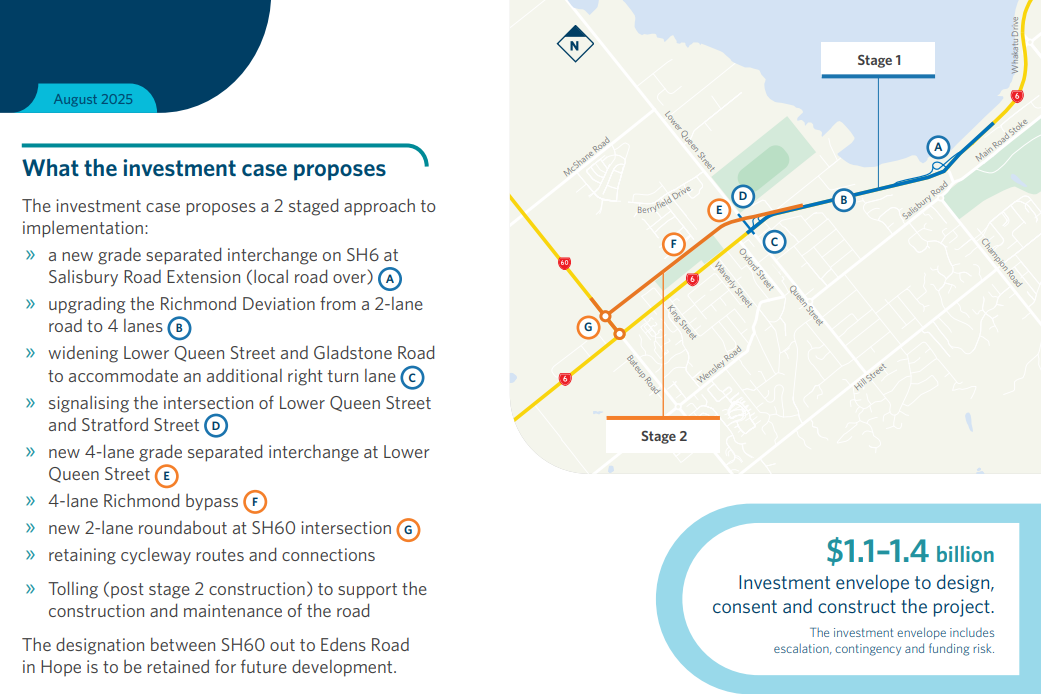
The Hope Bypass’s first stage – upgrading the State Highway 6/Queen Street intersection in Richmond – was within the pipeline’s second phase, which is about preparing for construction.
Almost $73 million has previously been allocated for its pre-implementation work, such as design and consenting, within the 2024-27 National Land Transport Plan.
No further funding or timeframe certainty for the Hope Bypass was provided within the pipeline released by NZTA.
However, the bypass’s first stage was one of only four projects within the pipeline’s second phase that were marked as “implementation ready” beyond 2027.
The second stage of the Hope Bypass – building a new highway parallel to Gladstone Road – was in the pipeline’s third and final phase, for projects that were “continuing more slowly”.
After 2027, the second stage was only signalled to move to pre-implementation/ implementation.
The pipeline reinforces the timelines that have been previously signalled by the Government and NZTA since the bypass’s two-stage investment case was approved in October last year.
Labour MP for Nelson Rachel Boyack says the timeline was “extremely frustrating”.
While the first stage of the Hope Bypass appeared “locked in”, she is concerned that the second stage – the “most important part” of the project – might never be delivered.
“We were promised, by National, the full Hope Bypass; they’ve put it through a fast-track process as part of the legislation, but this looks like slow-track to me.”
She highlighted that the South Island only had two Roads of National Significance, and half of Nelson’s was uncertain following a “massive blowout in the cost”.
When National campaigned on the Hope Bypass, it had been budgeted to cost $250 million.
The project now has an expected cost of between $1.1 and $1.4 billion.
“They made a lot of promises, and now they’re having to wind a lot of that back,” Rachel says. “That’s not a good enough outcome for the South Island. We need certainty on the second phase.”
But Blair Cameron, National’s candidate for the city in the upcoming election, who missed out in 2023 by 26 votes, said the party remained “100% committed” to both stages.
It was “good news for the region” that NZTA was prioritising the first stage of the Hope Bypass.
“The less great news… was that there has been a big drop in the funding in real terms available in the National Land Transport Fund.”
In real terms, fuel excise duty fell 21% since 2020, while construction costs have risen significantly over the same period, partly due to conflict in the Middle East.
“That has meant that of several of the Roads of National Significance in the pipeline, the timing for those has been delayed a little bit,” Blair says. “It is important to phase the road.”
He says that the project would be jeopardised under a Labour-led government because of the party’s policy to “raid” the National Land Transport Fund to fund its public transport fare cap.
“I’m somebody who is going to fight tooth and nail to make sure that we get prioritised.”
An NZTA spokesperson says the agency “remained committed” to the full scope of the project.
“[We] will continue to progress detailed design for the project, with the priority being to finalise design of the SH6 Gladstone Road and Lower Queen Street intersection improvements.
“When funding is available, we will then progress the detailed design for the other sections.”
When previously asked about their concerns about only the first stage of the Hope Bypass being delivered, the region’s two mayors were unfazed.
Tasman mayor Tim King said that the first stage addresses the “major problem” of congestion at the Queen Street intersection, while Nelson mayor Nick Smith thought it was better to get problems solved sooner rather than waiting longer for a complete package.
Both National and Labour campaigned on building the Hope Bypass in the 2023 election.