
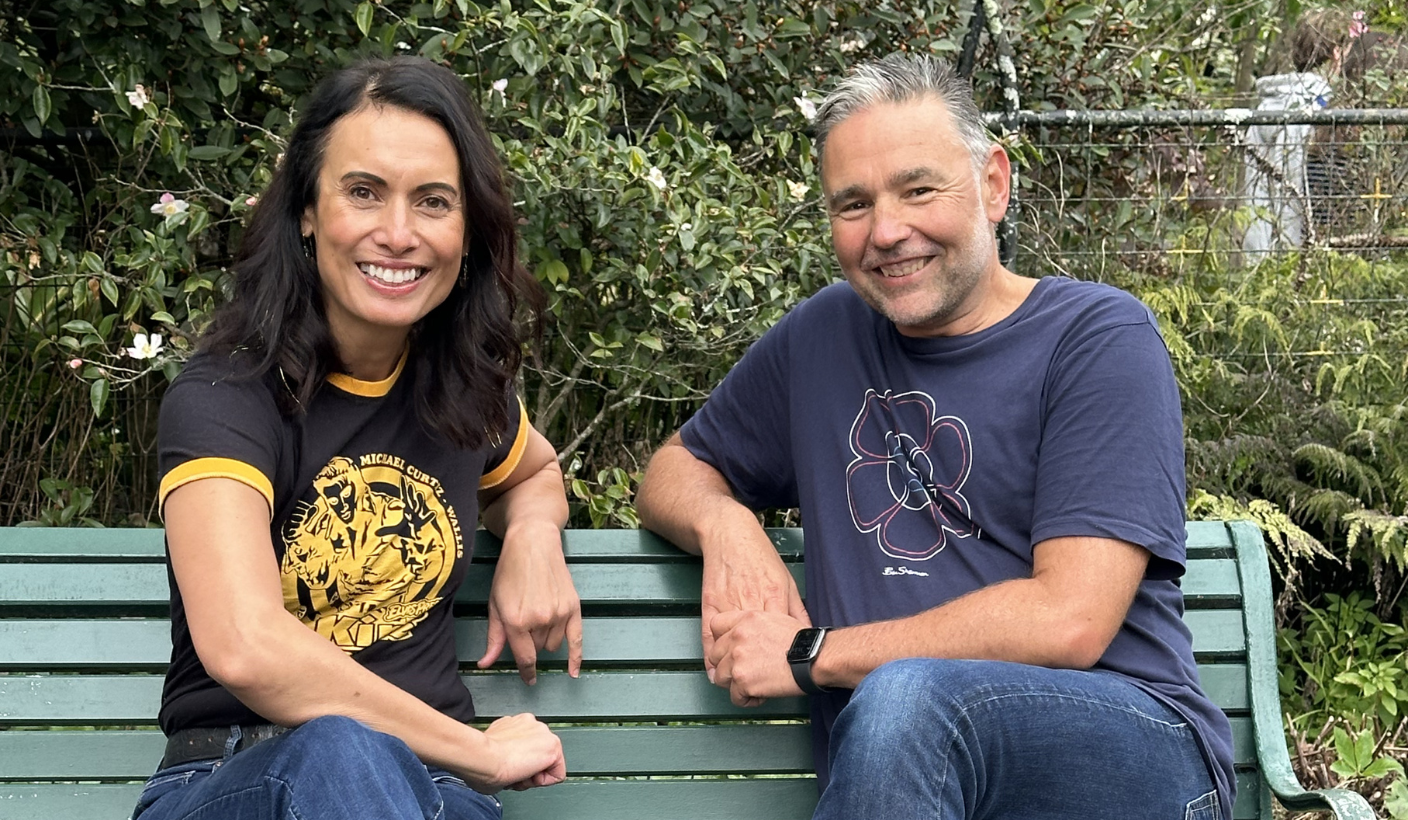
For some people, an ADHD diagnosis isn’t something read between the lines of a school report – it turns up decades later, after a lifetime of losing keys, overthinking conversations, and wondering why everyone else seems to be keeping things together. Britt Coker finds out from two Nelsonians what it’s like to get a diagnosis much later in life.
Amy Cunningham doesn’t mince words when describing her life last summer. “I just kept f**king things up and I got to the point where I had another massive life event, and I looked around at everybody else my age (48) and was like, why has everybody else got it together? Why do I keep doing this? And so that's when I really decided to get some answers, and firstly, delve a bit deeper into, ‘Could it be this?’ because people have been saying to me for quite some time, I think you might have ADHD.” And sure enough, she did.
Marie McManaway, Neurodiversity Clinic Coordinator and Administrator at The Nelson Clinic, says Amy's experience is a familiar one. "Many adults tell us they've spent years wondering why everyday tasks seem harder for them than they appear to be for others. A diagnosis doesn't change who someone is, but it can provide a framework for understanding lifelong patterns and experiences."
Looking back on her childhood, Amy says it seemed obvious. While she was described as a gifted child due to her hyperfocus – completing high school by the time she was 15 – she also found life challenging from a social perspective. “I have always found it quite difficult to maintain friendships, which is another classic sign, a bit of a loner. You always feel different. I actually have autism as well, which is something that they found out from [tests] last year. But another thing was my son has autism quite significantly. My older brother was diagnosed with ADHD a long time ago, and there's a lot of neurodivergence in my family. My parents, looking back, they were too.”
One of the reasons it is hard to maintain friendships and handle disagreements is not just due to atypical cognitive function, but real-life experiences. Amy shares a well-known quote. “By the time you're 10, someone with ADHD has received 20,000 times more criticisms than a neurotypical kid.” This is an estimate from a child psychiatrist who calculated that a hyperactive child might receive an average of three corrections from teachers every hour of the school day. There is no official research to back this number up, but it has likely received traction because the figure seems entirely possible. If we were all told repeatedly to ‘behave’, I imagine we’d also end up with low resilience to the emotional paper cuts of daily life. Officially this is called Rejection Sensitivity Dysphoria (RSD).
“It's programmed into us to think that we’re always doing something wrong, always thinking everyone's mad at us. We'll pick up on little things like tone. We're masters at pattern recognition, so someone might say something that's ordinary or neutral and, for us, our brain will just fire out 20 different possible meanings for what that person has said. I think in a way it's kind of sad because we're trying to protect ourselves, but we're also so desperate to just fit in.”
In the years preceding her diagnosis, it was suspicions of anxiety and depression that instigated repeated visits to her GP. “When you're in a hyper- fixation, then what follows, it's called ADHD burnout, which is natural, right? Because you're absolutely exhausted. You might have been stuck in whatever mode for days. You likely wouldn't have slept properly, wouldn't have eaten. Your brain is just like absolutely on fire and you're loving it, but naturally what goes up must come down, so then that sort of looks like depression.”
There is actually a strong correlation between ADHD and depression. Researchers reviewed the mental health records of six million people in Denmark over 17 years. They found that those diagnosed with one mental health condition were more likely to have, or later develop, a secondary condition. For example, they found that people who developed a mood disorder before age 20, 40 per cent of men and 50 per cent of women later developed a secondary condition within fifteen years. This kind of overlap is common for people with ADHD. Among adults with ADHD, about 47 per cent also have depression and 53 per cent have anxiety. Sleep disorders are also common.
Males are diagnosed more often with ADHD but they researchers now suspect females are there in similar numbers, it’s just been buried a bit by a couple of things. Behavioural tendencies, being one, says Amy. “If you think back to what the classic ADHD person was, it was like a really naughty boy, right? But that's not it at all, that's just one presentation, and so a lot of girls in particular get missed with ADHD as well, because we're so good at masking. Quite often it's the quiet ones, which was what I was like as a kid, actually. And with hormonal changes, it's quite tricky.” ADHD girls may look like they’re daydreaming when it could be a brain with too many tabs open. But we keep it together for years and then perimenopause comes along and the coping strategies aren’t enough anymore. Before you know it, you feel like you ‘just keep f**king things up.’
Marie says growing awareness is helping to identify people who may previously have been overlooked. "We're seeing increasing recognition that ADHD can present differently in girls and women. Many people have developed effective coping strategies for years, which can make symptoms less visible until life demands change."
With diagnosis comes the option for medication. For Amy, the meds have done their job and her highs and lows have evened out. Overall, she is happier with Amy 2.0 but also admits she probably wouldn’t have achieved so much if she’d been diagnosed years earlier. “What used to happen before medication – and again, it's a blessing and a curse – I would be having constant creative waves. So as a songwriter [non-professional], I have a lot of songs coming in, I call it coming in, because that's how it feels. It's like almost being a portal or something to creative stuff. It's amazing, but I would have to drop everything and just focus on that because it felt so urgent. But because my dopamine is managed with the medication, it's not like it used to be. So I can sit down and go, okay, I'm going to write a song now, and think more practically about it, and then it still happens, but it's controlled.” She misses those creative waves coming in. The portal door, just ajar now. But that’s okay. “Once you get your dopamine regulated, you just feel better about yourself because you're not just doing things that you're not supposed to be doing to get [natural] dopamine... I'm not a huge fan of pharmaceutical drugs actually, but I don't think I'll ever stop taking my ADHD medication, because I'm just a better person all around with it.”
We might think that ADHD is a modern disorder as it wasn’t widely recognised known about before the 1980s. However, it was first noted in German medical literature back in 1775. Then in 1798 it appeared in the English language when a Scottish physician, Sir Alexander Crichton, wrote of it, "Every public teacher must have observed that there are many to whom the dryness and difficulties of the Latin and Greek grammars are so disgusting that neither the terrors of the rod, nor the indulgence of kind entreaty can cause them to give their attention to them."
Despite the first official recording of ADHD being 245 years ago, the disorder – somewhat ironically – only got decent attention from the medical profession relatively recently. ADHD’s awareness campaign has also been hampered by generational rebranding. In 1968 it was called Hyperkinetic Disorder; by 1980 it was ADD; in 1987, ADHD; and then finally in 1994 they added a slash and three subgroups to get us to where it is today, AD/HD. The slash delineates between two presenting types as well as a potential for overlap. Recognising these three subtypes provided greater identification in girls and preschoolers, and less biased towards boys. However, virtually no source uses the slash, even though someone with AD may not have HD, and vice versa. Since both types share the same brain chemistry, separating them completely would also be incorrect. So technically it requires a slash, but colloquially it is not used.
Richard Butler was also diagnosed late, at 53. It was his sister receiving a formal diagnosis that made him think about it. “She was telling me about her symptoms, and I said, ‘Wow, that feels a bit familiar’, and she said, ‘Yeah, you should probably go and get tested’. So I went through the process, it took quite a long time, almost a year from start to finish, which seems to be quite normal in New Zealand, and probably not ideal.”
Society’s late awareness of ADHD means adult diagnosis is common. Richard suggests, “I think, unless you were that child who ran around and threw chairs in the classroom, and was very disruptive, it wasn't really considered as an option. So, I think what's happened is the diagnostic techniques and tools are just getting a lot more sophisticated, so it's easier to spot in people nowadays.”
It’s also common for more than one sibling in the family to experience symptoms, which perhaps makes it harder for parents to recognise behaviour that is atypical. The Butler siblings also didn’t have the disruptive symptoms you associate with ADD (Attention Deficient Disorder),which were the presenting symptoms teachers were looking for in the 80s and 90s. “We weren't over the top in many ways. In fact, if anything, I was quite a quiet child, and I would just disappear off and read books and that kind of stuff.” He was hyper-focused, rather than hyperactive. “But it started becoming more apparent to me, when I thought about it, going back to around the age of about 13 or 14, that's when I stopped being top of the class at school and started slipping down the ranks a little bit. Not that I ever did badly at school, but I think that's when it started to really manifest for me around that time.”
Richard, being someone who didn’t even suspect he had ADHD, never thought to look, instead he just created work arounds. “I know that I have built systems and ways of behaving in my life that I needed to operate, but which unknowingly were based around the symptoms of ADHD. So, for example, my wallet and my keys, they have to live in one of two or three places, and if they're not in that place, I have no idea where they will be.”
Open-plan office environments and device notifications can also be challenging. The answer for Richard was noise-cancelling headphones and making sure that any notifications that could pop up on his computer or phone, didn’t. While most of us will relate to this tendency to be easily distracted by devices, the difference with ADHD is that it impairs functioning across all life areas (work, relationships, home) and does not improve simply with rest, reduced screen time, or removal of stressors.
When you’ve lived a decent chunk of your life with an undiagnosed condition, it must feel a bit like you are starting again as a different person. The grief of ‘If only’ kicking in. Richard agrees. “A lot of people who get diagnosed go through this period of time after diagnosis where they get into a little bit of a slump, and go, ‘What have I missed out on?’”
But then, the portal has also been fully operational all that time. “A lot of people who have ADHD consider it a superpower, for want of a better word, and there are certainly areas in my life which have benefited from being that way… I mean, a lot of people who have ADHD are insanely creative." Amongst those it has been theorised to have had ADHD are Thomas Edison, Albert Einstein and Mozart.
The major upside to a diagnosis is that it can provide clarity, relief and understanding around lifetime behavioural patterns that most other people didn’t recognise or relate to. Says Richard, “Oh well, now I understand why that was that, and this was that, and things were as they were.”
Marie says there is often a profound sense of validation. "One of the most common responses we hear after a diagnosis is relief," says Marie. "Many people describe finally having an explanation for experiences they've carried with them for decades."
The process to finally get a definitive answer ‘is fairly involved’. Richard found it heavy on detail, lengthy in time and expensive in outcome. A lot of questionnaires are to be completed by you and family members, and interviews with a clinical psychologist. The final test, of course, is to tell close friends of your diagnosis and for them not to be surprised in the least.
With a confirmed diagnosis validating your suspicions, your GP then prescribes medications. The good news is that as of 1 February this year, Pharmac’s rules for prescribing (and re-prescribing) ADHD medicines changed to allow a wider range of health professionals to start people on these medicines, including nurse practitioners in child and adolescent mental health services. The aim being to improve access and reduce wait times for ADHD treatment.
Of course, the final test is to tell close friends of your diagnosis and for them not to be surprised in the least.
Medication has also made a big difference to Richard’s life. “I find conversations where there's conflict much easier to handle. That was something that could be really problematic for me, because I would spend a long, long time before those conversations came going through my head over and over and over again. What I was going to say, that would cause me issues of with sleep and things like that, so I don't spiral-think like I used to, and that's really nice.” It’s the thoughts that count. He is also able to focus better on tasks and his sleep has improved.
While medication can be transformative, Marie notes it is only one part of the picture. "Medication can be life-changing for some people, but it is only one part of treatment. Understanding how your brain works, developing practical strategies, and addressing any co-occurring difficulties are equally important. Many people find coaching and talk therapy beneficial."
Last year, Richard and Amy, both united and inspired by their late diagnoses, began a podcast they called The Juice, to share their experiences and raise awareness about symptoms, diagnosis and treatment. Explains Amy, “I think the reason that we started the podcast was just because it can be quite an isolating journey when you finally decide to go and get the diagnosis and get some support in whatever way that means for you. You can feel quite isolated, and I just wanted to be able to reach out to people who are feeling alone, because it is a bit of a solo pursuit anyway. You kind of feel different your whole life, and then to have that validated is quite a confronting process, although it is ultimately awesome. I've found, anyway. Because you learn more about yourself, and then you can get help. It sounds a bit cheesy, doesn't it? But just for people to know that they're not alone. It's so cool now that more people are getting diagnosed and there's more talk about it.”
The Juice: The ADHD Podcast, available on a podcast platform near you.
ADHD symptoms
1. Predominantly Inattentive (Formerly called ADD)
People experience the "attention deficit" side but have little to no physical hyperactivity. In adults, this is often an internal struggle and can easily go unnoticed by others. Symptoms include being easily distracted, forgetful, daydreaming, disorganisation, poor sustained attention, and difficulty completing tasks.
2. Predominantly Hyperactive-Impulsive
People display physical restlessness and struggle with impulse control, but they generally can maintain cognitive focus when required. Presents with excessive fidgeting and restlessness, hyperactivity, and difficulty waiting and remaining seated.
3. Combination of both
Many people experience both inattention and hyperactivity.
