
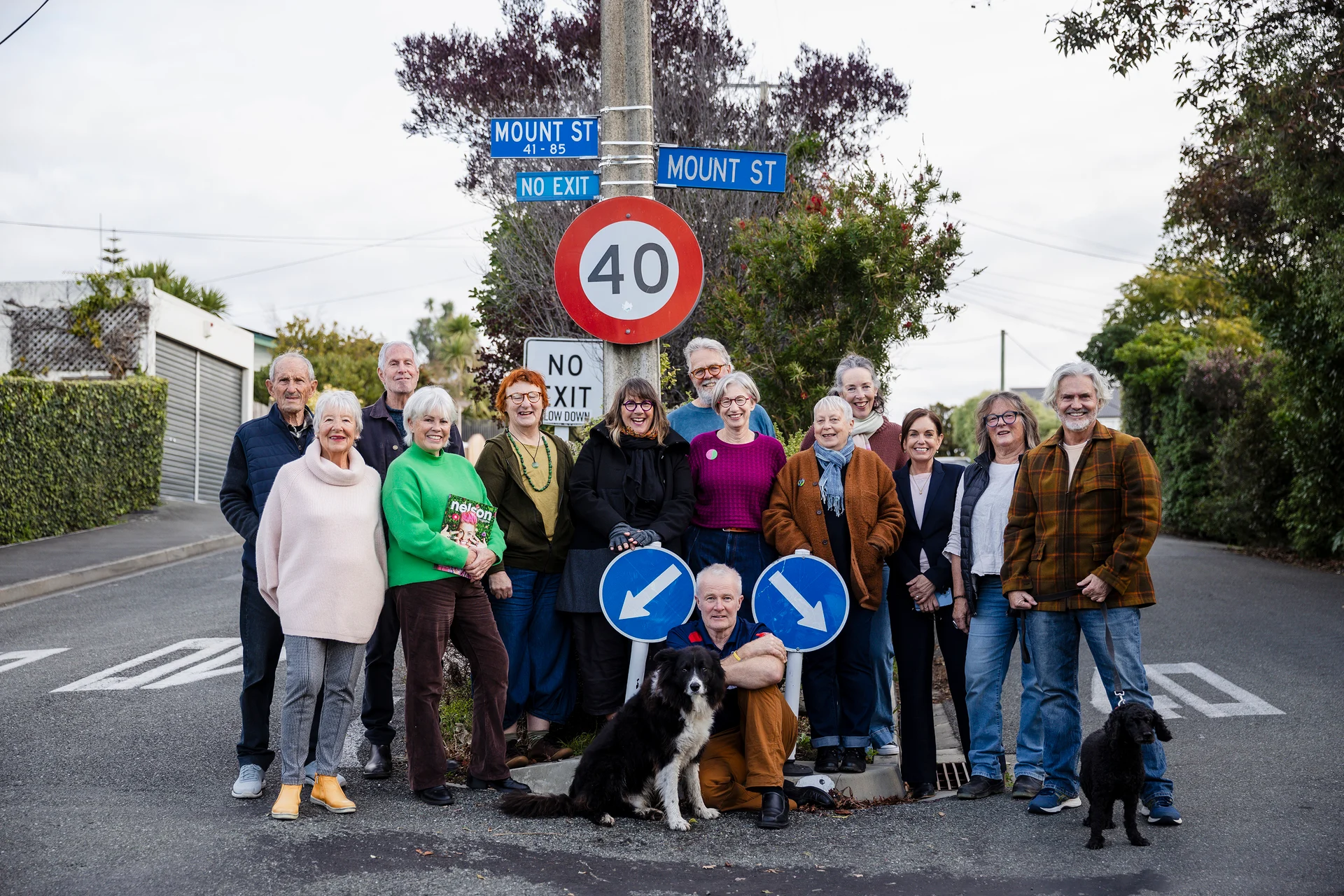
Perched above Nelson’s CBD, Mount Street is more than a collection of homes. Writer Adrienne Matthews chats with the residents who have shaped this unique neighbourhood over decades, uncovering the stories, traditions and neighbourly spirit that continue to make it one of the city’s most treasured streets.
Photos: Tessa Claus
For many Nelsonians who grew up in the 1960s and 70s, the street they lived in was more than an address. It was where children roamed until dinner, bikes rattled over driveways, neighbours borrowed sugar, swapped fruit, minded one another’s children and gathered for Christmas drinks.
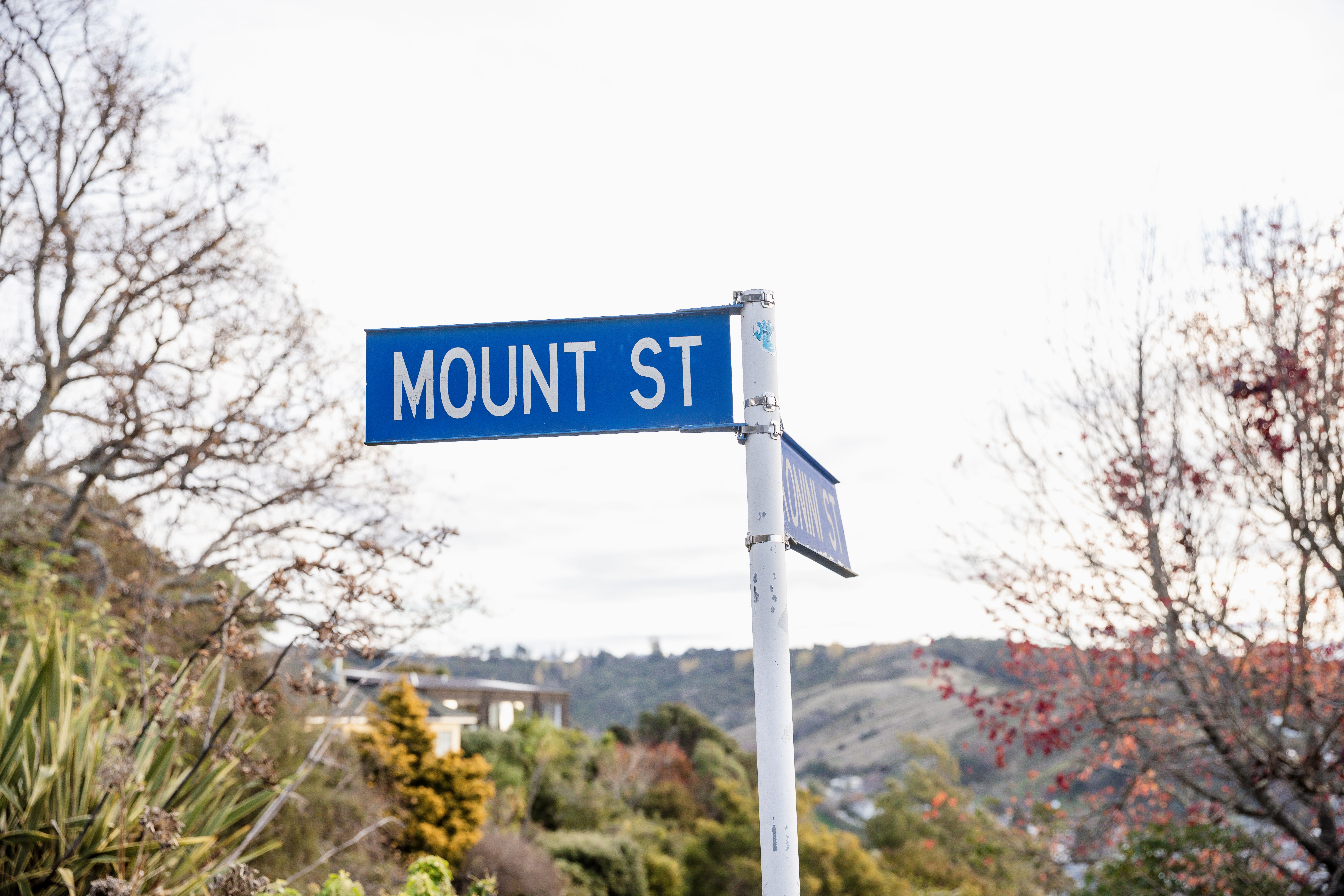
Today, that kind of neighbourhood life can feel like another era, but on Mount Street, tucked along a sunny ridge just west of Church Hill, something of it remains.
The street rises above Nelson’s CBD, high enough to feel private and leafy, but close enough that town is only a short walk away. There are glimpses across the Maitai Valley, towards the Haven and across to the Grampians.
The street’s history is part of the magic. It began life as a rough track along the crest of a ridge, with larger blocks of land owned by notable Nelson families and businesspeople. In the early 1900s, it blossomed into a lively residential pocket, with villas appearing one by one rather than as a uniform development. That piecemeal growth gave the street its wonderfully individual personality.
The houses span generations, from early villas and bungalows to later additions, softened by gardens and an abundance of greenery.
This is not a preserved museum street, nor a polished heritage precinct, although that was once mooted. Its charm is in the lives layered over decades.
Lloyd and Bridget Harwood moved to Mount Street nearly 29 years ago, looking for sunshine and a place where three small children could grow up with freedom. Bridget already knew it well; her parents lived there.
“It’s very friendly and very relaxed,” Lloyd says. “When we arrived there were quite a lot of young families and children in the street, which was great because we had young kids as well.” Those children are grown now, but the street has begun turning again. “Over the last 10 years, with new people coming in, it’s a family-friendly street again.”
People arrive for practical reasons like the sun, schools, proximity to town, but then find themselves held by something less tangible. Lloyd talks about “fabulous views” and “all-day sun”, as well as casual gatherings, neighbourly check-ins and a WhatsApp street chat where someone can ask for help. Their own story has come full circle: their children have returned to Nelson, and their daughter has bought a house just down the road.
Annie Leather and Rory Langbridge have lived on Mount Street for 26 years in a late 1940s house that has changed with the family it sheltered. Their daughter was 18 months old when they arrived, and their second child was born four years later. At one stage, Annie remembers, there were “probably about 14 kids within 10 houses or so”.
The street became an extension of home, with “endless games of kids playing on their bikes”, long evenings of spotlight with older children keeping an eye on younger ones. For Annie, what made Mount Street special was “the street camaraderie”. There were progressive dinners and, as now, the annual Christmas party. “We’ve made some of our best friends on the street,” she says.
She describes Mount Street as “a friendly little funky street”, helped along by its odd geography, with the road splitting and confusing visitors but its real character, she says, comes from the people. “It’s full of artists and craft creative people.” Once, when hosting Auckland women interested in collecting art, she realised she barely needed to leave the neighbourhood. “I could just take you up Mount Street,” she says. “We spent the whole day visiting the different artists here.”
That creative thread runs deeply through the street. Gill Starling and James Taylor arrived more than 20 years ago and found Mount Street quietly persuasive. “We never intended to stay here so long,” Gill says, “but it’s just such a good street to live in.”
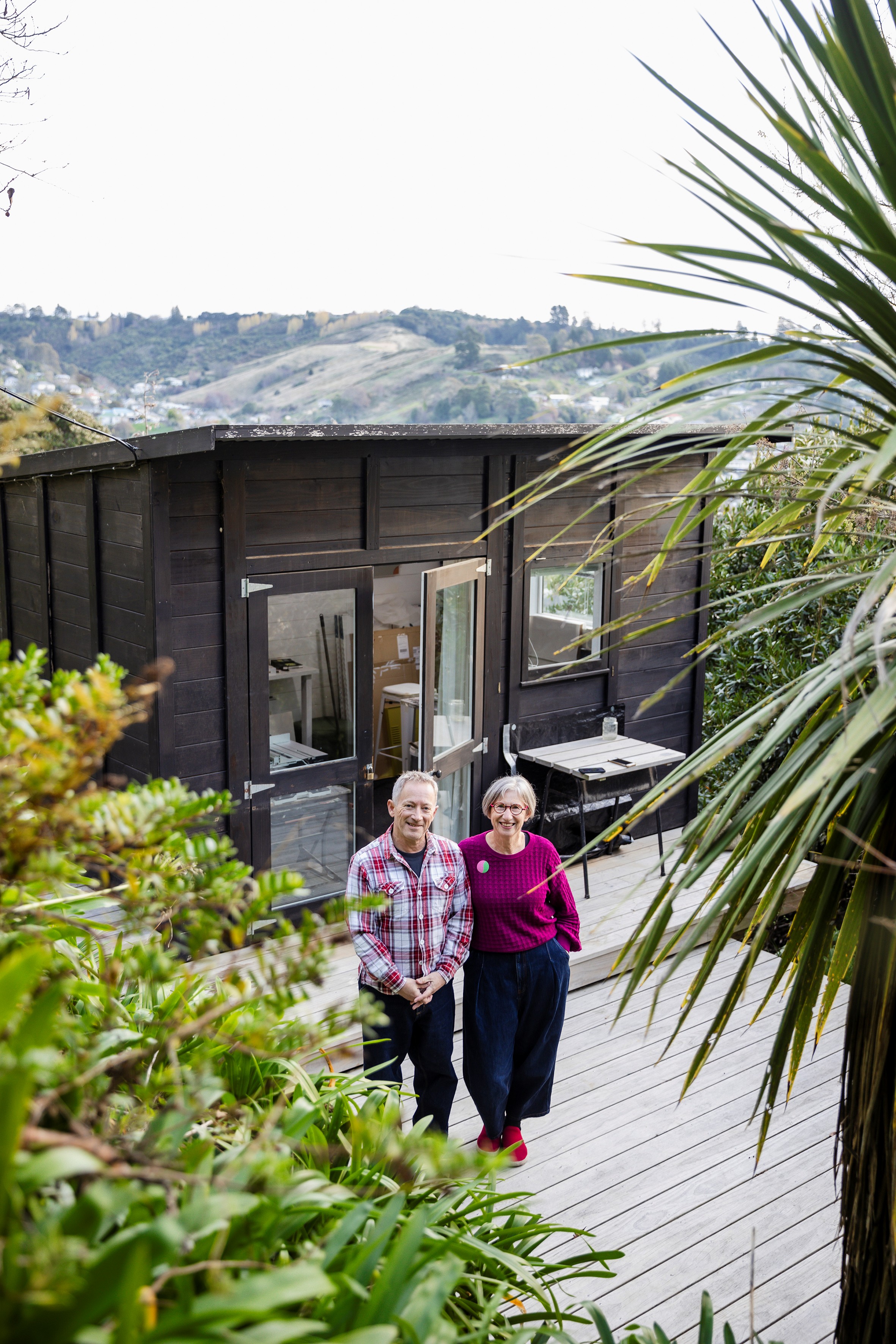
For nearly two decades, Gill and James were known through their businesses the Quiet Dog Gallery and The Framing Rooms, recently sold. Now James, who paints as Stan Bowski, has more time in his garden studio. “I’m from the UK, and it feels like you’re in the countryside,” Gill says. “There are plenty of established trees and birds and it’s quite quiet, but it’s also really handy to town.” They have considered moving for more workshop space, but “we can’t actually find anywhere that has the sort of charm of Mount Street”.
Over the years, the street has attracted artists, makers and people who shape their working lives around light, space and quiet. A few years ago, Quiet Dog Gallery hosted an exhibition featuring only Mount Street artists, nine of them.
Artist Nic Foster and his wife Susie moved to Mount Street 14 years ago because the family had always wanted to live there, and because the house had potential for a studio. “When we first came here, we loved the views that you can get,” he says. For a painter, the light matters. “The magic for me is on a Sunday morning, having a coffee and hearing the church bells, a reminder that you’re right in the heart of the city.”
Nic sees Mount Street as “very, very neighbourly. If someone needs “a step ladder, a chainsaw or a box of something or other”, he says, “it always miraculously appears.”
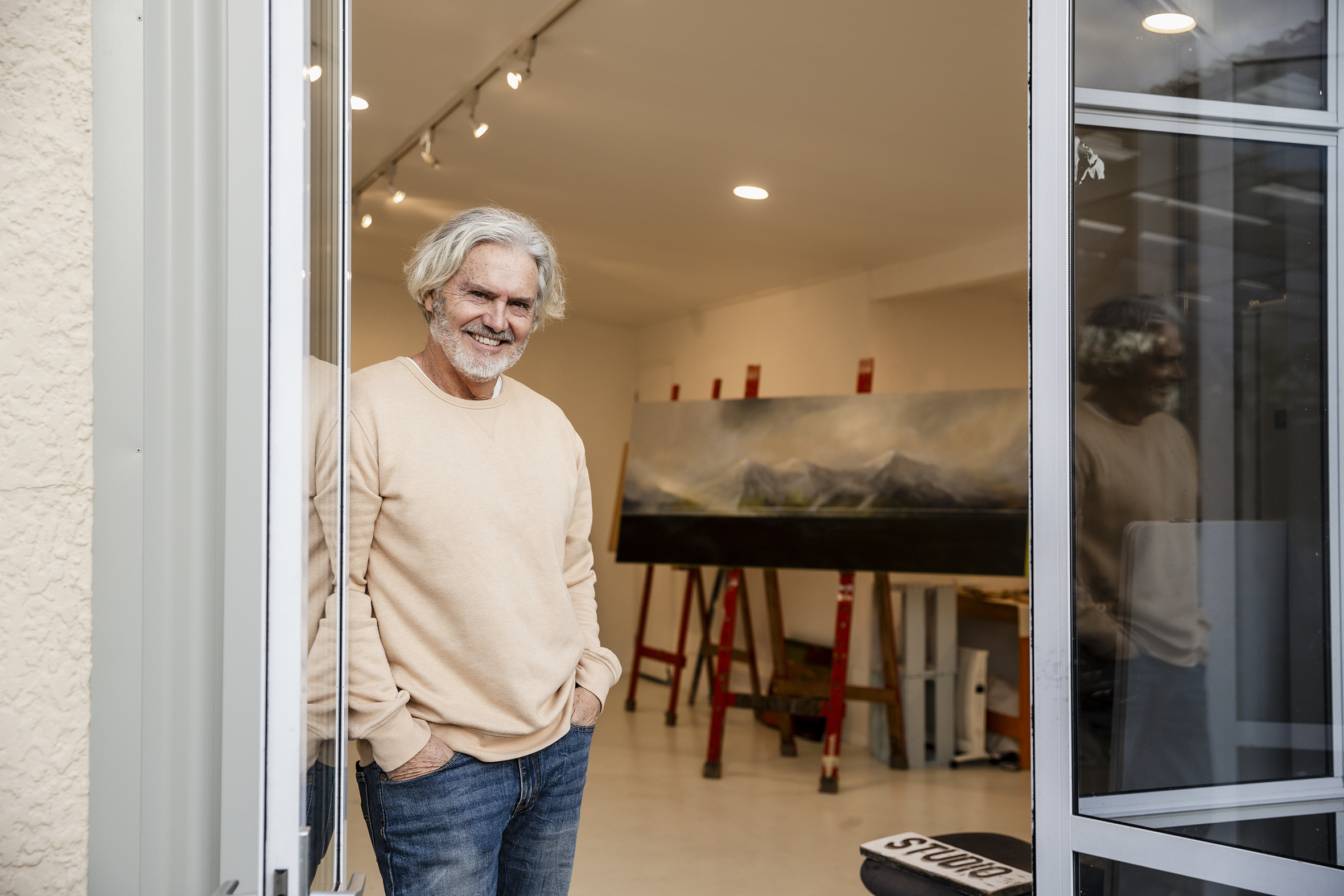
That practical generosity comes up again and again: fruit on a doorstep, chickens fed, a dog walked, a ladder lent, a tree trimmed, a Christmas gathering organised, a WhatsApp message answered.
It was in Mount St too where Nelson’s Art Expo was born, a popular event that continued from 2012 to 2019 when Covid hit. “We held meetings here and Annie was involved in the early days too. At one stage we had 177 artists showing their work.”
For Sue and her husband Pete Kortegast, who have lived on Mount Street for around 28 years, the street has been a place to grow a family, a garden and a much-loved way of life. They first arrived as renters after shifting to Nelson. Friends had found the place but decided against it. “They said, ‘You’ve got to come and have a look. It’s such a weird old house,’” Sue recalls.
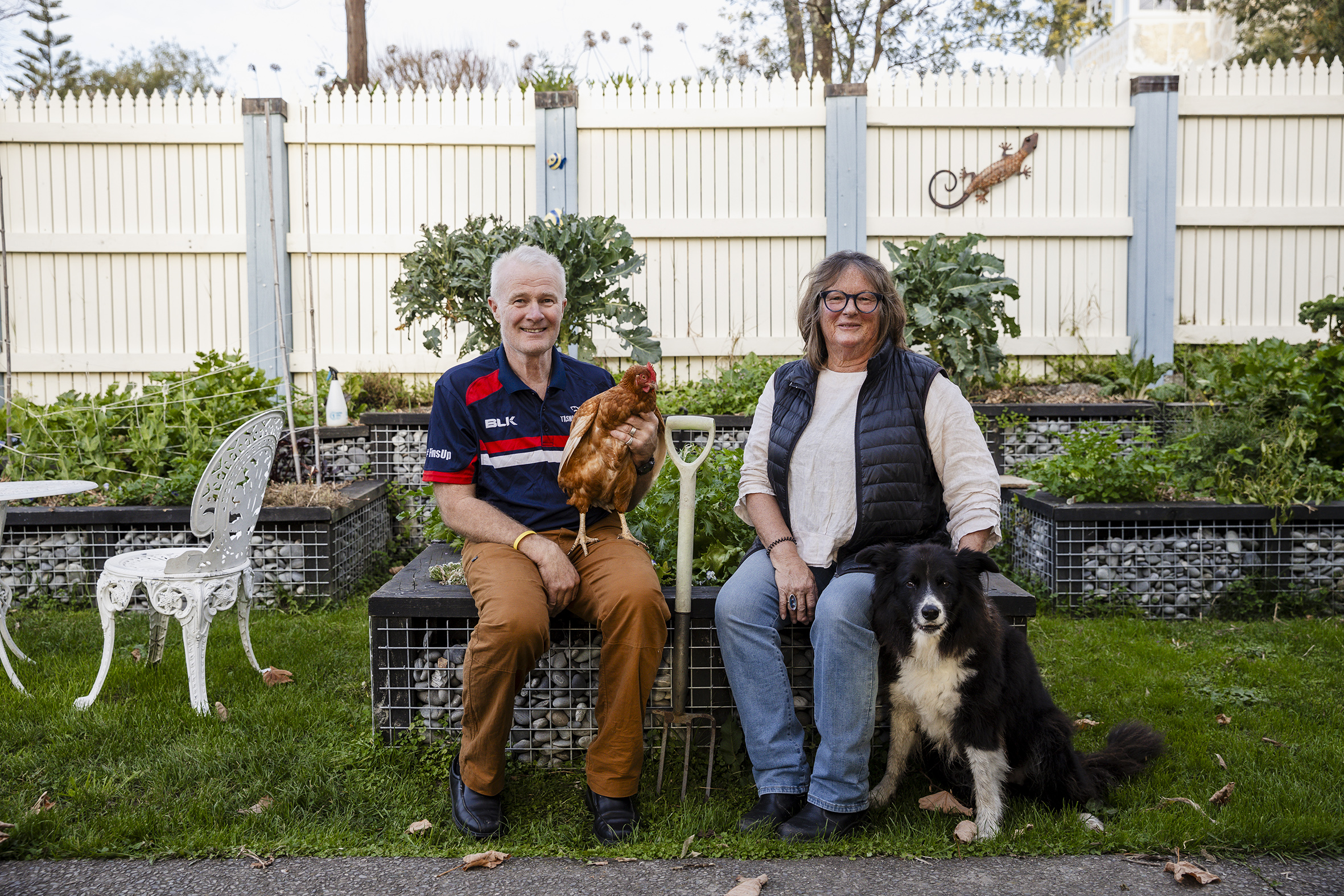
The house was rough, but the section was large, and over time they transformed it, keeping two heritage trees: a huge ponderosa lemon and a Braeburn apple. Now they have what Sue calls a food forest, with around 30 fruit trees, vegetable gardens, chickens and, at times, pigs and goats. “We’ve got fruit all year round,” she says.
That abundance spills into the street. Sue drops produce to neighbours; girls next door look after the chickens and take the eggs when the couple are away. One woman dog-sits for them; Sue and Pete trim her trees and chainsaw firewood in return.
Even their dog came from the street, after their daughter began exercising a plumber’s dog that was always left at home. When the owner moved away, the family kept it.
Mount Street has always had its quirks. When Sue and Pete’s children were young, one woman had a milking goat up the road. Their own house contains a climbing wall and a secret passage.
Adrianne and John Munting have the long view. Now in their 80s, they moved to Mount Street 55 years ago. When they arrived, the top of the street was full of children. “It was lovely. The children used to have their carts and they’d zoom down to where the join was from Konini Street. We had two tree huts on our property and they were always full of children.”
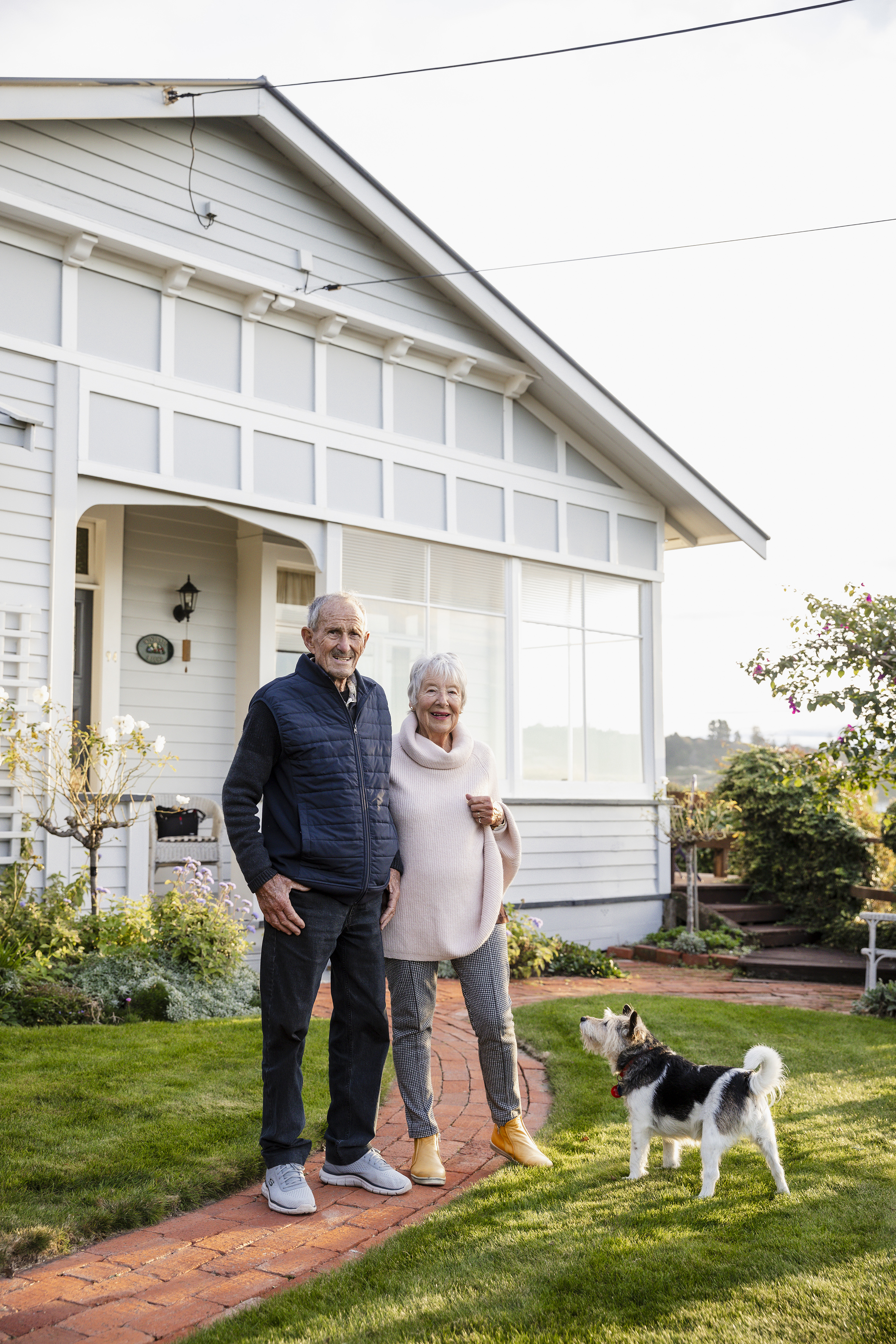
“There was a lot of neighbourly things that went on without us being in each other’s home,” she says. “People stood at the gate, chatted, asked after children, took turns helping with ballet lessons and cups of tea.”
To Adrianne, the street still feels recognisably itself. There are some new houses and some changes, but “basically it’s what it’s always been”. She and John share what their garden produces. “A lot of that goes on,” Adrianne says. “We’ve just done that with our persimmons. Last year John grew 57 pumpkins which were well shared.”
Their daughter and her family now live next door, in one of the street’s old villas. “Their villa was one of the first houses up here and the couple that owned it, they gave our section as a wedding present to their daughter which she built on. It’s been a lovely place for us to bring up our children and our grandchildren,” Adrianne says. Recently, when a new family moved in nearby and she saw their children going down the road on a little trolley, she called John to come and look. “This is wonderful,” she told him.
That renewal is also visible through newer residents such as Emma Marshall and her partner Jeremy Cook, who have been on the street for about six years. Emma grew up in Nelson but says she had barely known Mount Street existed.
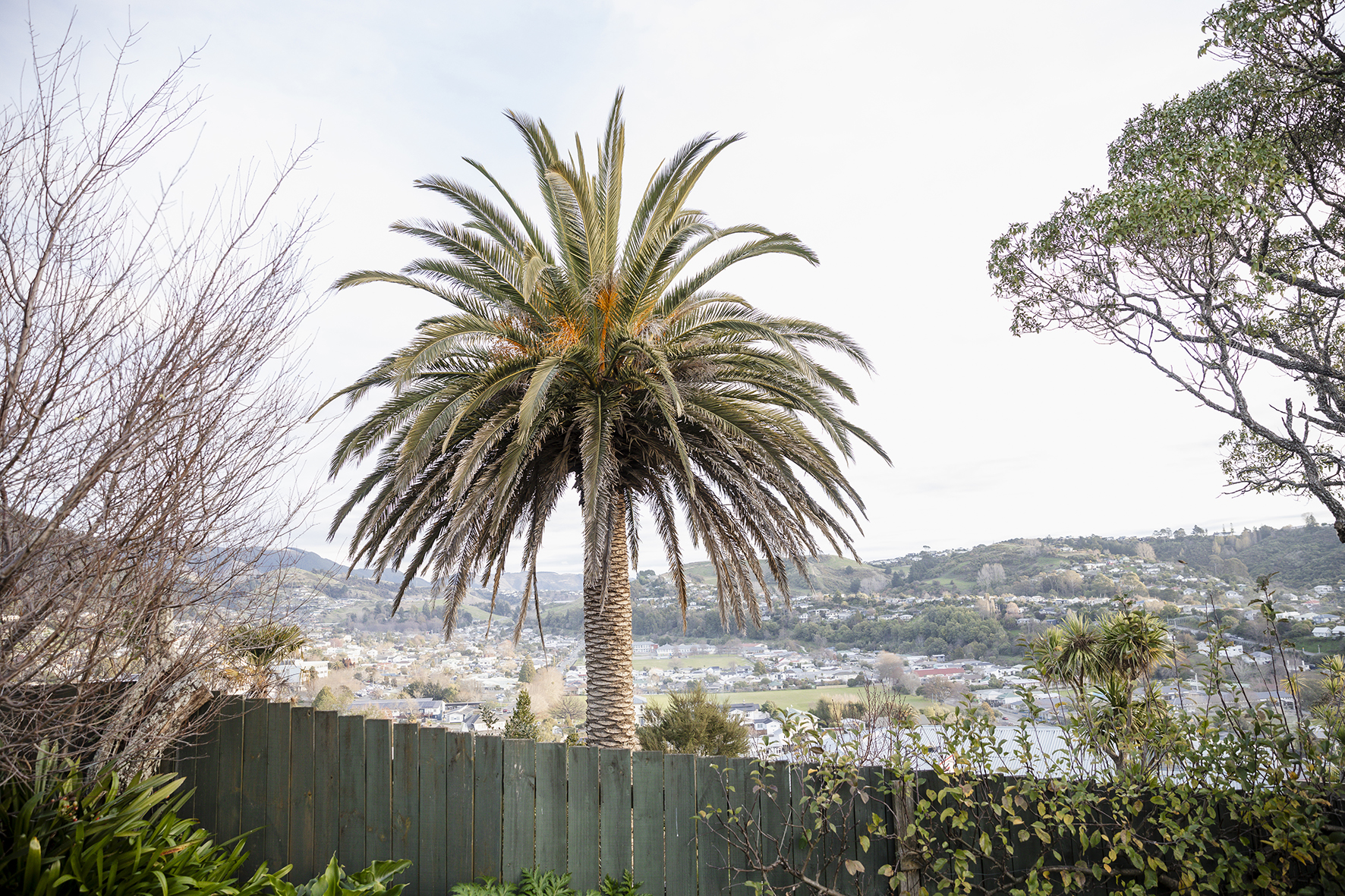
They wanted to be central, without a big commute, and felt lucky when a section came up. Their long, skinny property is almost 1,000 square metres. From the street, Emma says, you can look towards the sea and it feels “quintessential New Zealand and just like a little jewel.”
Emma has not only joined the community; she has helped activate it. After working full-time as a lawyer, she reduced her hours to do something practical for biodiversity. She began an urban backyard trapping group, at first just for Mount Street but now spread much wider. “I wanted to do something to help the environment,” she says, “to make myself feel less depressed about the state of biodiversity, even if I knew it was just a drop in the ocean.”
A letterbox flyer led to funding applications, a trapping plan and rapid expansion. The group now covers about 42 hectares spreading out from Mount Street, with more than 30 registered trapping households on the street itself. Rats are the main target species, and catches are logged on Trap.NZ but for Emma, the revelation has been people. “I found it so rewarding and heartwarming,” she says. “Trapping rats is not the most desirable thing to spend your days doing but it’s so worth it.” She speaks warmly of “amazing people generous with their time, kind people, and a supportive community.”
Mount Street’s WhatsApp group, little libraries, garage sales, Christmas gatherings and trapping network are modern forms of something older: the habit of knowing and considering one’s neighbours. Gill remembers the Covid WhatsApp group becoming “a great way of staying connected”. Annie remembers letterboxing Christmas invitations to the annual street Christmas party. Sue says there are often subgroups along the street. Nic sees potential for a street open studio day. Emma notices how word of mouth, letterbox stickers and local conversations build engagement.
The street has changed. Sue remembers when Mount Street “wasn’t an upmarket sort of a street” and says many houses have since been renovated and made beautiful. Infill housing has arrived in places. Long-time residents have watched children grow and leave, then new families arrive with bikes and school bags, but what remains is the same continuity of community. “It’s private. It’s friendly and it’s sunny,” Adrianne says. “Why would we move?”
Annie and Rory are often asked if they will stay now their children have left home. For now, the answer is yes. “We love the views and the sunshine and the proximity to town.”
Why leave a place where town is only minutes away, but birdsong is closer? Where children, artists, gardeners and old friends all seem to find the space they need, and where neighbourliness might arrive as a bag of fruit left at the door?
Mount Street is not remarkable because nothing has changed. It is remarkable because, through change, it has kept hold of the ordinary magic that makes a street into a community.
Then, in the middle of talking about Mount Street’s friendliness, its artists, its children and its years of neighbourly rituals with Annie, she pauses. A message has suddenly appeared on the street WhatsApp group chat. “Just bear with me a moment,” she says. “Oh. Someone’s missing a black guinea pig.”
