
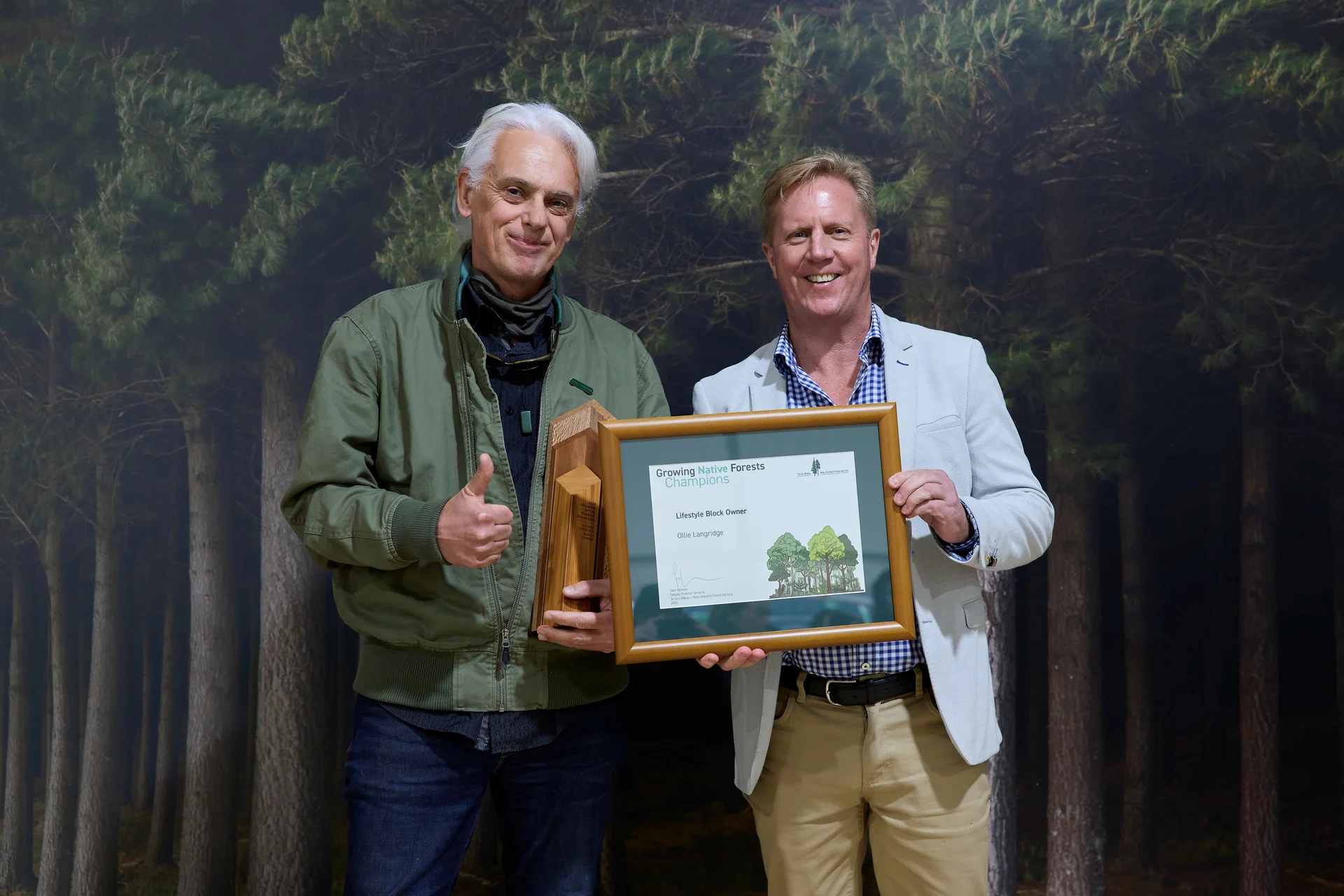
Conservationist Ollie Langridge thinks his award-winning lifestyle property isn’t just about restoring forests; it’s about helping people, too.
Ollie’s winning project, known as Rewilding, received recognition for his work restoring native forest, winning the Lifestyle Block Owner category at this year's national Growing Native Forests Champions Awards recently.
“It's great that work like this is valued and recognised,” Ollie says.
“Most people immediately think of Rewilding as returning landscapes to a more natural, self-sustaining state, but also applying that to people is both metaphorically rich and genuinely useful.”
“We've been tamed by screens, stress and systems, but under the surface we're still wild creatures, built for movement, community and wonder.”
Rewilding is based on Ollie’s 17-hectare Motueka River West Bank Road property in the lower Motueka Catchment, that has become one of the largest volunteer-led native forest restoration initiatives in the Tasman region.
Over the past five years, more than 450 volunteers from 23 countries have helped plant 17,000 eco-sourced native trees, while a further 500,000 seeds have been scattered on site.
Beyond restoring the land itself, Rewilding has become a hub for community learning.
Local schools, community groups and landowners regularly visit the property to take part in workshops, open days and practical demonstrations, with many participants going on to establish native planting projects of their own.
According to Ollie, when it comes to Rewilding, it's not just the native species and bringing back the bird song that is important.
“It's also the people that actually come here,” he says.
“I'll have that connection with nature and the natural world, which is great because we can do little workshops on anything from planting trees, how to plant for erosion, wild food foraging, edibles, and trapping.”
“So they can take that knowledge back to their countries or their places they come from and they get very inspired by what's going on here.”
Ollie says that setting this land up as a restoration showcase for the public, especially younger generations, who appear to be losing touch with natural world, motivates him.
“Restoration of biodiversity is rewarding work that has huge appeal to visitors to the region,” Ollie says.
“Actively converting the land back to its pre-human state as much as possible, bringing back the birdsong and propagating rare native species is a fantastic challenge that gives real meaning.”
Approximately half of the property is protected under a QEII covenant and is open to the public for education and restoration activities.
The project places a strong emphasis on best practice, including eco-sourced planting, on-site propagation, matching species to local microclimates, and ongoing predator control to support long-term biodiversity.
The annual awards, run by the Ministry for Primary Industries, celebrate individuals and organisations making outstanding contributions to establishing and protecting native forests across New Zealand.
Ollie also serves on the Motueka Catchment Collective Steering Group, working alongside iwi, community organisations and environmental groups to strengthen ecological restoration across the wider catchment.
The judges recognised the project's combination of long-term commitment, community collaboration and knowledge sharing, demonstrating how lifestyle blocks can make a significant contribution to New Zealand's native forest restoration efforts.
