The most recent proposal for the East-West Cycleway would see each section designed differently depending on its circumstances, and affected stakeholders’ views are just as varied.
The cycleway would run from Waimea Rd, along Van Diemen St, through Fairfield Park, down Trafalgar St South, around the Nelson Cathedral, and down Nile St until the Maitai Valley.
Nothing is yet decided, with Nelson City Council staff continuing to develop the cycleway proposal and elected members expected to vote on a route in September.
Van Diemen St
Described by council staff as “really busy”, the section along Van Diemen St would run along the footpath instead of having an on-road cycleway.
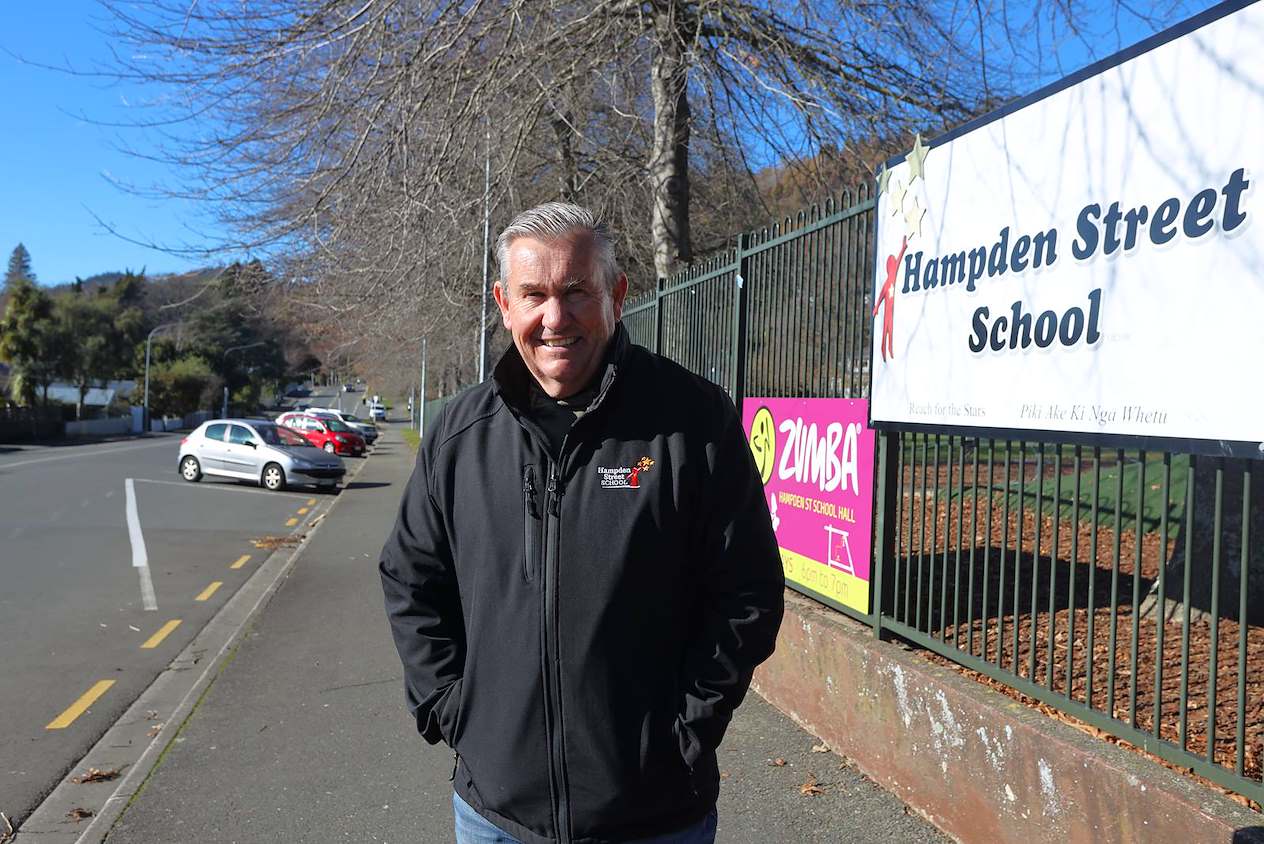
Hampden Street School principal Don McLean described the street as “really scary” and was “happy” with the proposed arrangement.
With vehicles from neighbouring Nelson College also using the area, it got “chaotic” during pick-up and drop-off times.
“We’ve tried to encourage parents to park away and walk further or to have bike trains… it just hasn’t worked,” he says. “There’re more and more kids who are wanting to bike to school… So, it’d be great to have an effective cycleway.”
However, Don thought the footpath solution could “present problems” for residents backing out of their driveways.
“I’m 100% in favour of us having a cycleway… I just want to make sure it’s done in an appropriate way.”
Trafalgar St South
After cutting through Fairfield Park, the cycleway would reach Trafalgar St South.
South of Bronte St, the road would have a two-way cycleway on its eastern side, like Tāhunanui’s Muritai St.
North of Bronte St, northbound cyclists travelling downhill would merge into traffic before passing through the Examiner St roundabout and then either pass across or around the Nelson Cathedral grounds.
Slower, uphill southbound cyclists would have a separated cycle lane to protect them from traffic, at the cost of the on-street parking opposite Nelson College for Girls.
Principal Claire O’Fee thought the proposal seemed “flawed”.
“Parking around here is at a premium… We would struggle for parking if that whole strip was to disappear.”
The Examiner St roundabout was “quite dangerous”, even for drivers, as is Trafalgar Square which skirts the cathedral, she says. “If [cycling] is something that you want to really encourage… then the route needs to be as safe as possible.”
She acknowledged that cycling cultures had to be deliberately cultivated, often entailing difficult transitions, and was open to discussing options with the council.
“The idea of the cycleway is fantastic. It’s about finding the ways to mitigate and minimise those pain points.”
Claire and Don were both concerned about the safety of the road crossings that the proposed route necessitated.
Nile St
West of Collingwood St, Nile St was proposed to remain unchanged.
The car parks around the Nelson Centre for Musical Arts, apartments, and Marsden House Funeral Services were “really valuable” to the community, council staff said.
Considered a low-speed area, cyclists were expected to be able to safely mingle with traffic.
Marsden House funeral director Bevan Hoult agreed the parks were “vital”, saying they were often full and were used by a wide range of people.
Older, less mobile visitors to the funeral house would be especially disadvantaged if the parks were removed, he adds.
“I enjoy cycling, but I have never seen an issue in the area. I think the way it is at the moment, without a cycleway, works well.”
But Nile St east of Collingwood St would get more substantial changes.
Council staff suggested one-way separated cycleways on each side of the street, requiring much of its angle parking to convert into parallel parks, roughly halving the number of parks.
Potential parking losses in the area concern elected members because of demand from the Nelson Marlborough Institute of Technology, Nelson Central School, local businesses, and new housing developments.
Central School principal Pip Wells was “very aware” of the parking challenges for whānau and staff, but said safe cycleways for children was her “first priority”.
She adds that the East-West Cycleway would provide well-being and environmental benefits.
Mike Walker, owner of the Prince Albert further down the road, was a “big advocate” of active travel.
“But we still don’t want to lose the ability for people just to nip in and grab a coffee.”
Even though the proposal would only take two or three parks, that amounted to half of the on-street parking outside the business.
Ultimately, he would “wear” the final design but wanted to know all options had been considered and that ongoing dialogue would occur.
“You are trying to find that sweet spot where it’s good for everyone.”
Cycling advocates
Groups supporting the cycleway presented to the council earlier this month.
Sustainable transport group Nelsust was advocating for an alternative, flatter route along the arterial Waimea Rd-Rutherford St thoroughfare that then connects to Nile St.
Convenor Peter Olorenshaw highlighted that much of the route was already earmarked in the city’s active travel strategy, with member Kate Malcolm adding that cyclists should be able to safely use the route, but they currently cannot.
From Families for Safe Cycling, Andrea Ewing said more cyclists would reduce demand for car parks, and that studies show businesses “won’t suffer” if parks were replaced with a cycleway.
She adds that children are already biking on dangerous roads.
“Their lives are at risk... that is a far more important consideration than someone being able to park their second car on the road.”
In response to the presentations, Mayor Nick Smith said retrofitting cycleways into neighbourhoods was “tough”.
“Our council is deeply committed to making progress on the East-West Cycleway, but the devil’s in the detail.”