
Nelson City Council has awarded a long-term contract to Stand Forestry Limited, formerly PF Olsen Limited, to deliver large-scale forest establishment, weed control and targeted animal pest control across council reserves.
The work will focus on steep and erosion-prone land, with the aim of improving slope stability, reducing sediment runoff into waterways and creating more habitat for native wildlife.
The contract began on 1 July 2026 and will run for six years, with two possible two-year extensions subject to satisfactory performance. In the first year, work is expected to cover more than 200 hectares and include the planting of about 128,000 trees, alongside efforts to support the natural regeneration of native forest through weed and pest animal control.
“This is a long-term investment in Nelson’s land, waterways and biodiversity,” Nelson Mayor Nick Smith says. “Restoring forest on vulnerable hill country will help reduce landslides and erosion, protect streams and make our catchments more resilient to both heavy rain and dry summers.”
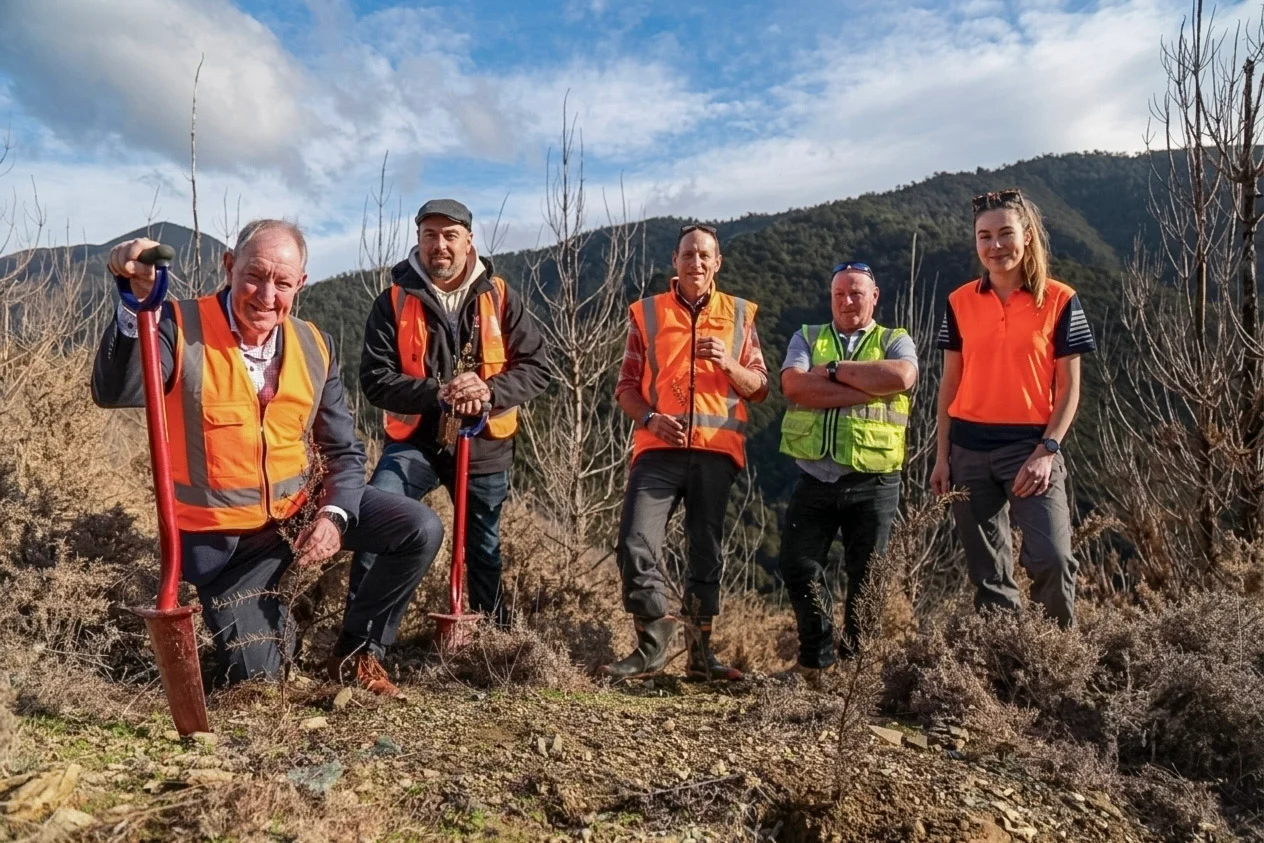
Tenders Committee deputy chairperson Kahu Paki Paki says he was delighted to plant a young tōtara on land included in the new contract near the Maitai Dam.
“Planting these trees in the shadow of 40-year-old established forest behind us makes it easier to imagine how this area will look once they mature. Tōtara are hardy trees that handle dry conditions and poor soils once established. Their forests provide food and shelter for native wildlife such as the kererū that eat the red fruit of the tōtara and spread the seeds. It’s a win-win for land management and biodiversity.”
The programme delivers on council’s Right Tree Right Place recommendations and its Long Term Plan commitment to transition suitable areas of council-owned commercial forestry from clear-fell rotations to permanent, mixed-species forest cover.
Council says the change will support biodiversity, protect catchments, provide recreational opportunities and strengthen long-term resilience.
The approach will vary between sites. Where native forest is already regenerating, the focus will be on controlling weeds and pest animals so the forest can continue to recover naturally. Other areas will require planting and several years of follow-up care.
Council expects the programme to cover between 120 and 250 hectares each year, depending on site conditions, work requirements and available budgets.
“The best result is not always achieved by planting every hectare,” council forest systems manager James Griffiths says. “In some places, native forest is already coming back, and our job is to remove the pressures holding it back. In other areas, planting will be needed. We will monitor the results and adjust the work as the forest develops.”
Locally sourced native species including kānuka, mānuka and tōtara will be favoured for planting because of their resilience on steep or exposed sites and their value to native wildlife.
In some locations, fast-growing exotic species such as Veronese poplar and Italian alder will be planted at wide spacings alongside native species to help stabilise landslide-prone slopes more quickly.
Council received eight proposals through an open competitive tender process.
“The overall standard was high, and council acknowledges the considerable time and expertise invested by all tenderers,” it says.
Stand Forestry Limited representative Blair Van der Mass says the company is looking forward to working with council and local partners.
“We are looking forward to working with Council and local partners to restore these landscapes safely and effectively. Every site is different, so the work will be tailored to what the land needs.”
