
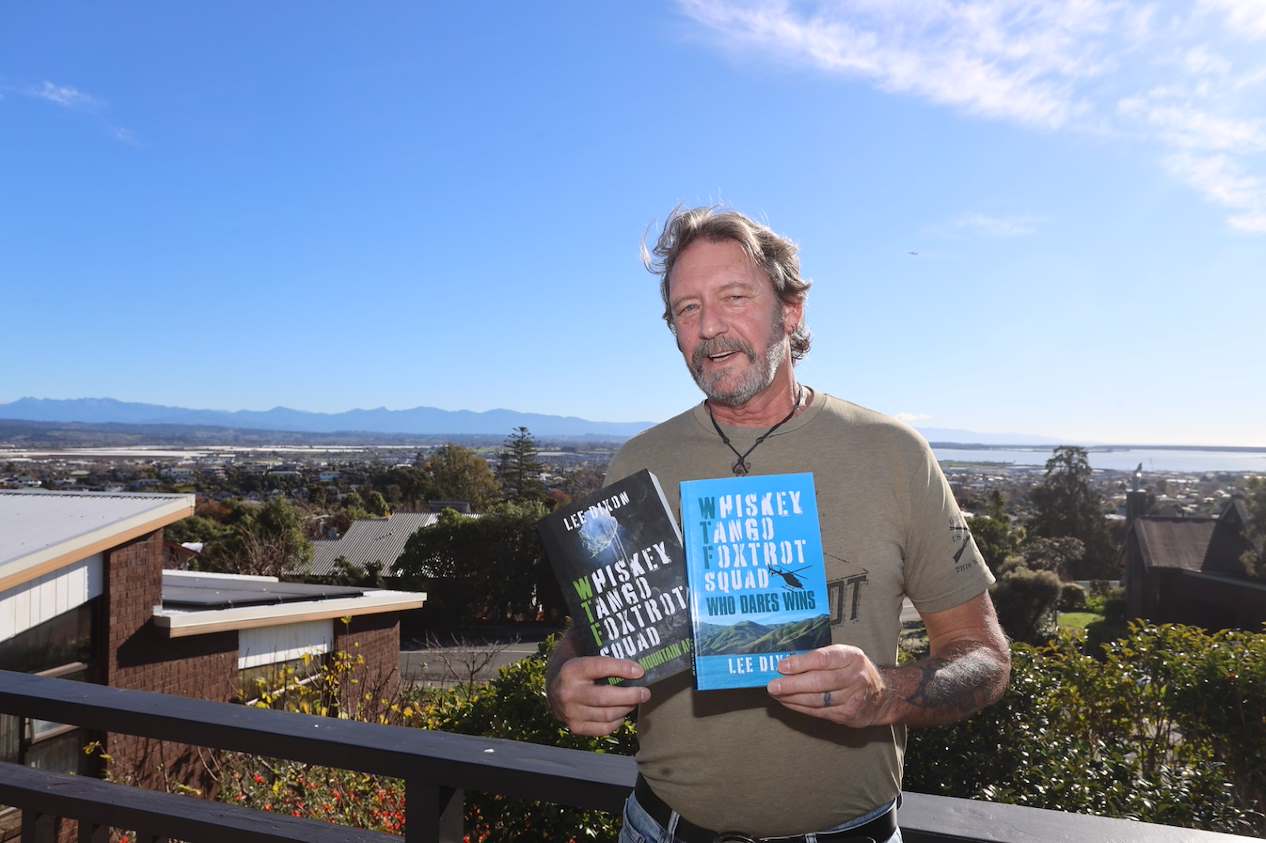
Lee Dixon has spent much of his life building things. Houses, walls and a journalism career. Now, he is nearly finished building a trilogy of thrillers inspired by the people, places and adventures that have shaped his life.
The Richmond-based author takes inspiration from bestseller Lee Child and his "all-time favourite" writer David Baldacci, but many of his characters and storylines come from much closer to home.
A former contractor and self-described jack of all trades, Lee retrained as a journalist in the 1990s after decades in the building industry.
"I started working for my dad in 1971 pouring concrete. He was a bricklayer plasterer."
Over the years he worked as a builder, painter, GIB stopper, bricklayer and plasterer.
"A jack of all trades, I won't say master of none, because I have mastered a few of them."
Born in Tauranga, before moving to Whanganui, Lee is a father of five and grandfather of nine. He first moved to Nelson in 2002 with his two youngest sons, intending to stay for only a year before heading north.
"But I couldn't get Nelson out of my head."
In 2006, he returned permanently.
Although officially retired, Lee says he is busier than ever, with writing now added to a lifetime of varied pursuits. Some of those experiences sound as though they belong in the pages of a thriller.
After the end of his first marriage, Lee travelled to Texas, where he drove trucks alongside a friend.
"I was driving the biggest truck you can get. I didn't have a licence, but it was Texas, and they do things different.
This is how you drive it, this is how you back it. Keep up, is the advice he was given.
"Before you know it, I'm driving back to Texas, a six or seven hour drive in a convoy of 20 trucks, and you're driving 75 miles an hour, left hand drive, right hand side, watch what you're doing, seat belt on, don't speed, indicate, and you should be fine."
Eventually, after returning to Nelson, he met Maxine, and the couple have now been married for almost three years.
Writing his first book brought a different challenge.
Lee secured a contract with a London publisher but, for various reasons, wasn’t happy, saying readers in New Zealand struggled to access the book because of its cost and availability.
So, he decided to self-publish and is now preparing for the first print run of the third instalment in the Whiskey Tango Foxtrot trilogy, hopefully in time for Father’s Day.
When writing, Lee imagines each chapter as a scene in a movie, helping him keep the pace moving and chapters short.
Readers, he says, should "expect the unexpected".
The books also reflect his admiration for older generations.
Looking at his own life and what his father endured as a soldier, Lee says the older men are often the heroes in his stories.
"I've had a chequered past,” he admits. Real-life events and people also find their way onto the page.
One character is inspired by a man Lee knew who flew helicopters for the CIA and carried out what Lee describes as a daring rescue mission - landing his helicopter on a beach not much bigger than the deck at Lee’s Richmond home, where American soldiers were hiding buried under the sand after being chased.
"He landed on them, they jumped out of the sand, jumped in the helicopter, and they're shooting their way out."
Another character, Jesse, draws on the experiences of professional soldiers.
"So, the main character in here, Jesse's got a little bit of PTSD because he was a professional soldier.
"So, he's a little bit more serious than some of the other guys."
The character Grumpy is based on a Texan friend.
"Grumpy was a guy, he was usually drunk, he had three Harleys, he was a couple of years younger than me, ex-Navy. There'd be his wife, Mary, dolled up like a million bucks and we'd be drinking and smoking cigars and shooting pool.
"He talked with a fairly raspy voice, and his nickname was Grumpy."
And while many characters have direct inspirations, Lee says there is a little of himself in all of them.
When deciding where to set the books, he followed the example of authors who write about places they know best.
As a result, familiar locations such as Māpua, Hope and Wellington feature throughout the books.
For local readers, those settings offer a personal connection. For everyone else, they provide the backdrop to a fast-paced tale shaped by a lifetime of experiences.
