

Residents protested at the weekend’s forestry awards in Nelson amid concerns about the industry’s impact around Mārahau.
The beachside village has been repeatedly battered by severe weather events in recent years.
Forestry debris blanketed the area after Cyclone Gita hit in 2018 and, most recently, was cut off during the June-July 2025 storms, with the second of two access roads only recently partially re-opened to traffic.
Much of the area was Separation Point Granite – an erosion-prone strip of bedrock that runs from the Abel Tasman to Murchison.
Residents were concerned about the ongoing impacts that forestry on the unstable soil appeared to be having on the area.
Landslides impacting roads, and sedimentation filling up the Otuwhero Inlet and Sandy Bay, were among the key issues that prompted 18 residents to protest outside the 2026 Top of the South Wood Council Forestry Awards that were held on Friday evening at Nelson’s Trafalgar Centre.
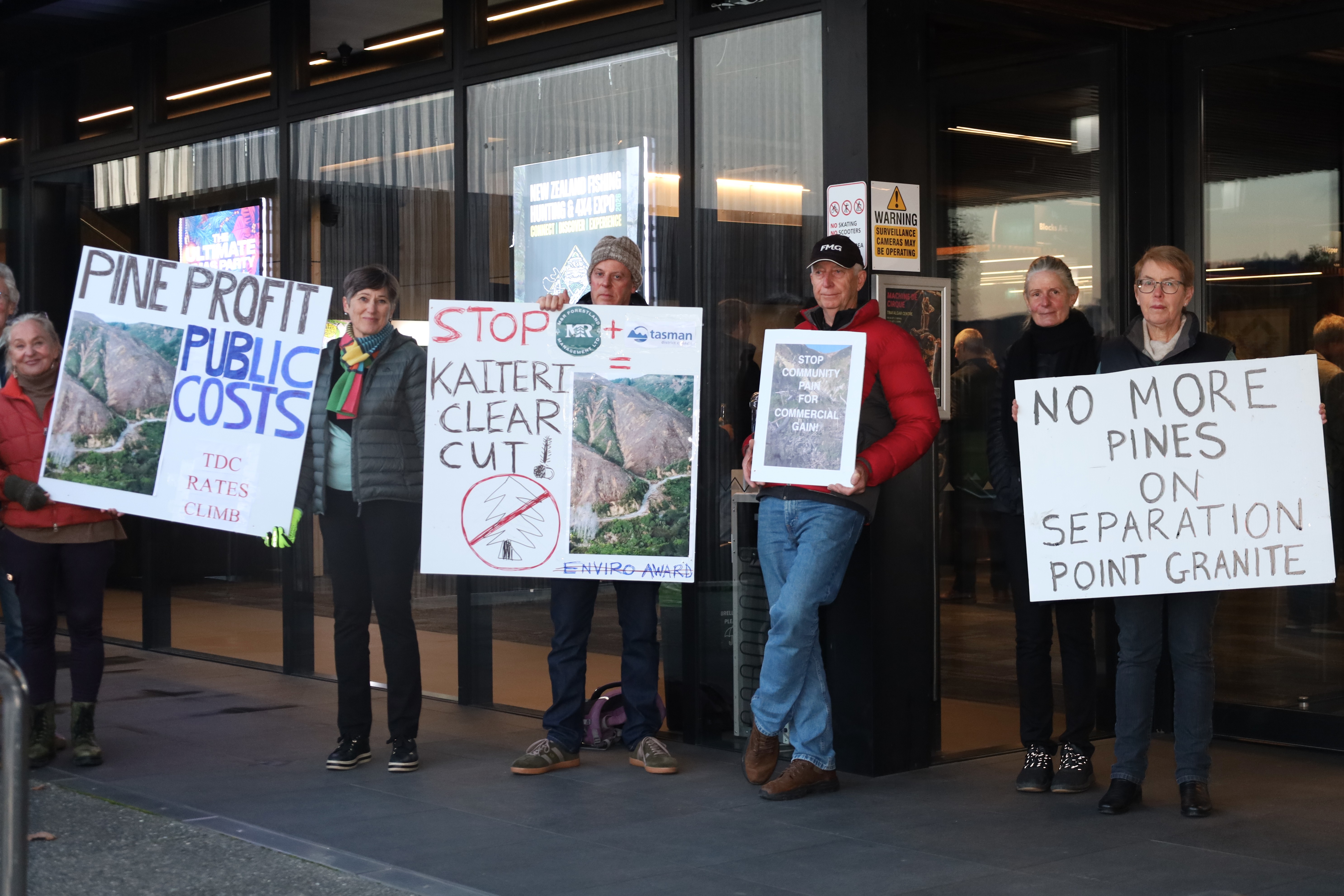
Marieann Keenan said she was not protesting because she had “any personal beef” with anyone at the awards.
“It’s just that we’re tired of the damage being done to our community.”
She said Separation Point Granite was not suitable for clear-fell forestry and that the Tasman District Council needed to do more compliance monitoring because of the “destruction” forestry can cause.
“It is a case of socializing the pain and privatizing the gain.”
Adam Langley, with the Split Apple Rock Owners’ Association (SAROA), also protested.
“My bigger, broader concern is just the deterioration of the environment, but at the same time it’s causing a lot of disruption.”
Ratepayers were bearing the cost of reinstating roads impacted by slips on deforested land, while native species were being driven from the area, he said.
“The wading birds and other birds in the estuary are no longer there, certainly not in the numbers that they were… their food’s been swamped.”
Adam, representing the SAROA, presented to the council’s annual plan hearings in May outlining the community’s “high degree” of concern, as did Chris Rutledge from the Mārahau and Sandy Bay Residents’ Association.
The two groups have jointly complained to the council about its monitoring of forestry practices in the area.
Chris told Local Democracy Reporting that the council had not yet found the “right balance” of forestry and environmental regulations.
“There aren’t appropriate controls in place to deal with forestry on Separation Point Granite,” he said.
“We’re not saying, ‘You can’t have forestry here’, but at the moment, pretty much, you’ve got free rein.”
Chris understood that the Government had halted work on plan changes, which would allow forestry rules to be updated, but he wanted the council to lay the groundwork now to implement the new rules once the plan stop was lifted.
“This an important issue. It’s not going to go away, and it needs to be addressed.”
Council communications manager, Chris Choat, said several plans were being worked on.
“We just can’t put them in place because of the Government’s decision to hold all plan changes.”
However, he said that updated regulations would not be the “ultimate panacea” for the environmental changes, which forestry was “exacerbating”, but were ultimately “natural”.
“They’re managing a changing environment as opposed to stopping it,” he said.
“It is literally going from estuary to lowland… Unfortunately, because of the geology of that area, the Separation Point Granite, that’s happening faster than normally would in other places.”
About 70 percent of slips in the area from June-July 2025 had come from native bush, he added.
Chris Choat says that forestry operators in the area were adhering to the regulations outlined in the National Environment Standards for Commercial Forestry.
M&R Forestland Management has harvested in the Mārahau and Kaiteriteri areas in recent years, and a representative said their activities followed all relevant rules.
Site-specific management plans contained earthwork requirements that were “more stringent” than the national regulations, they added.
“Council… audits have found the operations to be compliant with the relevant requirements.”
Protecting waterways was a “key focus”, they said, with felled trees pulled away from waterways, trees in difficult-to-access gullies poisoned rather than felled, stream health monitored, and fish passage through historical culverts improved.
Forest Management Group oversees the re-establishment of the land after it was harvested and returned to its iwi owners.
Nelson manager Craig McMiken said about 120 hectares at Mārahau were retired from forestry and planted in mānuka to assist with soil stabilisation and transitioning to native forest.
Sensitive sites, such as slips in the area, were also planted in poplar, due to their root strength.
He added that a buffer strip was planted above the Riwaka-Sandy Bay Road, and that “living fences” of poplars will act as “slash traps” when further harvesting occurs in 25–30 years.
“Separation Point Granite soils are very sensitive and there has been a history of issues with all land uses,” Craig says.
“The goal is improving environmental outcomes and making the areas more resilient to future storm events by taking higher risk areas out of production.”