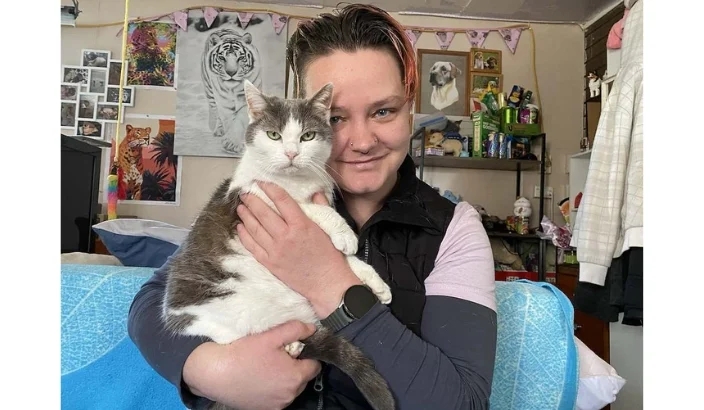
Brenna Coleman has retrieved hundreds of cats killed on local roads, checking each one for a microchip so it can be returned to its family. Over the years she has also rescued around 100 stray cats, caring for them and rehoming whenever possible.
It has been an emotional journey, and it never gets any easier. Her latest rescue, which she named Charlie, was in rough shape when she was alerted to a Richmond stray in need of help. She found the elderly, long-haired tabby blind in one eye, and a veterinary examination the following day revealed kidney disease, a tumour at the base of his tail and broken teeth. The kindest option was euthanasia, but for one night, he had a home and a full tummy.
“He was growling at me in the trap, but I figured he was just trying to figure out what was going on. Then I gave him food and he came out and was meowing at me and loving the attention. He was looking at me with such love in his eyes, and it broke my heart that he had gone through so much and was still happy to have someone care for him.”
Most of the cats she rescues, or the road deaths, come to her attention through Facebook posts or from members of the public, because over time she has earned a reputation as ‘the cat lady’.
The loss of one of her own cats a decade ago, and never knowing what happened to it, prompted her to help other families find closure and bury their feline companions.
“The first cat I picked up was named Angel, an 18-year-old who had gone missing from home and someone found her curled up under a tree where she had died. Her owner was 80 years old with a disabled adult daughter and she was very grateful. She’d had Angel since she was eight weeks old from the SPCA.
“It is traumatising,” she admits. “But I feel I’m the only one dealing with it.”
The same applies with the stray cats she rescues.
“I couldn’t knowingly leave a cat in need of help. What if it was my cat?”
It is a role she has taken on despite living with hypermobile Ehlers-Danlos syndrome (hEDS), which causes constant pain and makes walking difficult. She also has to cope with people who vehemently dislike cats.
“Compassion goes such a long way. You don’t have to like them, but you don’t have to hurt them.”
She would like to see more people look out for the animals around them and do something if they need help.
At home, she has eight cats inside with access to a cattery, plus a couple of outdoor cats that were left by the previous house owners. Most are rescued and the oldest is 17-year-old Jellybean who “has been with me through everything”.
Between caring for her own cats and paying for treatment, desexing, or in the case of Charlie, euthanasia for rescued strays, she has little money to spare. She gets donations from the people in the community and provides the veterinary clinic’s account details so people can contribute directly towards veterinary costs.
“I want the cats to have a long, happy life, be loved and sleep on the bed, and experience that love. I love what I do, despite it being hard. I love that cats get to experience that and don’t end up like Charlie did.”
