
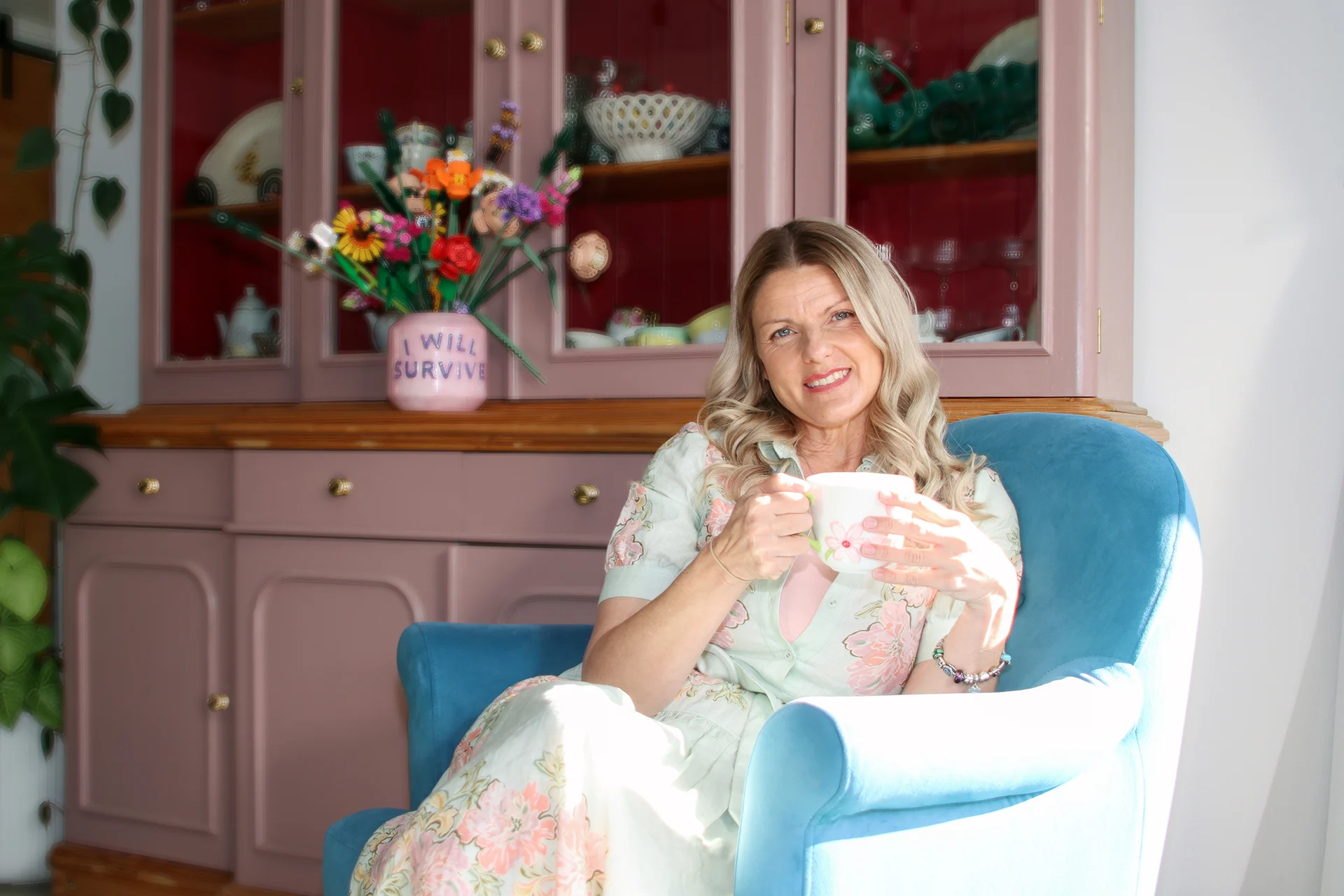
When chronic illness changed everything, Anita Newport refused to stand still. Instead, she kept pivoting – and in doing so, found a new way to live.
Words & Photo: Amy Russ
There is a phrase Anita Newport returns to whenever life throws another obstacle in her path. "Pivot until your feet bleed." Half inside joke, half mantra, every time life changes direction Anita chooses pivoting – because standing still has never really been an option.
For someone meeting Anita for the first time, they'd probably never guess the pain that lies behind each smile. Over the past decade she has had to say goodbye to a business she built, leave the home she thought she'd grow old in, raise two daughters while living with multiple chronic illnesses, and slowly let go of the woman she once was. Yet somehow, she still speaks first about gratitude.
“I know there are a lot of people who don't understand how hard day-to-day life can be, but I try to do the best I can for myself, my girls and my loved ones,” she says. “I still feel grateful it's not worse. I see other people go through terrible things and I think we all owe it to all those people to live our best lives. None of us are getting out alive. We just need to get out and live life. As long as we are living forward in a direction, we are still moving forward. I guess it’s still the determination in me that says ‘yep I’ll pivot to my feet bleed’ – meaning that I’ll keep trying to move forward when it hurts.”
Living with Myalgic Encephalomyelitis/Chronic Fatigue Syndrome (ME/CFS), fibromyalgia, Functional Neurological Disorder and POTS (a disorder of the autonomic nervous system) means that each day begins with a limited supply of energy. Using the concept of Spoon Theory, Anita carefully budgets every task, weighing what she can do against what it might cost later.
"It's a constant pace and plan," she says. "Every day I have to make choices about what I can do, what will happen if I do those things, and balancing what is important." Some days she can. Some days she can't. "I don't get to choose. I remember when I was first diagnosed, my specialist told me that this wasn’t going to kill me but some days it will definitely feel like it."
For years Anita kept much of that struggle hidden. "Maybe part of that is because I am still grieving for my pre-disability life... Not sharing the hard stuff still allowed me to be that capable person in other people's minds." Now, she's choosing to share her story. "I think that I can be more helpful by being open and honest. I do not want sympathy, but I hope that my honesty will give at least one person the strength to learn how to deal with their own journey.” She also shares parts of her journey online, helping her stay connected during the times illness keeps her at home.
If there is one constant throughout Anita's life, it is her daughters. When illness forced her world to slow down, her greatest fear wasn't for herself. "It was definitely for my girls. Was I going to be able to give them all that I wanted to? Was I going to be capable of the things they needed from me? This is still my biggest fear but also my greatest motivation."
Everything from moving, to homeschooling, to ensuring the family home became the place for friends to gather, has been built around making sure her girls could flourish. “Having little girls gives you the chance to make your childhood dreams come true and to give them some amazing experiences. I didn’t have my mum when I was growing up. She went into care when I was six. I wanted my girls to have all the things I never had and so much more."
Those memories became priceless. Together they've chased adventure across the globe from caravanning around New Zealand to Europe, Las Vegas and, most memorably, a six-week Christmas adventure to the North Pole.
At the time, Anita's diagnosis was still unfolding. Unsure what the future might hold, she decided not to wait. They stayed in castles, wandered German Christmas markets, travelled the length of Finland by overnight train, rode reindeer beneath the Northern Lights, baked gingerbread with elves and spent Christmas Eve meeting Santa himself, before welcoming the New Year in London, enjoying crepes and street performers in Paris, and finishing with a photo shoot in Tokyo.
“I had not long been given a diagnosis of ME but at that stage my symptoms were looking like early MS, so my doctor just told me to go and do ‘all the things’. In the back of my mind I didn’t know if I was going to be able to do it with my health if I left it till later. The girls were eight and ten and they still believed in Santa. To be honest, so did I after our trip. It was the most amazing and magical trip we've ever been on."
For Anita, experiences have always mattered more than possessions. "No matter what you have, you'll always have your memories.”
Travel, she says, teaches confidence, resilience and adaptability, qualities she hoped her daughters would carry long after childhood. “Adapting to change and how to communicate and build relationships with people from all over the world is something that I felt would take them a long way and learning to problem solve on the go. “
Career-wise, Anita has reinvented herself more than once. After working as a chef aboard fishing vessels, she and her then-partner bought an automotive workshop in Motueka so they could settle ashore and raise a family. Following their separation, Anita ran the business herself for five years before her health forced another difficult decision. Selling it wasn't easy. Neither was leaving the Ruby Bay property where growing flowers became both therapy and purpose. "I could do it in my own time, often in my pyjamas! Nurturing something from a tiny seed into a beautiful flower gave me pride. I learnt a lot. I did a lot of bare foot grounding and soul searching while playing in the dirt but eventually we had to make some big decisions."
Eventually practicality won. With teenage daughters needing independence and activities in Richmond, country life no longer worked alongside unpredictable health. So once again, Anita pivoted. Today, that reinvention has become The Curator's Cupboard, a business centred on decluttering, vintage treasures, travel, storytelling and helping others through life's transitions. It began while simplifying her own life. "Curating by definition is broad and I wanted to share the things I cared about. It opened up a world that I could live at my own pace."
More importantly, she wanted her daughters to see that life doesn't stop simply because circumstances change.
Living with invisible illness has reshaped Anita's definition of success. "I've learnt to prioritise. What was best for my family became the core behind every decision." She has also learnt lessons her healthy self may never have understood. "You are not in control of everything, nor should you be expected to be. Not everybody is going to understand and that’s ok."
These days she notices life's quieter moments. Morning sunshine with a coffee. Gratefulness to try again after failure. The simple gift of time. Asked what she would tell the woman who had just received her diagnosis, Anita doesn't hesitate. "Stop caring about what other people think. You don’t understand so how are they meant to. Do the best you can and that’s all you can do. Be kind to yourself. You are enough."
When people finish reading her story, she hopes one message remains. "Be kind, always. You never know what someone else is going through." And if life forces another unexpected change? She'll simply pivot again. “Never give up. Rewrite your story as many times as you need but keep going in your own time. After all, it's a comma, not a full stop."
