
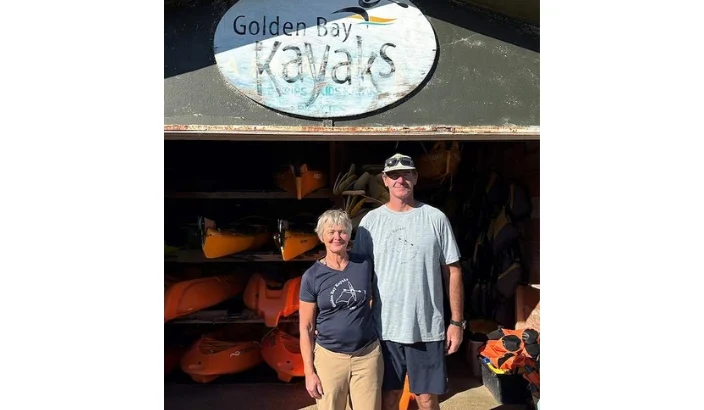
A local tourism business will be able to keep operating after the total sale of the council-owned land it leases has been rejected.
During it’s Thursday meeting last week, Tasman District Council agreed to a partial sale of 29 Cornwall Place to Golden Bay Kayaks, while vesting the rest as a historic reserve.
Co-owner Lisa Savage said that she was “quite relieved” by the decision.
“[We can] actually now confidently hire guides with the knowledge that we’ve actually still got a business.”
The Tata Beach property had been identified by the council as potentially surplus to its requirements.
Residents were subsequently consulted on three options: selling the entire plot, selling part and retaining the rest as a reserve, or keeping it all and signing a long-term lease to Golden Bay Kayaks.
The owners had previously warned that a full sale would be “fatal” for the business and that a lease did not offer the long-term security it desired, thus favouring the partial sale option.
They lease the site to house most of its equipment, including 35 kayaks, up to 10 paddle boards, life jackets, spray skirts, flares, and other gear. It is also where they liaise with customers.
Submitters also decisively preferred the partial sale, with 77 percent of the 656 submissions favouring that option.
A further 21 percent favoured retaining the land with a long-term lease, while just two percent wanted the entire property sold.
“The community have been very supportive, and that’s not lost on us,” said co-owner Tony Bateup.
“It’s a nice feeling to know that you’re doing something that’s worthy of praise.”
The council’s intention was to sell the minimal amount of land necessary to ensure the ongoing operations of Golden Bay Kayaks, and to sell it at a market rate, while ensuring public access to Tata Beach remained.
Bateup did not yet know how much land that would be as they did not yet have clarity on the potential implications of operating beside a historic reserve, while of the sale, Savage added that they would “have to make it work”.
“If we don’t… the land will get sold. So, we really need to do this for the community and for ourselves, because we can’t lose that access.”
A lack of clarity around the financial aspect was a key concern for councillor Timo Neubauer, who ultimately abstained from the Thursday vote.
“There are commercial considerations and a question about fairness throughout our district about how we treat one business compared to other businesses,” he said.
“I haven’t got any figures in front of me… what are the commercial implications?”
But deputy mayor Brent Maru said the consultation had gone through a hearing, with the panel recommending the partial sale to the council after considering the views of the community.
“I’m absolutely confident that the hearing panel has reached what the community wants in Golden Bay.”
Golden Bay councillor Mark Hume added that adopting with the hearing panel’s recommendation would reassure residents that the council listens to its community.
Should there be any concerns about the sale, public access, cultural or environmental safeguards arise, the council will reconsider the matter.
The process of investigating selling 29 Cornwall Place had raised alarm bells for Te Rūnanga Ngāti Rārua.
Chief executive Shane Graham fronted the council and said that it needed to engage with iwi on land disposal earlier in the process.
Ngāti Rārua has identified the site as being of high cultural, historical and archaeological significance, with Tata Beach being specifically named in Ngāti Rārua’s deed of settlement.
However, they only found out about its potential sale through a general notification process without prior input.
While Graham said the council had not acted in bad faith and worked constructively with iwi once the issue was raised, but he wanted structural changes to council processes to ensure there was not a repeat.
“Good faith on its own does not guarantee good outcomes.”
He wanted each site facing disposal needed to be screened against cultural, historical, archaeological, and statutory interests, with the relevant iwi authorities notified directly.
Graham added that Tasman, along with Nelson and Marlborough, had signed a partnership agreement with Te Tauihu’s eight iwi, and he hoped the council’s oversight would provide a chance to develop and mature their relationship.