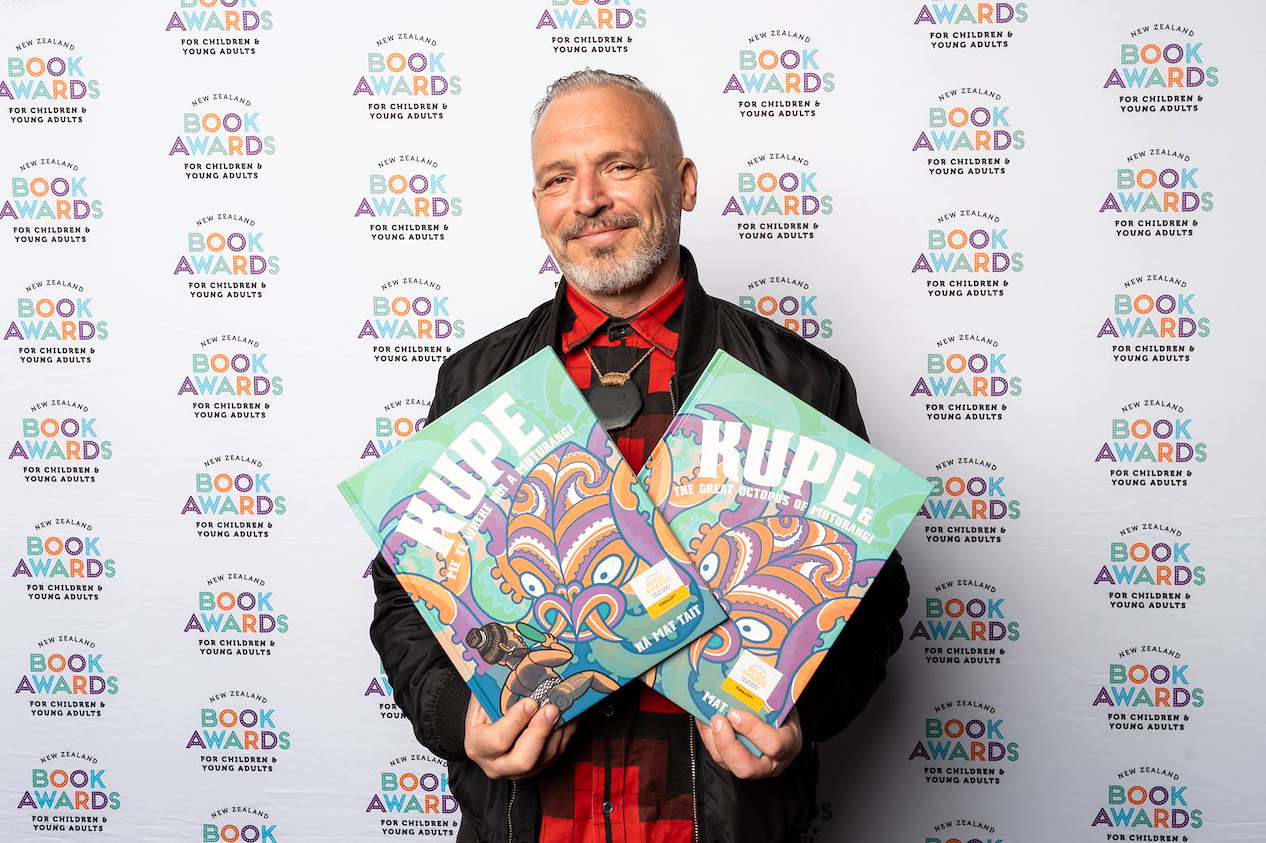
Being recognised by his creative peers is one thing, but for local author and illustrator Mat Tait, the real affirmation comes from his young readers.
Mat’s latest book, Kupe me te Wheke nui a Muturangi, also published in English as Kupe and the Great Octopus of Muturangi, gained two awards at the New Zealand Book Awards for Children and Young Adults in mid-August. He won the Wright Family Foundation Te Kura Pounamu Award for a Book Originally Written in Te Reo Māori, as well as the Russell Clark Award for Illustration.
Published by Allen and Unwin Aotearoa New Zealand, the book tells the pūrākau, or legend, of Kupe’s discovery of New Zealand during his pursuit of the giant octopus of Muturangi.
In their feedback, the judges praised Mat’s work as “an outstanding contribution to Māori children’s literature”, describing how the artist maximises the use of vibrant colour and illustration to “make the story pop off each and every page”.
Mat, who has Ngāti Apa ki te Rā Tō, Ngāti Kuia and Rangitāne o Wairau heritage, is an author, illustrator, artist and cartoonist. He says he has been creating art consistently for the past 20 years.
Most of his work is now done digitally and Mat says he has shifted towards that method because there is “so much flexibility and sophistication in software these days”.
His 2023 bilingual book, Te Wehenga: The Separation of Ranginui and Papatūānuku, won the Margaret Mahy Book of the Year at the same awards.
This time, however, he took a different creative approach by writing first in te reo Māori before translating the text into English.
“It was a big challenge, and one that was sort of laid down at the last Book Awards.”
He says careful translation is needed to retain the poetry and nuance of the original text.
“It’s finding the right way to get across the feeling.”
Mat offers a “big mihi” to Riwaka School, saying it was through working with students several years ago on the school’s new mural and house designs that he found his way into this book.
He describes the process as “approaching it through their eyes”.
As much as any creative wants confidence in their own work, Mat says recognition from his peers remains meaningful.
“I can’t pretend it’s not validating,” he says with a smile.
