
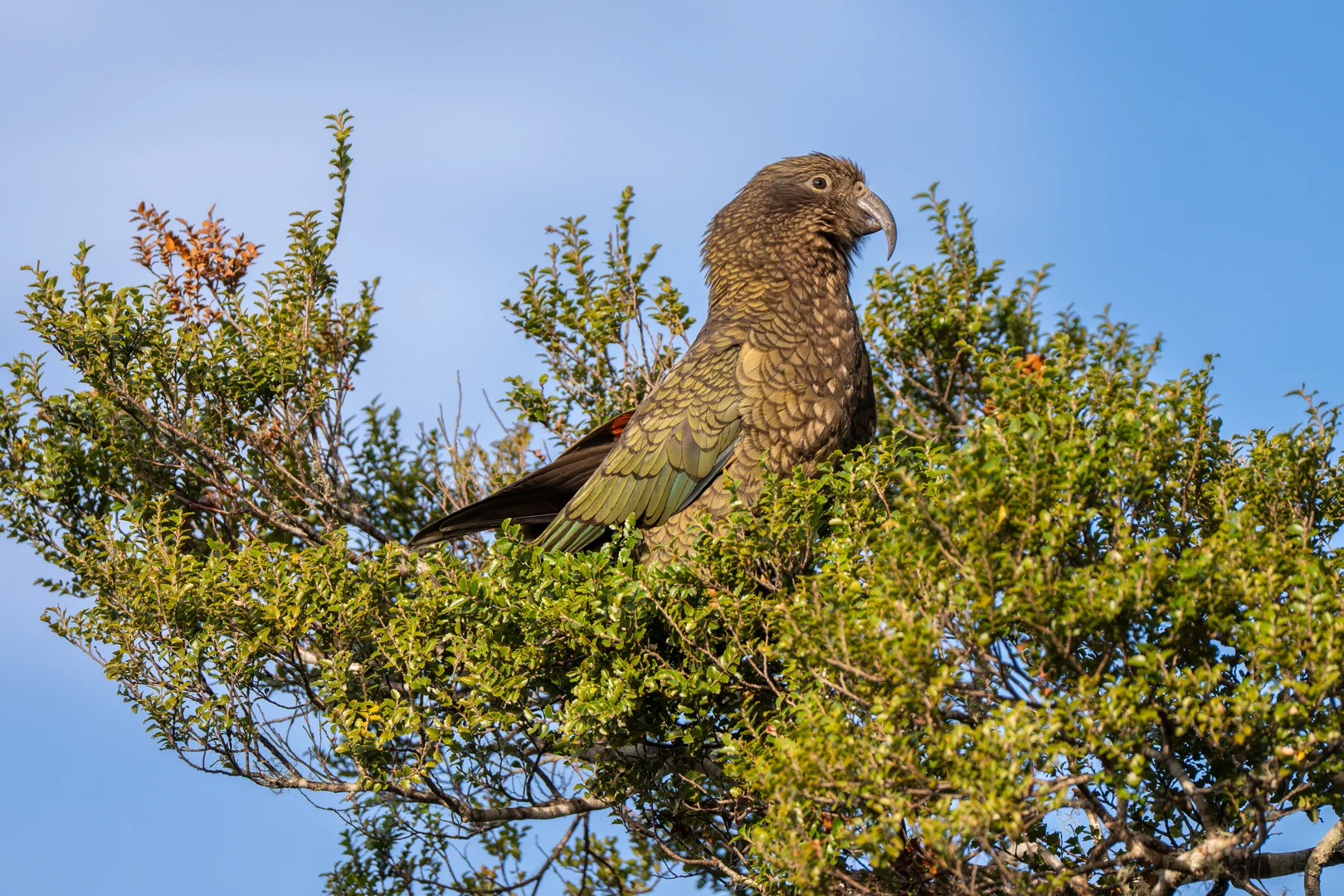
The annual kākāriki karaka survey at the Brook Waimārama Sanctuary had an unexpected participant this month when a curious young kea named Track turned up and followed volunteers through the forest.
Sanctuary staff, Department of Conservation (DOC) workers and volunteers took part in the population survey on 1 and 2 September.
But when about a dozen members of the group arrived at the top of the sanctuary early on the second morning, it was the unmistakable call of a kea that greeted them.
“On day two, to our great surprise, a kea awaited us on top of the hill, and it followed one of our volunteer teams around for half the day,” Brook Waimārama Sanctuary biodiversity ranger Chelsea Haley says.
Nobody in the group could recall previously seeing a kea in the sanctuary. The alpine parrots tend to live at higher altitudes, although young birds are known to head off exploring before returning to the mountains.
As the group headed into the forest along the spur line, Track followed. He took a particular interest in volunteers Peter Hayes and Jaap Buys. He followed the pair for about 1.5km, creating what Chelsea described as “general kea mayhem” along the way.
“Nibbling their booots, landing on heads and throwing our tracking tunnels off the tracks.”
Volunteer Sean McGrath, who also took some great photos of Track, described him as a “very naughty boy”.
The bird’s leg bands revealed his name and that he was a sub-adult male kea banded in a forestry block between Murchison and Nelson.
Despite Track’s efforts to distract the team, Chelsea says that they completed the survey.
The annual count, led by the DOC kākāriki karaka team alongside sanctuary staff and volunteers, involves playing a recorded kākāriki karaka call at predetermined points throughout the sanctuary and counting the birds that respond.
Preliminary figures recorded 285 birds on the first day and about 230 on the second, although DOC will analyse and average the survey numbers before final results are available.
“This number gives us an indication of how the population is doing and serves as a baseline for other influences later on, such as incursions, beech masts and illness.
“All in all, the kākāriki karaka in the sanctuary are thriving. Their reintroduction has been a resounding success and boon for the population as a whole.”
You can follow Track at https://keadatabase.nz/birds/track. After visiting the sanctuary, you can see he went on an adventure to Pelorus Bridge, where he was spotted on several occasions between 5-10 September.
One observer on 10 September said Track was “playful, friendly, biting at my gumboots and kept wanting to land on my head”.
Another observer on 5 September described him as “very gregarious” and that he enjoyed being in the garden with people, interacting with garden tools, car parts and even landing on a moving tractor!
